

As companies embrace digital transformation, a growing number of them are increasingly realizing that their old-fashioned applications are no longer able to embrace the changing needs of their customers, business requirements, and business goals. The legacy systems usually pose difficult issues that are associated with performance, security, scalability, and integration, thereby making it hard to keep up with the changes in the market. This is the time that application modernization is needed. Legacy application modernization allows organizations to enhance the efficiency of operations, boost security, facilitate cloud adoption, and speed up innovation. Regardless of whether it is legacy application modernization, cloud application modernization, or an overall approach to application modernization, businesses are able to convert the old systems into agile, scalable, and future-proof solutions.
This blog will discuss the potential application modernization benefits, why modernization of legacy systems is essential to modernizing the enterprise, and how modern technologies could assist organizations in propagating long-term growth and digital transformation success.
What Is Application Modernization?
Modernization of applications involves more than updating legacy applications. It is a multi-step, tactical process through refactoring and replacing platforms and re-creating applications to align with the business needs that change. It leverages the strength of new technologies, including AI, cloud computing services, and microservices, to implement the agile and scalable solutions.
Modernization helps the companies advance their on-premises systems to cloud-native applications. It ensures faster development, improved performance, and increased safety of applications. Applying AI, ML, and cloud services, companies can simplify the work process and accelerate the digitalization process.
Why Legacy Applications Are Holding Businesses Back
Legacy applications might still support some of the major business processes, but in most cases they can barely handle the contact with the new digital world. As the business and technology evolve, the existing systems might be in the way and influence the efficiency, innovative abilities, and success of businesses in the medium term.
High Maintenance Costs
Older applications are in need of maintenance, updates, and special support. This may add more costs to IT, and the resources would be directed towards innovation and business development activities.
Security Vulnerabilities
Most of the old systems are based on old technologies that might not be updated on security. This subjects them to higher vulnerabilities to cyber threats, data breaches, and compliance risks.
Limited Scalability
Old applications are in most cases not developed to support increased workloads, users, and volumes of data. Operational bottlenecks and performance problems can happen as the demands on the system rise because of the needs of a business.
Poor User Experience
Both the employee and the customer can be aggravated by old interfaces that are slow to operate with. This may cut productivity and customer satisfaction and increase inefficiency throughout the organization.
Integration Challenges
The modern business is based on cloud and AI, analytics, and automation solutions. Older apps are usually incapable of being integrated with these technologies, restricting the innovation and digital transformation initiatives.
Growing Technical Debt
The presence of patches and temporary solutions throughout the years can lead to an increase in the complexity and difficulty of using the legacy systems. This technical debt causes the maintenance costs to be high and postpones the further development.
Moving Beyond Legacy Systems
Modernization of legacy applications is the kind of venture being faced by organizations as a result of these challenges. When properly modernized, legacy systems enable businesses to enhance performance and improve security, enable scalability, and deliver a more agile base for future development.
Key Benefits of Modernizing Enterprise Applications
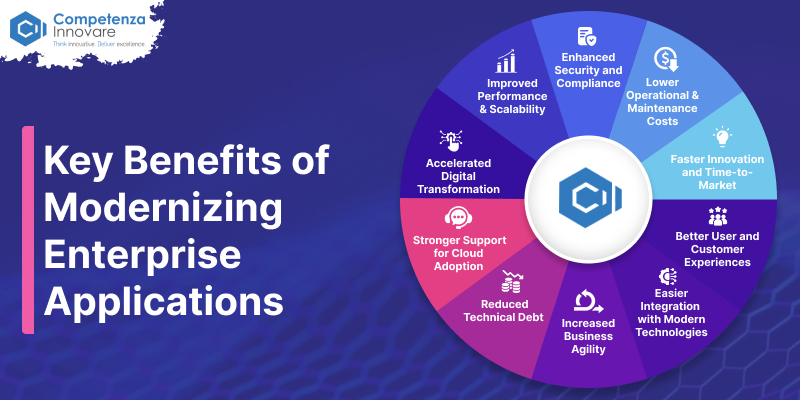
Enterprise application modernization services assist organizations in breaking the restraints of legacy systems and developing a solid base to grow, innovate, and transform digitally. Modernization of applications, along with the modernization of old technology, not only makes the business more agile but also safeguards it more effectively and at lower costs and gives a chance of better responsiveness to the dynamic customer and market needs.
Benefit 1: Improved Performance and Scalability
Outdated infrastructure and monolithic systems typify legacy applications, which are struggling to withstand growing workloads and user demands. As the number of businesses increases, the performance of these systems can go to the point of bottlenecks, and this affects the productivity and customer satisfaction.
Modernization of applications enables compliance with scalable environments and clouding to improve performance, reliability, and speed of applications in organizations.
Key benefits include:
- Faster application response times
- Improved system reliability
- Better support for business growth
- Reduced performance bottlenecks
- Enhanced user experiences
Benefit 2: Enhanced Security and Compliance
Obsolete applications can also be a security threat in the organization since they lack support, lack security features, and are slow in updating. Due to the rapidly changing nature of cybersecurity threats, it is becoming more and more challenging to maintain outdated systems.
Application security: The modern applications are characterized by more robust security design, as well as higher capability in safeguarding sensitive data and mitigating risk.
Key benefits include:
- Stronger cybersecurity protection
- Reduced risk of data breaches
- Improved regulatory compliance
- Better access control management
- More efficient security updates
Benefit 3: Lower Operational and Maintenance Costs
The legacy support cost may include a considerable investment in the infrastructure, support, and technical know-how. These fixed expenses can limit an organization from making the investments such as innovations and growth projects.
As legacy applications are modernized, businesses can accelerate their operations, reduce the necessity to maintain applications, and make maximum usage of technology.
Key benefits include:
- Reduced infrastructure costs
- Lower maintenance expenses
- Improved IT resource allocation
- Fewer system disruptions
- Better long-term cost efficiency
Benefit 4: Faster Innovation and Time-to-Market
To be competitive, organizations should launch new products and services that will be introduced on time. However, the use of the old technologies and intricate architecture can slow down the development process of the old systems.
These applications allow organizations to develop faster, automate, and deliver continuously to ensure that teams are able to innovate more quickly and deliver solutions to market more effectively.
Key benefits include:
- Faster software releases
- Accelerated development cycles
- Improved development efficiency
- Greater innovation opportunities
- Quicker response to market changes
Benefit 5: Better User and Customer Experiences
Customers and employees need flawless digital interactions, which are fast, reliable, and convenient. The outdated interfaces and the lack of performance of legacy applications often do not support these expectations.
Modernization of the applications is beneficial to their usability, access, and overall application performance, which assists the organizations in providing enhanced experiences in all of the touchpoints.
Key benefits include:
- Improved application usability
- Faster user interactions
- Higher employee productivity
- Increased customer satisfaction
- Stronger customer retention
Benefit 6: Easier Integration with Modern Technologies
There is a growing reliance on the idea of cloud computing, artificial intelligence (AI), automation, and analytics by businesses to accelerate innovation. However, it is often challenging to tie the legacy applications to these solutions, as they are often not flexible enough.
The ability to modernize legacy applications offers an environment that is more connected to give a smoother flow of information and make the business process more efficient.
Key benefits include:
- Better integration across systems
- Easier adoption of AI and automation
- Improved data visibility
- Enhanced business intelligence
- Reduced operational silos
Benefit 7: Increased Business Agility
The business environment nowadays is highly dynamic, and businesses need a technology that is able to react rapidly to emerging challenges and opportunities. Modification of legacy systems is often strenuous and not fast.
Enterprise modernization helps firms be more dynamic in the sense that it develops dynamic applications that can be modified to accommodate the changing business needs in relation to business needs.
Key benefits include:
- Faster adaptation to market demands
- Improved organizational flexibility
- Better support for innovation
- Quicker decision-making
- Stronger competitive advantage
Benefit 8: Reduced Technical Debt
Legacy applications may develop into an extremely complex and tricky entity due to years of patches, upgrades, and temporary fixes. This increasing technical debt is likely to hamper innovation and pose operational risk.
Legacy system modernization can help people simplify their application architectures and shed off old technologies and make their environment maintainable and sustainable.
Key benefits include:
- Simplified application management
- Reduced maintenance complexity
- Improved developer productivity
- Lower long-term support costs
- Better future scalability
Benefit 9: Stronger Support for Cloud Adoption
Cloud migration has emerged as a priority to organizations that desire to be more flexible, scalable, and economical. There are, however, numerous legacy apps that are not cloud-optimized.
Cloud application modernization also equips the applications to run in the cloud and enables companies to optimize returns on their investments in cloud migration services.
Key benefits include:
- Improved cloud readiness
- Better scalability and flexibility
- Optimized resource utilization
- Enhanced business continuity
- Reduced infrastructure dependency
Benefit 10: Accelerated Digital Transformation
Modernization of the application is a major aspect of a successful digital transformation project. Modern applications need to be flexible, connected, and scaled to meet the emerging technologies and business strategies.
In the process, organizing technology for business interests can help organizations improve their innovation and operational efficiencies and create new growth opportunities.
Key benefits include:
- Greater operational efficiency
- Improved innovation capabilities
- Better use of business data
- Enhanced automation opportunities
- Long-term business growth
Application modernization is much more than modernization of the obsolete software. Modernized enterprise applications can transform organizations into more competitive, efficient, and future-ready ones, whether due to higher performance and enhanced security or a greater degree of agility and lower cost. Application modernization is one of the investments made in business sustainability as digital transformation is likely to revolutionize business sectors.
How Cloud Migration Supports Application Modernization
Cloud migration is often a part and parcel with application modernization since it can help companies to drop old-fashioned infrastructure and adopt new scalable technologies. Moving applications to the clouds could help businesses improve their performance, increase the extent of flexibility, and support their long-term digital transformation aspirations.
Cloud migration facilitates application modernization by:
- Greater scalability to better handle growing workloads and user traffic.
- Reducing the prices of the infrastructure due to the reduction of required on-premises hardware and maintenance.
- Optimizing the current cloud settings and apps and enhancing their efficiency and performance.
- The innovation process will be more dynamic by allowing rapid design and implementation of new features.
- May improve security and reliability through embedded cloud security applications, surveillance, and backup.
- Empowering the adoption of the latest technologies, including AI, automation, analytics, and cloud-native services.
- Enhanced business agility by the capability to quickly adapt to market and customer changes.
Cloud migration, as well as application modernization, may help organizations to design a more flexible and efficient and future-ready technology ecosystem.
Also Read: 10 Signs Your Legacy Application Needs Modernization
Key Application Modernization Strategies for Enterprises
The modernization of enterprise applications does not always imply migration systems to new platforms. Organizations need a plan that best suits business requirements, technology, budget, and long-term growth strategies. The modernization approach is the right approach and can be applied to reduce technical debt, boost scalability, bolster security, and support the digital transformation process.
Common Application Modernization Strategies:
| Strategy | What It Involves | Complexity | Time Required | Ideal Use Case | Key Benefits |
| Rehosting (Lift and Shift) | Relocate applications to the cloud with minimal changes in code. | Low | Short | Organizations seeking a quick cloud migration. | Faster migration, lowered start-up fees and increased flexibility in infrastructure. |
| Replatforming | Doing minor application changes during migration to a modern platform. | Medium | Short to Medium | Businesses looking to improve performance without rebuilding applications. | Enhanced scalability, greater efficiency, reduced costs of operations. |
| Refactoring | Refactoring application code to increase architecture and performance. | High | Medium to Long | Applications that need cloud capabilities and long-term maneuvering. | Improved scalability, faster innovation, easier maintenance. |
| Rebuilding | Restructuring applications with new technologies without compromising the business values. | High | Long | Old systems with a de-technological architecture. | Improved user experience, enhanced performance,applications with future readiness. |
| Replacing | Layering out the old applications and adopting the new SaaS or commercial solutions. | Medium | Medium | Applications that no longer meet business requirements. | Reduced maintenance, modern features, faster deployment. |
How Application Modernization Drives Digital Transformation
One of the aspects of digital transformation is application modernization. The move to modern applications with greater scalability will enable an organization to improve efficiency, become increasingly innovative, and respond more quickly to changing business needs.
Key benefits include:
- Increases the speed of service provision and innovation.
- Eliminates cloud adoption and investment.
- Improves efficiency and productivity.
- Anywhere analytics, automation and AI.
- Improves customer and staff experiences.
- Increased makeup and scalability of business.
- Reduces the technical debt and older system problems.
The upgrade of old applications can help companies to create a dynamic technological base, which will allow long-term digital transformation and long-term sustainable expansion.
Ready to modernize your enterprise applications? Let Competenza build your smarter digital future.
Best Practices for Successful Application Modernization
The modernization of applications should have a strategy and emphasis on the long-term business objectives. Following best practices, organizations can reduce risks and improve efficiency and make modernization investments worthwhile.
Assess Existing Applications First
Prior to the move to modernization, assess the existing applications to understand the current state of performance issues and security risk, as well as technical debt and business requirements. This aids in specifying the best way modernization ought to be.
Align Modernization with Business Goals
The modernization of the application should help in realizing key business objectives such as improving scalability, reducing operational costs, improving security, or accelerating digital transformation initiatives.
Choose the Right Modernization Strategy
All applications cannot be approached the same way. Organizations are supposed to use a strategy that is most suited to them, either rehosting, replatforming, refactoring, rebuilding, or replacing old applications.
Prioritize Security and Compliance
The modernization process should involve security throughout. Modern applications should be considered to have strong security controls, periodic updates, and compliance management of business-critical data.
Leverage Cloud Technologies
A modernized cloud application will increase flexibility, scaling, and performance and reduce the infrastructure management challenges. Cloud-first is also used to guarantee future development and innovation.
Focus on User Experience
Custom applications should be able to offer increased performance, interactive interfaces, and smooth operations. Ensuring better user experience may enhance the productivity of employees and customer satisfaction.
Continuously Monitor and Optimize
Application modernization is a continuous process. Performance, security, and business monitoring consistently allow organizations to learn which areas to continue improving and extract the most value in the long term.
Conclusion
Modernization of applications assists businesses in abandoning the shortcomings of legacy systems and enhancing the base upon which future expansion can be achieved. Modernizing old applications helps organizations to drive better performance, offer better security, achieve lower costs, facilitate the adoption of clouds, and incite digital transformation faster. With the competenza, we assist businesses to adopt the appropriate application modernization strategy to enhance agility, minimize technical debt, and develop scalable and future-ready applications that result in long-term success.
Frequently Asked Questions FAQs
What does application modernization mean?
Application modernization is a process employed to update the legacy applications with the modern technologies, architectures and development practices to improve their performance, security and scalability and business agility.
What is the importance of modernization of applications to enterprises?
Application modernization assists organizations in conquering the boundaries of the legacy systems, lessening technical debt, enhancing operational effectiveness, and achieving long-term digital transformation intentions.
What are the main advantages of application modernization?
The benefits of modernization of applications include enhanced performance, increased security, reduced maintenance costs, improved scalability, accelerated innovation, and increased support for adoption of the cloud, among others.
What is the legacy application modernization?
Application modernization, which concerns the transformation of old applications and systems into modern, scalable, and secure applications, is an effort to attain alignment to the current business and technology needs.
What does application modernization do to support digital transformation?
Application modernization is the technology foundation needed in digital transformation as it facilitates the adoption of clouds, automation, and data-driven decisions and speeds up innovation.
What can cloud migration do to modernize applications?
Cloud migration services are employed to help organizations migrate applications to new cloud environments to help them achieve scalability, flexibility, reliability, and improved overall application performance.
What is the broad-based modernization strategy?
The most common application modernization techniques and strategies include rehosting, replatforming, refactoring, rebuilding, and replacement of applications, according to the business needs and technical requirements.
What is the security benefit of modernizing applications?
The vulnerability of cybersecurity is addressed by emerging types of security models, regular software updates, new accessibility, and compliance-oriented practices used for new applications.
What role can modernization play in helping businesses with technical debt?
The substitution of old technologies, streamlining of architectures of applications, and an upgrade of legacy systems enable limiting the technical debt and improving their maintenance over time.
Which is the appropriate application modernization strategy?
The modernization strategy of rights application is based on application complexity, business objectives, and budget requirements as well as scalability requirements and cloud adoption requirements.