
All organizations that operate using worn-out software end up at the same crossroad. The system still works technically. It accepts orders and data and conducts operations. But it does so gradually, at a high cost, and in manners that more and more interfere with the operations of the business. And the system begins to exhibit the symptoms that your antique application should be modernized. Legacy application modernization refers to the process of overcoming crossroads The modernization of legacy systems involves either updating, re-architecting, or replacing old systems to allow them to serve present business needs instead of limiting them.
The worldwide expenses of sustaining legacy systems end up in hundreds of billions of dollars per year. Federal agencies in the US alone are incurring over 80 percent of IT budgets to maintain the legacy systems. The trend of spending a disproportionate part of the budget on sustaining old system usage is going on in the UK, EU, Australia, and other parts of APAC, without much money left to fund the innovation and digital transformation projects that lead to competitive advantage. A technology project is not a legacy system modernization. It is a company choice that has immediate cost, risk, growth, and customer experience impact.
This guide answers the question of what legacy applications are, why they turn into business liabilities, ten signs that your system needs modernisation, and what best practices define whether the process is successful.
What Is a Legacy Application?
A legacy application is a software program whose architecture, technology, or development methods are old and which has become hard or prohibitively costly to maintain, extend, or modify to act with modern software system(s). Age is not the only defining characteristic. The age of a ten-year-old application based on a modern, well-maintained stack is not a reason to consider it a legacy system. Very much so is a five-year-old application based on a proprietary platform that has no upgrade path.
A system can be called “legacy” due to a combination of the old-fashioned technology, increasing technical debt, lack of vendor support, inability to integrate with others, and the excessive cost and effort to maintain the system running and changing.
Common Characteristics of Legacy applications
The legacy applications normally have few distinguishing features, which are similar in nature. His or her run-time software supports end-of-life programming languages, operating systems, or databases that are no longer supported by security patches or the vendor. Their design is monolithic, one tightly bound-together system where a requirement to make a modification to one part would require testing and possibly breaking the entire system. Their documentation is either not complete or not up-to-date, or it does not exist at all. Years of short-term hacks and workarounds they have amassed have rendered the codebase more and more fragile and understandable.
They typically operate on on-premises infrastructure, which is costly to maintain. They can only relate minimally or not at all to new APIs, cloud platforms, and third-party platforms. And they are generally buttressed by a diminishing cadre of such developers, capable of the relevant killskills the technology needs.
Why Businesses Still Depend on Legacy Systems
It is such a problem with legacy systems. Why do organizations still use them? The straightforward answer is that the cost and risk of modernization are more palpable than the cost and risk of not doing it. Business-critical processes, which cannot be interfered with by the organization, are usually administered by legacy systems. Modernization programs pose very real threats: schedule slips, data migration failures, and integration issues. And the overall price of the status quo builds up slowly enough as not to equate to the urgency created by a solitary big budget of modernization.
Nonetheless, the status quo price is a fact. It merely comes in smaller and less visible segments: maintenance contracts, fire incidents, developer hours stuck fire fighting, not building, and business opportunities that will never run on the system.
Why Legacy Application Modernization Matters
Improved Security
Security breach statistics include disproportionately legacy applications. Unsupported software is not provided with security patches. There are gaps in security that are known. Data are exposed to outdated encryption standards. Financial services, healthcare and government in the US, UK, and EU In regulated industries where end-of-life software is used, it is not only a security risk; it is a compliance failure with clear regulatory implications. Modernization of legacy systems implements applications that are up-to-date on security guidelines and vulnerability management cycles.
Better Performance
State-of-the-art application architecture, cloud-native, microservice-based, and containerized provides far better performance compared to monolithic on-premise systems, especially at unpredictable loads. The user who has a slow load time, gets a lot of downtimes, or has a poor performance with peak load will pin the experience to the business but not the technology. Modernized apps will provide the response time and reliability that both employees and customers demand in 2026.
Lower Maintenance Costs
The maintenance cost curve of old systems tends to a single direction. Considering the maturity of systems and the small number of developers with corresponding skills, hourly wages of experts in legacy technologies rise. The codebase becomes more complex as the fixes begin to stick to the fixes. There are added costs associated with infrastructure maintenance of old on-premise hardware. Application modernization solutions eliminate these expenses; it can radically cut them, often by eliminating high-maintenance proprietary systems and replacing such systems with modern, widely supported architectures that can be maintained by a growing talent pool.
Easier Integration
A contemporary company operates based on interrelated systems: CRM, ERP, marketing engines, analytics software, and a growing array of SaaS systems. Applications developed before this integration-first world have been developed, and to bridge them to modern systems takes workarounds, custom middleware, and maintenance since then, further increasing the cost as well as introducing vulnerability. With a clean interface with the tools the business requires, modernized applications are created on API-first architectures and built without the duct tape.
Greater Scalability
Monoliths have limited scaling. Capacity additions usually involve the addition of costly hardware, and even in this case, architecture limits tend to cause the system not to utilize extra capacity well. The modern cloud-native applications have a horizontal scale of adding capacity as required, reducing capacity as required, and handling spikes much more efficiently than legacy infrastructure needs.
Enhanced User Experience
The UI/UX application has evolved considerably because the majority of the old system was developed. The desktop interfaces of the 2000s are not what users who use modern applications interact with day-in-day-out expect as an employee using internal tools or as a customer using digital products. This low user experience in internal applications will minimize productivity. Bad user experience in customer-facing apps diminishes conversion and retention.
Support for Digital Transformation
Digital transformation initiatives On the one hand, AI implementation, process automation, data analytics, omnichannel customer experience, and all require application infrastructure that can support them. The most prevalent blocker of digital transformation programs is legacy systems. Digital transformation opens up the infrastructure layer, which organizations that modernize their core application estate unlock.
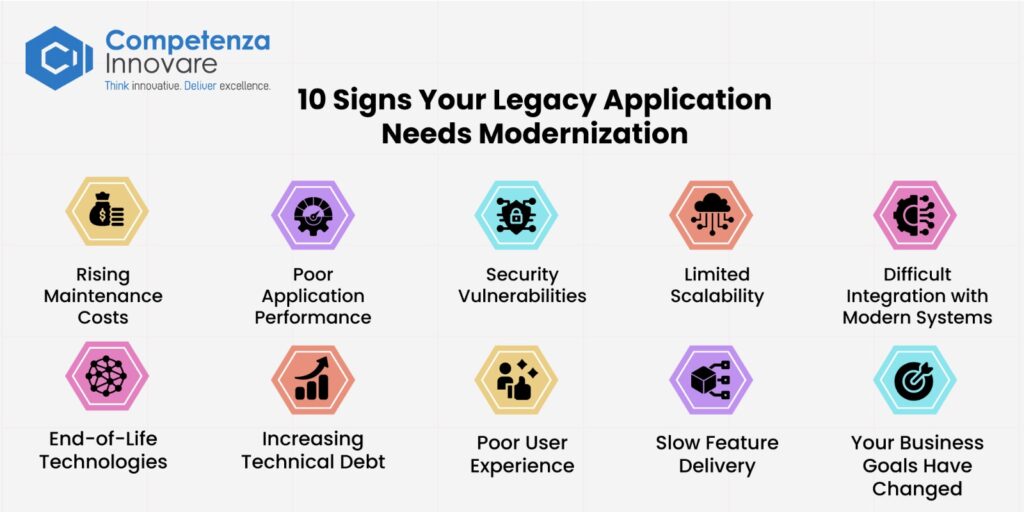
10 Signs Your Legacy Application Needs Modernization
The indications that the cost of inaction is greater than the cost of change. Here are indicators that guide you on when you must upgrade old systems.
1. Rising Maintenance Costs
When maintaining the system incurs more expenses than upgrading it.
When your expenditure on maintenance of an application has increased since years past with no similar increase in the value the application provides, that trend is not going to change on its own. The increasing maintenance expenditures caused by the aging infrastructure and deteriorating sets of specialist talent as well as technical debt are the most noticeable financial indicator that the modernization of legacy applications is no longer in the future but in the present commercial need.
Monitor the overall cost of ownership cost per year. In situations whereby the annual maintenance expenditure is equivalent to or higher than the cost of a modernization program during the same time period, then the financial case of modernization is already closed.
2. Poor Application Performance
Delays in loading, downtime, and bad user experience decrease productivity and income.
Optimization alone is rarely a solution to performance problems in legacy systems. When the architecture must operate within inherent limits imposed by a monolith, which can not be scaled, a database not designed to accommodate the current volumes of data, on-premise infrastructure with either minimal headroom performance progressions are diffuse and short-lived. If the users of your systems are reporting slow response times, frequent timeouts, and even unavailability of your systems when needed the most, then they are architectural symptoms, which cannot be cured through maintenance.
3. Security Vulnerabilities
Old software also subjects your business to the risk of cyber attacks and compliance infractions.
There are no security updates to end-of-life software. Known CVEs are not patched. Standards of encryption that were strong at the time of building are deemed weak. To the extent that businesses are operating in a sector regulated by a particular regulatory body, as in the case of healthcare organizations operating under HIPAA in the US, financial services firms operating under the guidance of the FCA in the UK, and enterprises dealing with personal data under EU laws and regulations under the GDPR, the use of legacy systems with established security weaknesses represents a direct compliance risk at the regulatory level with financial and operational outcomes.
Modernization of legacy applications will bring applications to the modern security environment underpinned by active encryption, vulnerability maintenance, and compliance posture demanded by the regulated industries.
4. Limited Scalability
The implementation cannot serve growing users, data amounts, and workloads without a lot of work.
When the cost of software additions, market expansion, or even transaction processing volumes necessitates some slower or expensive infrastructure upgrades or workarounds, the system is telling you something significant. Manageable current scalability constraints are tomorrow’s business constraints that not only impair business expansion and customer growth but also reduce operational capacity at the worst time.
5. Difficult Integration with Modern Systems
The legacy applications hamper the interconnected, API-based business model that contemporary business needs.
The APIs have been the interconnective tissue of the current business technology. All service APIs include CRM platforms, marketing automation tools, analytics systems, payment processors, and supply chain platforms and more. Applications older than API-first design or exposing data via proprietary undocumented interfaces are points of isolation in your technology ecosystem and need custom mental effort to have them integrate, which creates complexity and vulnerability each time either party undergoes a change.
6. End-of-Life Technologies
The technology that the vendor does not support anymore runs your application.
End-of-life software is the type of software whose vendor no longer releases security patches to it, or no longer releases bug fixes, nor does the vendor continue to provide technical support. Conducting operating systems, databases, end-of-life runtime environments, or frameworks that are unmitigated. The bigger the system operates on unsupported technology, the greater the unpatched exposure is. It is not a hypothetical risk; this is the very risk profile that facilitated some of the most prominent data breaches in recent history.
7. Increasing Technical Debt
The fact that short-term fixes are accumulated makes each change slower and costly.
Technical debt is accrued by any software system in which short-term demands keep on dominating the quality of the code. Fixes that are made upfront without fixing the root cause. The reason for the inclusion of workarounds was that the correct solution was too intricate. Added functionality placed on a non-design architecture. The cost of every shortcut is growing in the future, one by one, and the interest of technical debt accrues. At what level does technical debt have to reach in order that the velocity of new development has been divided by half? That is the level at which modernization must be on the immediate agenda.
8. Poor User Experience
A user interface that is outdated diminishes employee productivity and it harms customer satisfaction.
The dynamics of user demands regarding interfaces on applications have improved tremendously since most of the legacy systems were developed. Modern consumer users cannot tolerate the same level of cognitive load of internal systems they endured 10 years ago. Legacy interface: customers who are touched by your digital products are making judgments about your business based on that. Internal applications incur poor user experiences that are costly to productivity. Unsatisfactory user experience in front office applications is lost revenue.
9. Slow Feature Delivery
New functionality requires months to be delivered due to architectural resistance to change.
When your development group continually has difficulty adding new features due to the current architecture complicated, dangerous, and time-intensive every change, the bottleneck is the architecture. In competitive markets, where responding to the needs of the customers, changes in regulation and competitive shifts count, then a system which cannot bring change fast, is one which is costing the business market position.
10. Your Business Goals Have Changed
The application is no longer compatible with up-to-date business processes and growth plans.
Software is developed to cater to a business model at a given point in time. As the business model changes—new markets, new channels, new operational processes, and new regulatory requirements—the uses that had worked with the old model may not work with the new one. A need to modernize legacy systems becomes critical when the application in question is currently preventing the business from achieving its modern strategic goals, as opposed to just complicating the implementation process as much as it must.
Also Read: What Are the 7 R’s of Application Modernization
Best Practices for Successful Legacy Application Modernization
The difference between modernization programs that can deliver and those that overrun and underdeliver.
Prioritise High-Impact Applications
Begin with those systems that modernization offers the most commercial benefit.
Not all the legacy applications must be updated equally and simultaneously. Prioritize the applications that have the highest cost of maintenance, the highest level of security threat, the most severe performance limitations, or linkage to strategic growth programs based on business impact. An organized program of modernization yields a faster payoff and instills confidence in the organization through realized success prior to addressing the most complicated systems.
Adopt an Incremental Approach
Gradual modernization minimizes risk and brings value sooner than big-bang replacements.
The most risk-handled way to modernize a complex and business-critical legacy application is the strangler fig pattern, which slowly removes legacy functionality and replaces it with modern components without fully decommissioning the legacy system. It does not expose the system to the risk of an all-or-nothing bring-up of a big-bang system, allows delivery of modern functionality to users gradually, and gives the team time to learn about the existing system even as the team replaces each element.
Incremental modernisation is the commercially viable way to go in most organisations less risk and sooner realisation of values and an easier-to-manage investment profile than trying to go out of business in all respects at the same time.
Build a Modern Architecture
Take the modernization as a chance and lay an architectural base for the coming decade.
Modernization of legacy systems is the chance of making rectifications in the architectural choices that cost the business money and limited them over the years. Cloud-native architecture, microservices breakdown to fit the right components, API-first design, and containerization enable the freedom, scaling, and integration that otherwise cannot be achieved with legacy monoliths. The architecture choices to be undertaken by modernisation will determine both the cost profile and the capability profile of the system over the next decade or fifteen years and will invest sufficient time to get it right.
Strengthen Security
The point of modernization is to create a security posture that the previous system was not able to offer.
Establish security early in the process of the modernization program, not as an end review prior to going live. This entails threat modeling in design, proper coding practices in development, automated security testing as part of the CI/CD pipeline, and extensive data protection architecture at its core. The switch to the modern is also the opportunity to raise the regulatory compliance posture, such as GDPR in the EU, HIPAA in the US, and FCA requirements in the UK, that has long been undermined by legacy systems.
Automate Testing
The safety net that allows incremental modernization to take place is test automation.
Modernization of the legacy systems without extensive automated testing is assumed to be very risky. Automated test suites, unit tests, integration tests, and end-to-end regression tests exhibit the assurance that modifications to a complex, not all understood legacy codebase have not caused broken behavior. One of the initial (and most significant) investments in any modernization program is the creation of automated test coverage, especially in the context of the strangler fig pattern wherein both legacy and modern systems co-exist.
Upgrade Your Legacy Systems and Unlock Better Performance, Security, and Scalability
Monitor Performance After Migration
The post-migration observation reaffirms that modernization provided the desired results.
Modernization does not go live. Ensure the first day of production operation has comprehensive monitoring of application performance, cost of infrastructure, user experience metrics, error rates, and security posture. Post-migration monitoring confirms that the modernized system is providing the areas of performance and reliability improvements that the business case forecasted and communicates any problems that need to be addressed before they can have user material impact.
Conclusion
Key Takeaways
Modernization of legacy applications is not a technology program. It is a business investment that has a direct business impact on maintenance cost, security risk, operating performance, and the capability of the organization to implement its strategy. These ten signs in this guide are the most obvious indicators that the cost of carrying on with a legacy system has surpassed the cost and risk of modernizing it.
When to Modernize vs. Replace
Modernization is reasonable when the legacy application has a sound business rationale and the issues are architectural or technological but not fundamental. Replacement would be reasonable if the business logic itself were so inherently locked up in old code that it could neither be stored, documented, or relocated, or when the use of the application itself is not useful to the business model at all. In the case of most organizations like Competenza, the response lies between the two partial modernizations of high-value components and the replacement of components that do not have a viable route to a modern architecture.
Frequently Asked Questions
What is legacy application modernization?
Legacy application modernization is the process of updating or transforming outdated software to improve performance, security, scalability, and compatibility with modern technologies.
How do I know if my legacy application needs modernization?
Common indicators include rising maintenance costs, poor performance, security vulnerabilities, unsupported technologies, and difficulty integrating with modern systems.
What are the benefits of modernizing legacy applications?
Benefits include improved security, lower maintenance costs, faster feature delivery, better user experience, easier cloud integration, and enhanced scalability.
What is the difference between rehosting and refactoring?
Rehosting moves an application to a new environment with minimal changes, while refactoring modifies the code to improve performance, maintainability, or cloud readiness.
Should I modernize or replace my legacy application?
If the application still supports core business processes, modernization is often more cost-effective. Replacement may be better when the software cannot meet future business or technical requirements.
How long does a legacy application modernization project take?
The schedule is dependent upon the size of the application, architecture, complexity, and modernization course adopted. Projects may take a matter of months and even more than a year.
What are the largest possible risks of modernization?
Not modernizing now adds to the technical debt, maintenance, cybersecurity, and compliance and reduces your innovation capabilities.
How do you start a legacy application modernization project?
Begin with a deep analysis of the application and its legacy application to understand technology, business value, risks, cost, and modernization priorities.