

The artificial intelligence is not only transforming into general-purpose tools but also into the development of vertical AI agents—purpose-specific system architectures that meet the special needs of particular industries. These industry-specific AI agents are trained to recognize industry workflows, regulations, and business processes, unlike the traditional AI solutions, which can provide more correct and efficient results.
In the healthcare and financial sectors as well as manufacturing and retail, autonomous AI systems are assisting organizations to automate operations, optimize decision-making, and increase efficiency. Vertical AI is a major source of innovation and digital change as business organizations begin to invest more in their AI workflow automation and enterprise AI agents. Here in this blog, we will discuss what the vertical AI agent development services are, their advantages, their implementation in industry, and how they are transforming the future of smart business automation.
What Are Vertical AI Agents?
Vertical AI agents are said to be vertical AI applications that are applied in particular industries like healthcare, finance, manufacturing, and retail. These industry-specific AI solutions do not rely on the general AI tools because they are trained using industry data, processes, and policies in order to deliver more meaningful and superior results.
Smart AI agents can perform automation and analysis of data, assist in making decisions, and be connected to the enterprise solution, including the CRM and the ERP systems. They allow businesses to be more efficient depending on their experience in the industry, reduce manual labor, and simplify things.
An example is a patient documentation AI agent to help solve the problem of patient documentation and a finance AI agent to help identify fraud and compliance control procedures.
Why Vertical AI Agents Are Gaining Rapid Adoption
Organizations are gravitating towards the investment in industry-specific AI workers in order to mechanize complex workflows with the aim of making them more efficient and producing insight into their business. These industry-specific solutions are industry-specific and can be used in a specific business as opposed to general AI tools; therefore, they are more appropriate in real business applications.
Growing Demand for Intelligent Automation
Organizations are in search of more intelligent ways to automate the time-consuming and repetitive tasks. The automation of business AI can assist organizations in automating their operations, lessening manual workload and enhancing productivity without any impact on accuracy and consistency.
Need for Industry Expertise and Contextual Understanding
Different industries are marked by different procedures, rules, and problems. AI agents tailored to an industry domain are trained with industry knowledge and thus know industry vocabulary, regulatory needs, and business processes in a superior way when compared to general-purpose AI systems.
Increasing Complexity of Business Operations
This creates difficulties providing organizations with management of vast amounts of data and processed workflows as organizations expand. Enterprise AI agents are able to interpret information, automate simplistic processes, and assist businesses to make faster decisions and thus run more efficiently.
Focus on Productivity and Cost Optimization
Companies are turning to AI to enhance their productivity and minimize cost of operation. Vertical AI agents enable companies to save time, reduce human resource costs, and make companies more efficient by automating repetitive tasks and decreasing human errors.
Enterprise Demand for Scalable AI Solutions
Enterprises today require AI-based systems that are scalable to their operations. Enterprise AI agents are able to connect with the current business tools, facilitate various workflows, and evolve to meet the alterations in business requirements; thus, they can be well-invested in the long term.
AI Adoption Trends and Investments
The use of AI is on the increase as organizations boost the pace of their digital transformation endeavor. Businesses are also beginning to invest in AI-related technologies in healthcare, finance, manufacturing, and retail, among others, to automate their businesses, enhance the experiences of their customers, and keep a competitive advantage. This increasing need for AI-based automation is driving the swift use of vertical AI agents in various industries.
Vertical AI Agents vs General-Purpose AI Systems
As vertical AI agents continue to rise, general AI continues to rise, where business determines the most appropriate solution based on the requirements they have. In comparison to the general AI systems, which are meant to perform a wide duty, vertical AI agents are constructed to perform tasks associated with particular industries and business processes. Their industry-oriented approach can deliver their high level of accuracy, the ability to connect their workflow, and their business-oriented insights.
| Feature | Vertical AI Agents | General AI Systems |
| Industry Expertise | High | Broad |
| Accuracy | Industry-Specific | Generic |
| Compliance Awareness | Strong | Limited |
| Workflow Integration | Deep | Moderate |
| Business Value | High | General |
The autonomous AI systems are also better prepared to have knowledge of business requirements, automated specialized processes, and the intelligent decision-making process since they are trained with specific data and workflows of the industry. This predisposes vertical AI specifically to be useful in industries where accuracy, compliance, and operational efficiency are paramount, e.g., healthcare, finance, manufacturing, and retail industries.
Key Benefits of Vertical AI Solutions
Vertical AI solutions are enabling organizations to become more efficient, streamline operations, and make smarter decisions as businesses adopt intelligent automation. These solutions provide quantifiable business outcomes to the different industries through the integration of industry knowledge and excellent automation.
Enhanced Operational Efficiency
The possibility to automate the repetitive, time-consuming tasks is one of the greatest benefits of AI workflow automation. Vertical AI agents have the ability to manage routine operations, thereby decreasing the number of manual workers and facilitating business operations, enabling teams to engage in more strategic and high-valued work. This causes the workflow to be quick, more productive, and efficient.
Improved Decision-Making
Vertical AI solutions assist the organizations in making informed decisions as they analyze vast amounts of data and provide real-time insights. Such systems will be in a position to detect trends, provide data-based recommendations, and facilitate predictive analytics as a result. Businesses will be able to quickly adapt and respond to new market conditions and the needs of the business.
Better Compliance and Risk Management
There are many industries that are controlled closely. Vertical AI agents help organizations in remaining compliant and meeting industry requirements, support reporting processes, and come up with proper audit trails. Through lessening manual mistakes and tracking key processes, businesses can be in greater control of risks and guarantee compliance with regulations.
Cost Reduction
Business AI automation reduces operational costs within organizations, as mundane processes are automated, and resource productivity is enhanced. Accelerated processing speed, less human intervention, and minimization in resource distribution lead to high cost savings and performance improvement for any business.
Businesses automate workflows, enhance decision-making, establish a higher level of compliance, and minimize costs through vertical AI solutions, which is why they can be very effective in long-term growth and operational excellence.
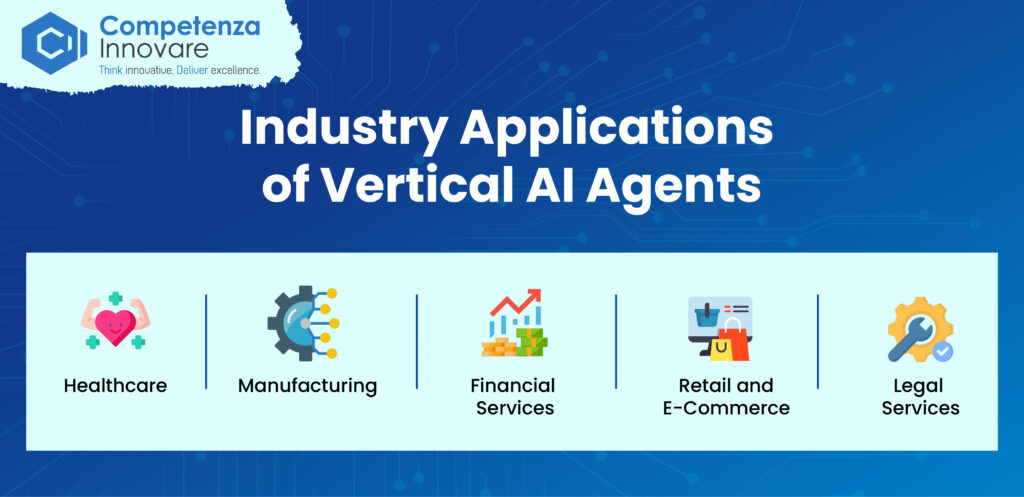
Industry Applications of Vertical AI Agents
Specific AI agents in the industry are enhancing the way organizations are conducted through work that may be complex to be automated, decision-making, and efficiency. These self-directed AI systems will cater to industries with unique needs and produce more precise and business-specific results.
Healthcare
In the healthcare vertical AI agents are used in the healthcare industry to enhance clinical and administrative processes. They can help with medical records, automate booking of patients, help with medical billing, and offer diagnostic support. This helps healthcare providers to be more efficient, do less paperwork, and improve patient care.
Financial Services
Industry-specific AI agents by financial institutions are adopted to enhance the security and service streamlining. These systems can detect frauds, detect risks, contribute to regulatory affiliation, and automate consumer response systems to help organizations become more precise and reduce operational risks.
Manufacturing
Self-reliant AI systems offer manufacturers a chance to improve productivity and performance in their operations. The AI helping agents helps in predictive maintenance, quality control process monitoring, improved production planning, and supply chain optimization to minimize downtime in the business and improve efficiency.
Retail and E-Commerce
Retail and e-commerce utilize vertical AI to make sure that companies deliver a high-quality experience and functionality to the customers. They have the ability to offer customized products. recommendations, predicting inventory demand, automating customer services, and upholding dynamic pricing schemes, according to the market dynamics and consumer behavior.
Legal Services
Legal firms are embracing AI agents to simplify research and document-related activities. Such systems may be valuable to review contracts, carry out legal research, track compliance, and analyze documents so that legal professionals can work more efficiently and increase accuracy and minimize human effort.
In the health and financial sectors, as well as the manufacturing, retail, and legal services sectors, industry-specific AI agents have been assisting organizations automate workflows, enhance decision-making, and unlock more business value with the help of intelligent automation.
The Technology Behind Agentic AI Systems
The increasing potential of agentic AI systems is driven by advanced technologies that allow applying intelligent decisions, automating workflows, and autonomous performance of tasks. These technologies underlie the development of contemporary AI agents extensively, and thus, businesses are able to design scalable and industry-specific AI solutions.
Large Language Models (LLMs)
Large Language Models (LLMs) are artificial intelligence programs that enable AI agents to read and understand human language. They aid in the understanding of natural language, generate contextually welcoming responses, and help agents to extract and understand information, hence making interactions more accurate and natural.
Retrieval-Augmented Generation (RAG)
Retrieval-Augmented Generation (RAG) is an AI performance-enhancing technique that involves both language models and real-time data retrieval. It allows the AI agents to receive the latest update in the form of data, react to it more effectively, and provide more tangible insights that will include references to the latest business data and knowledge bases.
Machine Learning
Machine learning helps AI agents to learn and get better with time. Having relentless learning capabilities, these systems can identify trends, adapt to the current situations, and promote innovative information that can lead to better business decisions and efficiency.
Enterprise Integrations
The modern AI agents are designed to be used in collaboration with enterprise tools and platforms. By connecting with CRM systems, ERP systems, databases, and other business systems, they can automate the workflow, gain access to vital information, and streamline the operations performed daily in the organization.
Multi-Agent Architectures
Multi-agent designs allow the sharing of complex task solving by a number of specialized AI agents. Agents are anticipated to have a defined role, and the other agents collaborate to execute workflows, solve problems, and achieve the objectives of the business in a more effective way.
Advanced technologies, such as LLM, RAG, machine learning, enterprise integrations, and multi-agency, are enabling the creation of agentic AI systems, enabling smarter automation, better decisions, and smarter AI-powered business processes.
How AI Agent Development Enables Industry-Specific Automation
AI Agent Development helps companies to create intelligent solutions to their demands in the industry. The enterprise AI agents are crafted to adapt to the specific workings process, business process, and operational requirements, unlike non-enterprise AI tools.
Key Components
- AI agents that are developed to fulfill a business need.
- Training based on industry-specific data and knowledge.
- Workflow Automation for reducing human tasks and increasing productivity
- Integration with CRM, ERP and other enterprise applications.
- The security, compliance, and governance support.
Through AI agent development, organizations are able to develop advanced processes that are automated, enhance productivity, and generate better business results. Therefore, a large number of companies are collaborating with AI development firms to develop their unique solutions, which match their organizational objectives and business needs.
Challenges of Implementing Vertical AI Agents
Although the strength of autonomous AI systems is undeniable, organizations can encounter numerous difficulties in the implementation process. It is crucial to deal with them to achieve successful implementation of enterprise AI solutions.
- Data Quality: High-quality and accurate data are required by the AI agents to deliver quality results. The quality of data is poor and influences the performance and accuracy.
- Security and Privacy: The sensitive business and customer data should be at high levels of security and privacy.
- Complexity of integration: The issue of integrating the AI agents into the existing enterprise systems and processes of workflow may need a lot of planning and technical knowledge.
- Regulatory Compliance: It should be remembered that their AI applications must be in accordance with industry regulations and requirements.
- Workforce Adoption: There is a possibility that workers have to be trained and assisted to learn how to use AI technology and how to adapt to the new automated procedures.
Solving data, security, integration, compliance, and adoption helps organizations to successfully implement enterprise AI solutions and scale the value of vertical AI agents.
Future Trends in Vertical AI Agents
Vertical AI agents are focusing on their future based on their specialized nature, automation, and enterprise-wide intelligence. With the ongoing development of AI technology, businesses will move to having more complex AI agentic systems that require minimal human interactions to complete complex tasks.
Hyper-Specialized AI Agents
The AI agents in the future will be more selected and specific in terms of roles and industries, providing in-depth expertise and more correct results.
Multi-Agent Collaboration
Different AI agents will work to complete complicated work and work more efficiently and faster with the capacity to make decisions.
Autonomous Business Operations
The AI entities will still continue to automate routine jobs, helping companies to make operations smoother and reduce human labor.
Industry-Specific Foundation Models
The models of AI that will be used by businesses will be trained on industry-specific data, and this will be able to give more relevant insights and maximize performance.
AI-Powered Digital Workforces
Organizations will take advantage of AI agents as digital assistants that will assist employees, enhance productivity, and automate repetitive work.
Build smarter, industry-specific AI agents with Competenza and transform your business workflows today.
Advanced Enterprise Automation
The further advances in AI will consist of automating workflow, which will involve integrating with enterprise systems and end-to-end business process management.
Vertical AI agents will be a significant element of enterprise technology strategies as companies develop more efficient, intelligent, and scalable systems to bring about the next wave of automation and digital transformation.
Conclusion
Vertical AI agents are transforming how companies automate and enhance their decision-making and optimization processes. These industry solutions are tailor-made to learn the specialized business processes, policies, and functions, ensuring organizations can get improved outcomes unlike general AI tools.
Healthcare, finance, manufacturing, and retail are all trying Vertical AI Solutions as a way to simplify their work, save money, and improve efficiency. Even more importantly, these smart systems will contribute to business growth and innovation since AI technology keeps on advancing.
At The Competenza, we assist business organizations to capitalize on the development of AI agents to create tailored AI applications that would support their business needs and business objectives within their respective industries. With intelligent, scalable AI agents, organizations will be able to open up new opportunities around automation, efficiency, and long-term success.
Frequently Asked Questions
What is a vertical AI agent?
Vertical AI agents refer to AI systems that are specific to an industry and business operations. They can give a more exact output over general AI tools due to being trained with industry-specific data, workflows, and regulations and can give more insights into their industry, automate specialized techniques, and supply industry-specific decision-making.
What is a difference between vertical AI agents and general AI systems?
Specialization is the main difference. The general AI systems are developed to receive a variety of work in a variety of fields, in contrast to vertical AI agents developed to work in a single industry like healthcare, financial, or manufacturing as well as retail areas. Solutions based on industry are also allowing them to provide a higher level of accuracy, increased workflow integration, and compliance support.
What are the reasons businesses need to use vertical AI agents?
Businesses are resorting to vertical AI agents in order to streamline complicated workflows, increase operational efficiency, reduce manual workloads, and encourage quicker decisions based on data. The solutions help the organizations to automate, enhance productivity, and gain a competitive edge in a more digital business environment.
What industries are the most assisted with vertical AI agents?
All industries with vertical AI agents include healthcare, financial services, manufacturing, retail, e-commerce, and legal services. They help organizations to automate industry-specific processes, improve customer experiences, improve compliance, and improve business performances in general.
What are the key benefits of vertical AI solutions?
Vertical AI solutions enable corporations to have more effective work, automation of unnecessary processes, simplified decisions, better compliance, and lower costs of operation. Its solutions are based on industry expertise and intelligent automation to allow organizations to become more efficient and scalable.
What are the technologies of agentic AI systems?
Examples of the agents that implement agentic AI systems are large language models (LLMs), retrieval-augmented generation (RAG), machine learning, enterprise integrations, and multi-agent architectures. These technologies enable the AIs to read between the lines, have access to the relevant information, automatize the processes, and continually improve performances.
Will vertical AI implementers integrate with existing enterprise systems?
Yes, contemporary vertical AI agents have the ability to interface with CRM systems, ERP applications, databases, and other business applications. The integrations enable organizations to automate workflows, get real-time information, and also enhance operational efficiency without affecting any ongoing processes.
What are the challenges related to the deployment of vertical AI agents by businesses?
The issues that organizations could face include data quality, security and privacy, system integration, regulatory compliance, and workforce adoption. These factors can be dealt with by proper planning and governance to establish an effective implementation and value over time.
Will vertical AI agents have any future?
Further specialization, collaborative multi-agent interaction, autonomous business processes, and powerful enterprise automation are the future of vertical AI agents. The AI technology keeps developing, and we can anticipate that such forms of intelligent technologies will gain even more power in the digital transformation and business innovation.
What role does The Competenza play in helping businesses leverage vertical AI agents?
The Competenza helps businesses create, build, and implement custom AI applications to suit their unique industries. The Competenza can do this through its AI agent development services, which assist organizations with the automation of their operations, raising their productivity, and enhancing decision-making, as well as leveraging the opportunities of intelligent business automation.