

The contemporary business world requires data in order to come up with more effective and faster solutions. All business operations generate valuable data, and it begins with sales and marketing, customer care, and operations. In a dynamic market, a review of the past data is now no longer enough. Businesses need a kind of intelligence that helps them to know what is likely to happen next in order to take action before making matters worse or missing out on an opportunity. This is where predictive analytics dashboards can be significant. These dashboards utilize AI-based business intelligence to analyze both historical and real-time data, which helps to show trends and predict the future of the business and behaviors. They do not merely tell what has already transpired in the past but assist businesses in making proactive decisions on what most likely may happen later in the future.
With AI business forecasting and predictive data analytics, organizations will be able to make superior predictions regarding customer behavior, sales performance, market demand, and possible business risks. Business intelligence dashboards of modern business intelligence present real-life insights that enable the teams to enhance their planning, reduce uncertainty, and achieve improved outcomes.
Through this blog, we will know how a predictive analytics dashboard functions, how business intelligence, which is supported by AI, can be used to predict business results, and why predictive analytics is now a mandatory tool for contemporary businesses.
What Are Predictive Analytics Dashboards?
Predictive analytics dashboards enable forward-thinking of the business with the use of AI, machine learning, and data analytics. However, in contrast to traditional dashboards, which pay attention to past performance, these dashboards are used to analyze historical and real-time data and predict trends, opportunities, and risks.
Understanding Predictive Analytics
Predictive data analytics involves analyzing past and recent data to predict what is to come. It helps businesses to make informed decisions; it discovers patterns and trends.
Businesses typically use four types of analytics:
- Descriptive Analytics – What happened?
- Diagnostic Analytics – Why did it happen?
- Predictive Analytics – What is likely to happen next?
- Prescriptive Analytics – What action should be taken?
Predictive analytics allows organizations to shift their decision-making processes from reactive to proactive planning.
What Makes a Predictive Analytics Dashboard Different?
The traditional business intelligence dashboards present the past data and performance indicators. Although they are useful, they explain the past outcomes only.
Predictive analytics dashboards are businesses using AI, machine learning, and business intelligence to predict the future. They do not just present the past but assist businesses in knowing what can occur in the future to make quick and intelligent decisions.
Key Components of Predictive Analytics Dashboards
- Data Integration: Data has a combination of data from multiple business systems into one dashboard.
- Machine Learning Models: Learning to forecast patterns and provide proper forecasts.
- Real-Time Monitoring: Monitors the knowledge of the business in real-time so that it can develop an immediate picture.
- AI in Forecasting: AI should be able to predict the sales, demand, customer behavior, and other useful indicators.
- Interactive Visualization: Exposes Insight is displayed in the format of easy-to-use charts, graphs, and dashboards.
With these capabilities, predictive analytics dashboards can enable businesses to make decisions that are more confident in the future, have fewer uncertain effects on their operations, and can reduce uncertainty about future outcomes.
Why Businesses Are Moving Beyond Traditional Reporting
A business enterprise cannot afford to operate without more than just the old reports in order to make effective decisions. With the evolving markets that are becoming quicker and customers demanding more, organizations require an insight that will enable them to forecast the future and react promptly.
The Limitations of Static Reports
A traditional report concentrates on past numbers and presents how things have already been done. Although they assist in performance monitoring, they tend to result in slow response actions and offer minimal insights into future prospects and possible uncertainties.
The Demand for Real-Time Predictive Analytics
Contemporary business organizations are fast-paced and competitive. Real-time predictive analytics assists organizations to analyze the available data, identify trends, and forecast using the available present data, enabling them to make decisions more quickly and based on sufficient availability of data.
The Rise of AI-Powered Business Intelligence
AI-powered business intelligence converts raw data into insights and predictions that can be acted on. With machine learning, AI continually learns every time there is new data and builds more accurate predictions as time goes on. This will allow AI-powered business intelligence to assist businesses to predict change, minimize threats, and make smarter strategic choices.
With predictive insights, businesses can move go beyond traditional reporting and create greater potential to compete and result in improved outcomes.
How AI Forecasts Business Outcomes Before They Happen
The AI assists companies to go beyond the guessing phase by making use of data to determine future events. With predictive analytics in business, organizations are able to predict trends and risks and make smarter decisions sooner than they would otherwise.
Data Collection and Pattern Recognition
Nonetheless, AI collects the information across various sources such as CRM systems, ERP systems, sales applications, marketing applications, and operational systems. It then evaluates this data to spot the latent trends and customer activities, as well as business trends that cannot be realized under conventional reporting.
Machine Learning Models for Forecasting
Machines learn through predictive algorithms, and they analyze past and present data. These models recognize, predict the future, and create projections of such areas as sales, customer demand, increased revenue, and operational efficiency. This renders AI business forecasting more precise and dependable.
Real-Time Data Processing
In order to maintain forecasts, AI constantly analyzes the incoming data. The updated predictions are informed by business conditions and automatically enable organizations to respond faster to new opportunities, market changes, or threats.
Predictive Scenario Modeling
The existing AI forecast solutions can be used to fit different business scenarios, including the best-case, worst-case, and expected scenarios. This helps the leaders to establish the possibilities, reduce uncertainties, and make decisions that are more strategic.
Data analysis, machine learning, and real-time insights, in turn, can be utilized with AI to foresee future developments and take proactive decisions, which can increase business growth in the long term.
Key Business Outcomes AI Can Predict
The potential of AI business forecasting to forecast the future using data can be considered one of the biggest advantages. Businesses will be able to make better decisions and reduce risks and improve their performance with predictive data analytics and AI forecasting solutions.
- Sales Forecasting – Artificial intelligence will be able to utilize the past data of sales, trends, and customer behavior in predicting future sales. It also assists businesses in predicting the seasonal needs, as well as assessing sales pipelines, which makes it easier to plan their growth strategies and organize resources.
- Customer Behavior Prediction – AI assists businesses to know the future behavior of customers. It can predict the purchase probability, customers who risk falling off, and the customer lifetime value. Such insights guarantee improved customer retention and marketing performance.
- Inventory and Demand Forecasting – AI will be able to optimize stocks and prevent shortages or surpluses based on the discussion of sales trends and market demand. It also aids in enhancing supply chain planning as well as assisting firms to react to fluctuating demand in a more cost-effective manner.
- Financial Risk Forecasting – AI will be able to predict the cash flow and help plan the budget, as well as anticipate possible financial risks. This allows businesses to make more enhanced financial decisions and enhance risk management.
- Operational Performance Forecasting – AI is able to anticipate the labor demands, employee productivity, and the level of resources. The insights will enable a business to enhance its operational efficiency and allocation of resources and aid in long-term planning.
The business can use the AI forecasting solutions to predict upcoming trends, make proactive decisions, and have a competitive edge in a fast-changing market.
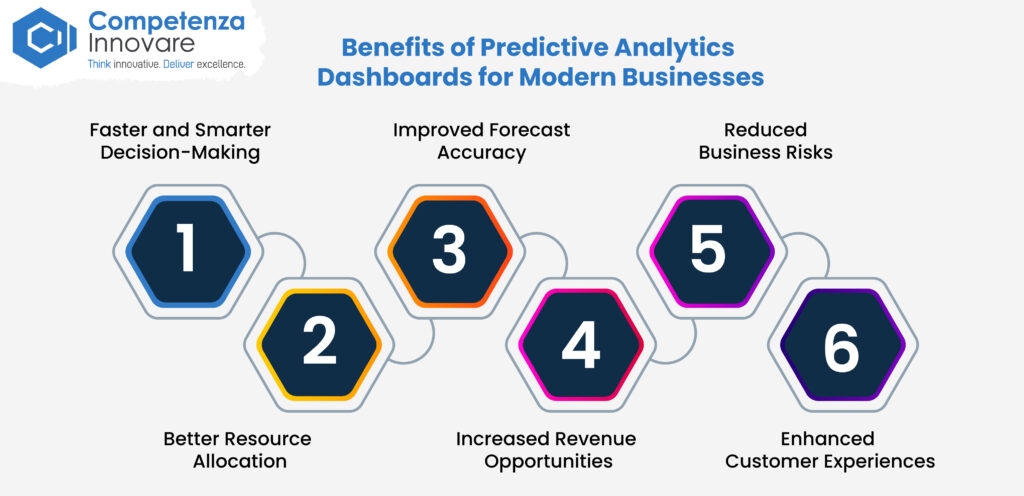
Benefits of Predictive Analytics Dashboards for Modern Businesses
Due to business production of more data than ever, predictive analytics dashboards enable it to convert it into actionable data. With the integration of forecasting with AI-driven business intelligence, organizations would be able to make smarter decisions and enhance overall performance.
Faster and Smarter Decision-Making
The predictive dashboards give insight and forecasts of events that will take place in the future so that decision makers will act swiftly and with a lot of confidence rather than just involving themselves with the past reports.
Improved Forecast Accuracy
AI will be more precise at identifying patterns and trends in historical and current data through analysis. This assists businesses to make effective predictions regarding sales, demand, and operation performance.
Reduced Business Risks
Predictive analytics can assist organizations in identifying possible risk early on so that a proactive strategy can be implemented to mitigate the effects of unforeseen problems.
Better Resource Allocation
Predictive insights enable businesses to allocate budgets, staff, inventory, and other resources more efficiently, leading to better utilization and reduced waste.
Increased Revenue Opportunities
The resulting strategic actions, through identification of the new trends and customer preferences and growth opportunities, help businesses sustain growth in revenues and long-term success.
Enhanced Customer Experiences
Predictive analytics can help companies to know their customers better, make correct predictions about their needs, and offer them experiences that are more personalized, resulting in higher satisfaction and loyalty.
With predictive analytics dashboards and intelligent business dashboards, companies can predict more effectively, reduce uncertainty, and have a competitive advantage within the current data-centric business environment.
Industries Using Predictive Analytics Dashboards
Businesses are turning to predictive analytics to improve business-specific aspects like better forecasting, risk reduction, and smarter decision-making by industrial businesses. Combined with the power of AI-based business intelligence, predictive dashboards can help organizations to make future predictions and cope with the evolving environment in a more effective manner.
- Retail and E-Commerce: Predictive analytics dashboards enable the retailer to make assumptions about the customer demand, identify trends in customer buying behavior, and manage the inventory. This is beneficial in the reduction of stock shortages, overstocking, and distribution of satisfaction to customers.
- Financial Services: Banks, fintech organizations, and financial institutions use predictive analytics to monitor compliance and predict risks and spot fraud. The insights can contribute to enhancing security and contribute to better financial decision-making.
- Healthcare: Predictive analytics enable healthcare organizations to predict demand among patients, staffing, and resource allocation in the most efficient way. This is good to enhance the care of the patient, and operational challenges decrease.
- Manufacturing: Manufacturers can use predictive analytics to track equipment performance and predict its maintenance needs and optimize supply chain processes. This cuts down on time-off and enhances productivity.
- SaaS and Technology: SaaS and technology firms apply predictive analytics to predict customer retention, analyze churn risk, and predict revenue growth. Those will help establish customer relations and build business in the long term.
With the further development of predictive technologies, businesses in all industries are turning to AI-based business intelligence to gain deeper insights, greater productivity, and proactive business decisions.
Essential Features of Modern Intelligent Business Dashboards
Intelligent business dashboards today are more than merely a show of numbers. They use artificial intelligence and automation and are sophisticated with analytics to help companies in making predictions, performance comparisons, and decisions that are faster.
AI-Powered Forecasting Engines
The AI-driven forecasting engines take into consideration previous data and up-to-date data to anticipate the future trend and customer behavior, sales results, and corporate risks. Such features allow AI forecasting solutions to be more precise and take action.
Real-Time Data Visualization
The contemporary business intelligence dashboard displays the information in visual reports, graphs, and interactive charts. Real-time visualization will enable fast interpretation of trends by the decision-makers and address business fluctuations.
Predictive Alerts and Notifications
Automated predictive alerts inform users of possible opportunities, risks, or abnormal usage of business. This enables organizations to be actionable before matters affect performance.
Automated Reporting
Automated reporting decreases the manual approach to generating reports and insights through the automated generation of the reports. Businesses are able to get up-to-date information without wasting time in gathering and storing information.
Natural Language Insights
Most modern dashboards are designed with AI, enabling them to convert complex data to simple and easy-to-comprehend explanations. This assists business users to get valuable insights without having to possess advanced analytical skills.
Multi-Source Data Integration
Smart dashboards are embedded with numerous sources of data such as CRM systems, ERP engines, sales applications, marketing apps, and financial applications. This will take the form of a single perspective on the business performance and enhance decision-making.
Incorporating these characteristics, intelligent business dashboards can assist organizations in turning their data into actionable insights and enhancing forecasting accuracy, as well as in making smarter business decisions.
Best Practices for Implementing Predictive Analytics Dashboards
Organizations must have the appropriate strategy, data, and technology to make the most of predictive analytics to benefit business. These best practices can help to enhance the accuracy of the forecasts and aid in the successful implementation.
- Create Empowering Data Foundation: Predictive analytics needs quality data. The companies are at liberty to amass and tabulate sales, marketing, customer, financial, and operational systems information to build a strong foundation towards forecasting.
- Consider the quality and governance of data: It is necessary to have quality data to make precise predictions. Validation and data cleaning and governance can be performed periodically and contribute to ensuring the insights are valid and palatable.
- Define clear business Objectives: When incorporating predictive analytics dashboards, organizations need to have clear objectives to be achieved. The desired outcomes are better and are a result of specific goals, which may be the measure of sales forecasts, churn reduction, or inventory reduction.
- Select Scalable AI Solutions: Business organizations must consider investing in scalable AI solutions with the capability to provide more data and other business needs. Such solutions as adaptive ones are facilitating future growth and success.
- Continuously Train and Improve Models: The AI models must be continuously updated with new data to stay accurate. A continuous learning process helps businesses to learn and adjust to the changing market and enhance forecasting results in the long run.
Adhering to the best practices would enable organizations to gain the most out of AI-driven business intelligence, enhance decision-making, and foster better and more accurate business forecasts.
The Future of AI-Driven Business Intelligence
The more AI technologies gain development, the smarter, proactive, and more business-oriented AI-driven business intelligence becomes. The next-generation business intelligence systems will be able to not only analyze data but also enable organizations to determine the answer and make decisions more quickly.
Agentic AI and Autonomous Decision Support
The agentic AI systems have the capacity to process data, discover opportunities, and suggest actions with a minimum of human intervention. This assists companies to automate decision-making processes and be able to respond faster to the changing circumstances.
Predictive Intelligence at Enterprise Scale
Companies are adopting AI business forecasting in various business functions, including sales, marketing, finance, and operations. Predictive intelligence on an enterprise-wide level allows planning, enhancing collaboration, and forecasting more effectively.
Hyper-Personalized Forecasting
AIs are transforming forecasts into more personalized ones by examining customer behavior and preferences as well as buying trends. This assists the businesses to provide tailored experiences to customers and enhance customer interaction and retention.
Explainable AI for Better Business Trust
As AI is used increasingly, businesses require transparency in the generation of predictions. Explainable AI assists users to be able to understand the rationale behind predictions, gaining trust and enabling more confident decision-making.
As AI forecasting solutions evolve, companies will be able to rely on increased prediction accuracy, quicker insights, and more intelligent strategies leading to long-term expansion and a competitive edge.
Turn your business data into predictive insights and make smarter, faster decisions with AI-powered analytics.
Why Businesses Need Predictive Analytics Dashboards Today
Businesses now require something beyond reports that reflect the past performance. The predictive analytics dashboards assist organizations in transitioning from reactive decision-making to proactive decision-making; that is, they attempt to forecast what the future trends and chances are and what threats might occur. Through AI-driven business intelligence, businesses are capable of making quicker and well-informed choices on the foundation of real-time understanding and forecasts.
As competition keeps growing, there is a need to invest in AI-based forecasting tools to aid in boosting performance, reducing uncertainty, and being at the forefront of the market. The Competenza helps businesses exploit predictive analytics and AI-based insights to formulate smarter business decisions and facilitate sustainable evolution.
Conclusion
Companies are moving their way out of historical reporting, and predictive analytics dashboards help them in making proactive decisions. Organizations can be better able to plan and respond faster with customer behavior, opportunities, risks, and predictions of trends by using AI. Predictive analytics will be used together with AI-powered business intelligence to deliver real-time insights to help make more effective decisions and facilitate sustainable business growth. As more businesses adopt more data-based strategies, predictive analytics will be more relevant in keeping up with the market and gaining a competitive advantage in the long run.
Frequently Asked Questions (FAQs)
What is a predictive analytics dashboard?
Business intelligence tools are known as predictive analytics dashboards, and they are based on AI, machine learning, and data analytics to predict the future. They have access to historic and real-time data with the help of which they can help businesses make predictions about trends, customer behavior, sales performance, and potential risks.
How does AI business forecasting work?
AI business forecasting processes use vast volumes of data (past and present) to extract the patterns and trends. This information is used by the machine learning algorithms to make predictions about the future, allowing businesses to make more appropriate decisions.
What is the difference between predictive analytics and business intelligence?
Conventional business intelligence is based on analysis of historic data and reporting on the previous performance. Predictive analytics takes it to the next level by forecasting the future by using AI and data models.
What is the accuracy of AI forecasting solutions?
The quality of AI forecasting solutions is based on the data and models. With the help of both specific and up-to-date data, AI has the capacity to predict data with high precision and, therefore, help to improve business planning and decision-making.
What are the best industries to apply predictive analytics?
The application of predictive analytics can be carried out in a variety of industries, such as in retail, e-commerce, finance, healthcare, manufacturing, and SaaS. These industries employ predictive knowledge in enhancing forecasting, optimization, and minimizing risks.
What does predictive dashboards do to improve decision-making?
Predictive dashboards help businesses realize opportunities and risks sooner and give insights along with future predictions in real-time. This assists the decision-makers to act in proactive ways as opposed to responding after the occurrence of the problem.
What is required for predictive analytics?
To come up with such correct predictions, predictive analytics normally employs the usage of CRM systems, EMR platforms, sales data, marketing campaigns, customer engagements, financial systems, and operational databases to gather relevant data.
Will predictive analytics minimize the risks in business?
Yes. Predictive analytics are able to detect possible danger, abnormalities, and arising challenges in advance, to a point where they turn into significant challenges. This will enable businesses to proactively respond and enhance risk management.
What would you like a predictive analytics dashboard to contain?
The predictive analytics dashboard based on AI should include predictive alerts, real-time data presentations, AI-based forecasting, automated reporting, multi-source data integration, and predictive alerts.
How can AI-driven business intelligence contribute to growth in a business?
Business intelligence based on AI helps organizations to turn data into actionable information. It also helps predict the future of business and competitive advantage integration, as it helps forecast trends, provide better decisions, identify areas of exploration opportunities, and reduce uncertainty.