

AI in healthcare is developing fast with organizations in the healthcare industry seeking smarter solutions to enhance patient outcomes, cut down on the workload of administration, and increase organizational efficiency. As patient expectations and the quantity of healthcare data continue to rise, care providers are looking after the technologies that could serve to deliver faster, more accurate, and personalized healthcare services.Generative AI for Healthcare in the field of healthcare is one of the greatest innovations of the last few years. Generative AI is not just an analysis tool, as demonstrated by traditional AI systems, but can be used to generate content, prepare clinical summaries, aid in medical records, research, and enhance patient communication. Generative AI is rapidly becoming a part of the healthcare ecosystem, being capable of not only automating mundane work processes but also assisting the workers in the healthcare industry in rapidly finding information that they are currently seeking.
Healthcare organizations are also utilizing generative AI to streamline workflows, enhance clinical decision-making, advance medical research, and grant their patients increased personalization. The healthcare AI innovation is rapid, powered by these innovations that help enable providers to become more efficient and care about better patient care.
Nevertheless, the opportunities are high, but implementation will need proper planning. To secure the safety and responsibility of these solutions, healthcare organizations will need to manage severe data privacy issues, regulatory compliance, accuracy, and responsible, ethical use of AI. Providing regulative control to the production system, healthcare providers will have the ability to harness the power of generative AI development and shape an efficient and patient-centric healthcare system.
Understanding Generative AI in Healthcare
Generative AI is an AI that can create content, summaries, and insights on extensive data. Generative AI, compared to traditional AI, can generate human-like responses, reports, and recommendations and is primarily used to analyze data.
In medicine, healthcare generative AI solutions are the technologies applied in healthcare to help the provider work more efficiently and to provide better patient experiences with the assistance of large language models (LLMs) and machine learning.
Some common applications include:
- Medical Content Generation: Summarizing of patients, clinical notes, and patient reports.
- Clinical Decision Support: This has to provide information that will aid the individual in making an informed judgment.
- AI-Based Healthcare Assistants: Assist patients in making appointments, send appointment notifications, and respond to general health-related questions.
- Automated Healthcare Workflows: Automation, such as clinical records, planning, and patient care.
As the development of AI in healthcare persists through the refinement phase, generative AI is helping healthcare organizations reach new, higher efficiency levels, help provide better care to patients, and bring innovation to the entire industry.
Why Healthcare Organizations Are Investing in Generative AI
The applications of generative AI in medical institutions are also increasing with the purpose to address the challenges growing in the field and improve the quality of care. The increasing healthcare costs, growing workload, and patient pressure, together with workforce limitations, are straining providers to find smarter and effective remedies.
Generative AI helps medical personnel to automatize less significant processes and streamline them, as well as access potentially useful data more quickly. It also helps in faster diagnosis and treatment planning as professionals are able to analyze high volumes of healthcare information and summarize it.
Key Benefits of Generative AI in Healthcare
- Enhanced Productivity: Automates the repetitive activities and minimizes the manual efforts of healthcare employees.
- Improved Patient Engagement: Provides an opportunity to personalize the interaction with the patients and respond to their needs quicker.
- Reduction in the operating costs: Allows optimization of workflow and greater utilization of resources.
- More Rapid Healthcare Insights: Enables a quick analysis of healthcare information and optimizes decision-making.
Generative AI is enabling AI healthcare automation and AI healthcare innovation, thus helping healthcare organizations become more productive, improve patient experiences, and provide more effective healthcare services.
Key Opportunities of Generative AI in Healthcare
Generative AI is changing the healthcare field as it assists companies in enhancing their efficiency, patient experiences, and research and contributing to improved clinical outcomes. As the adoption rate has been rising, healthcare providers have been seeking additional applications of AI in enhancing the level of patient service and operational efficiency.
Enhancing Clinical Documentation
Among the best ways to use AI in clinical documentation is to save the time that healthcare professionals use on paperwork. Generative AI is able to generate patient notes, visit notes, and help write a medical report automatically. Automation of routine documentation processes will allow healthcare providers to allocate an increased amount of time to work with patients and minimize the number of administrative loads and burnout experienced by physicians.
Improving Patient Care and Engagement
Genuine AI is enhancing the manner in which health services institutions communicate with their clients. Virtual assistants can also be used to schedule appointments, provide information about healthcare facilities, remind patients of those appointments, and facilitate communication with patients at all times with the help of AI. Also, these AI-based healthcare applications assist in providing more personalized healthcare experiences, increasing patient satisfaction and their involvement.
Advancing Medical Research
Generative AI in medical research Generative AI is helping researchers in the medical field work accurately with data, enabling them to tackle huge volumes of data. It can be applied to generalize the findings of research, to examine complex datasets, and to identify new treatment opportunities. By enhancing the speed of information discovery and analysis, generative AI is enabling scientists to generate new solutions to problems with less time and deploy them to the market in the healthcare industry.
Supporting Diagnostics and Clinical Decision-Making
Medical personnel can be assisted by generative AI, which will analyze patient data and identify important patterns of medical procedures. These can be utilized in diagnosis, treatment planning, and clinical decisions. The processes of radiology and pathology are also improving in efficiency and accuracy as the application of AI technologies becomes the assistant to the work of clinicians. Because of this fact, AI-based diagnostics are becoming increasingly more popular as an important part of modern healthcare.
Streamlining Healthcare Operations
Generative AI is also used to improve the effectiveness of healthcare organizations. Activities like claims processing, appointment scheduling, administration, and allocation of resources could be automated and the load of various duties decreased, enhancing productivity. AI healthcare automation allows providers to simplify the process, reduce operational expenses, and make healthcare services more efficient.
Real-World Applications of Generative AI in Healthcare
Generative AI is already being used across the healthcare industry to improve efficiency and patient care. AI-generated patient summaries are also used in hospitals as a way of assisting doctors to get an overview of valuable medical data very fast. Chatbots used in health care can help patients book appointments, provide appointment reminders, and answer frequently asked medical questions.
Pharmaceutical companies use generative AI with drug discovery and development, and AI-driven documentation software can help medical professionals write clinical notes and clinical reports at a faster pace. Smart healthcare assistants also make it possible for medical teams to access valuable information and insights when necessary.
Industries Benefiting from Generative AI
| Industry | Benefits |
| Hospitals | Faster documentation and improved patient care |
| Clinics | Better patient communication and workflow efficiency |
| Pharmaceutical Companies | Accelerated drug research and development |
| Medical Research Institutions | Faster data analysis and scientific discoveries |
| Health Insurance Providers | Improved claims processing and customer support |
The healthcare organizations using such generative AI healthcare applications are finding it easier to contribute to increased productivity, reduce manual efforts, and help patients have improved experiences.
Challenges of Generative AI in Healthcare
Although there are numerous advantages of generative AI, healthcare organizations need to face several issues to have safe and efficient implementation.
Data Privacy and Security Risks
Patient information in healthcare systems is very sensitive. Such data and protected data-handling procedures are vital towards achieving the demands of agentic AI in healthcare compliance besides averting the risk of cybersecurity problems.
Accuracy and Reliability Concerns
Generative AI can occasionally generate false or misleading information, surprisingly known as AI hallucinations. Since health concerns are sensitive, human monitoring is still relevant to confirm patient outcomes based on AI-generated insights and recommendations.
Regulatory and Compliance Requirements
Health institutions are obliged to meet the requirements of patient information, privacy, and security. Effective adoption of AI involves effective data governance, ethical AI, and standards relating to healthcare compliance.
Bias and Ethical Considerations
The AI systems are trained using the existing data, and using minor restrictions in training data can introduce bias in the result. The key to achieving trust in AI in healthcare applications is to ensure fairness, transparency, and responsible use of AI.
Integration with Existing Healthcare Systems
Legacy systems and electronic health records (EHRs) are used by many providers in the healthcare sector. Current infrastructure might be challenging to interface with new AI solutions,, and professional technical and planning skills can be needed to create AI solutions in healthcare.
These issues need to be discussed to make sure that healthcare organizations can reap the maximum advantages of generative AI without jeopardizing its security, accuracy, and compliance.
Best Practices for Implementing Generative AI in Healthcare
To achieve successful results, healthcare organizations should be strategic and responsible in the implementation of generative AI. Good and risk reduction need a good background to maximize good.
Key Best Practices
- Start with the use cases that are clear and include specific healthcare needs and goals.
- Enhance patient confidentiality and protect sensitive medical data on all levels.
- Make sure that there is human review of clinical and operational critical decisions.
- To enhance AI, trustworthy and quality healthcare data should be applied to achieve accuracy and reliability.
- Continuously observe AI performance and ameliorate when needed
- Ensure that compliance with regulatory and security requirements is considered early on.
This is not just an issue of adoption of a new technology to be successful in healthcare AI development. It involves a tradeoff between innovation and patient safety, data protection, and AI healthcare compliance. Using the best practices, healthcare organizations can create a trustworthy AI solution that will provide sustainable value and improved healthcare outcomes.
Measuring the Success of Generative AI in Healthcare
The use of generative AI in healthcare is just starting. Healthcare organizations should also evaluate the effectiveness of these solutions to enhance patient care, operational efficiency, and healthcare performance. Monitoring the right metrics assists the providers to have an understanding of the worth of their AI investments, and the unfinished areas that they can continually improve.
- Clinical Documentation Efficiency: Generative AI may be utilized to minimize the time needed in clinical documentation, which is one of its largest advantages. AI will be able to assist in writing patient notes, summaries, and reports faster, enabling the healthcare professionals to dedicate more time to patients and less to paperwork.
- Patient Satisfaction and Engagement: AI-powered healthcare solutions may enhance patient-provider communication by providing more expedited responses, assistance in making appointments, and personalized support. Increased patient satisfaction ratings usually would mean that AI is contributing to the process of developing a more stimulating healthcare delivery.
- Quickened Approving Division: Generative AI can simplify the booking procedure and patient requests. Healthcare organizations can help deliver patients faster and more convenient services by minimizing the response time and streamlining scheduling.
- Administrative Cost Savings: For a lot of healthcare providers, AI healthcare automation is an alternative to performing routine administrative duties. Routine processes can be automated, and the operational costs can be lowered; efficiency can be enhanced, and staff can concentrate on the activities that have higher value.
- Increased Productivity of Staff: Generative AI can allow healthcare providers to find information faster and more effectively and perform routine tasks. This will be able to boost productivity among clinical and administrative departments and lessen workloads and stresses.
- Quicker Clinical Information: Clinicians and healthcare workers frequently have to find patient history and records rapidly. Healthcare generative AI solutions are capable of summarizing large volumes of data and offering details that are of interest in a shorter period to enhance quality and bigger decision-making.
- Enhanced Operational Effectiveness: Generative AI has the potential to enhance processes within healthcare institutions, minimizing delays and streamlining operations and aiding in advocacy of resource management. These advances assist providers in providing healthcare services in a more efficient way.
Throughout the measurement of the results, healthcare organizations can know the actual effect of AI on healthcare. Following the increases in efficiency, patient experience, productivity, and work performance, the providers will be able to keep their generative AI healthcare applications, and they will keep on producing value for both their patients and healthcare team.
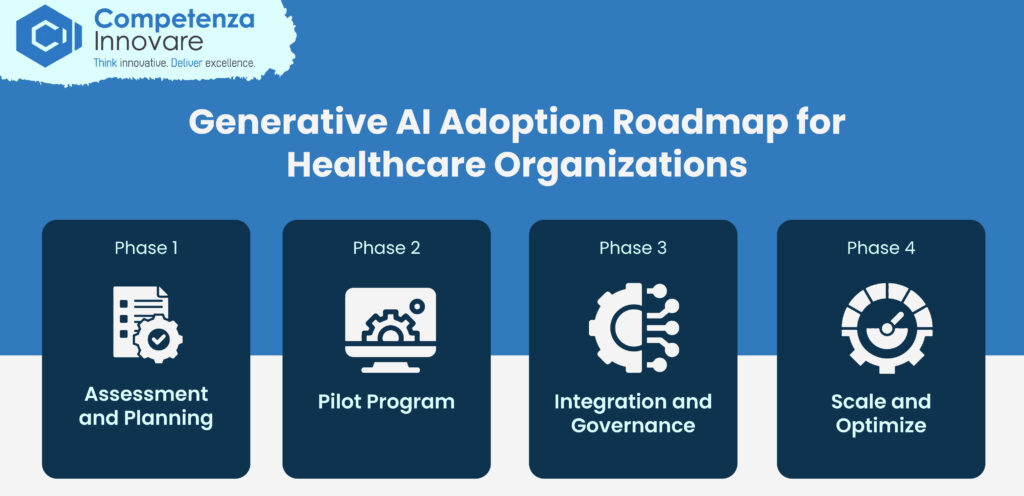
Generative AI Adoption Roadmap for Healthcare Organizations
The implementation of generative AI in healthcare is innovative and demands more than the selection of a technology to implement successfully. To ensure AI solutions address the clinical objectives, operational requirements, data security requirements, and regulatory standards efficiently, healthcare organizations require a systematic strategy that addresses the alignment between business requirements and AI solutions. A strategic roadmap assists organizations to limit hazards, enhance reception, and get the most out of their healthcare generative AI solutions.
Phase 1: Assessment and Planning
The initial thing is to determine the area where generative AI can generate the most value. To address the most significant use cases, healthcare organizations ought to assess the working processes, operational difficulties, and patient care. This step also involves the evaluation of the existing healthcare systems, data access, and compliance needs. Developing positions in the first place helps to develop a good background on which the successful change in healthcare AI development will be structured.
Phase 2: Pilot Program
Organizations should introduce a pilot project in a controlled setting prior to the large-scale deployment. It will help healthcare teams to test particular generative AI healthcare applications, assess performance, and detect possible challenges. At this stage, organizations can quantify improvements in their efficiency, accuracy of documentation, and workflow performance and obtain precious feedback on the solution, which will be used every day by healthcare professionals.
Phase 3: Integration and Governance
The second step after the positive results of the pilot is to include AI with the already existing healthcare systems (including electronic health records (EHRs), patient management, and operational tools). Healthcare institutions should also develop governance policies, security controls, and compliance frameworks to facilitate the safe and responsible use of AI. Staff training is also essential to make healthcare teams know how they can successfully apply AI-powered healthcare solutions into workflows.
Phase 4: Scale and Optimize
Once introduced successfully, the AI will enable the organizations to increase interdepartmental and healthcare functional capabilities. Such continuous monitoring can be used to monitor performance, see areas of improvement, and keep AI systems valuable. As more data on healthcare becomes available, the AI models can be modified and enhanced to improve accuracy, efficiency, and patient outcomes. This continuous cycle offers AI healthcare innovation in the long run and helps the organizations to adapt to the requirements in healthcare.
The gradual deployment plan can help healthcare providers to become more at ease with the idea of AI in healthcare. Having a major focus on evaluation, testing, incorporation, and constant optimization, companies will be capable of developing secure and scalable AI applications that are capable of improving care provision to patients, optimizing workflow, and enabling a sustainable healthcare revolution.
Emerging Generative AI Trends in Healthcare for 2026 and Beyond
Advances in generative AI in healthcare are shaping the future, as they enable healthcare organizations to increase efficiency and improve patient care and clinical decisions. With the ongoing adoption, there are several new trends that are anticipated to significantly contribute to the next step in the field of healthcare AI innovation.
- Multimodal AI will unite text, medical images, voice recordings, and patient data to provide further in-depth alleviation of healthcare and aid in making decisions much more accurately.
- Clinical copilots will also help reduce the workload and enhance the productivity of healthcare professionals with the use of AI-based clinical copilots that will assist with clinical documentation, patient summaries, information search, and administration.
- Individualized communication as well as reminders to appointments, health tips, and support will be provided in individualized patient interaction systems to make healthcare more individualized.
- Smart healthcare knowledge assistants will assist clinicians to rapidly search and find medical research, treatment guidelines, and patient information to aid clinicians in making quicker and informed decisions.
- As healthcare data is received, real-time clinical decision support systems will work on it and give information and insights that are going to be useful in the diagnosis, treatment planning, and managing patients.
- The preventive care interventions based on AI will assist healthcare institutions in detecting the possible health-related risks at earlier stages and facilitate taking proactive measures and promoting improved patient outcomes in the long term.
- Healthcare workflow agentic AI will be used to automate and integrate various healthcare processes, assisting organizations to streamline operations and enhance efficiency and operational complexity.
These healthcare generative AI solutions will be improved as they keep on developing, which is likely to increase the quality of care provided, operational efficiency, and the availability of healthcare services. Companies investing in AI development in the healthcare sector today will be in a better position to take the proactive role of fueling the future and creating more interconnected, intelligent, and patient-oriented healthcare systems.
The Role of Generative AI Development Services in Healthcare Transformation
It is not about AI tools but solutions that meet the distinct processes, systems, and compliance needs of healthcare organizations. This is the point at which the generative AI development services are central in achieving successful healthcare change.
Building Healthcare AI Solutions for Real-World Needs
- Custom Healthcare AI Solutions: Design AI software to address clinical, administrative, and patient care workflows.
- AI System Integration: Introduce AI solutions to any of the existing healthcare platforms, databases, and EHR systems.
- Safe AI Applications: Build the safest AI-based application to protect sensitive patient information.
- Scalable Automation Solutions: Automate the procedures that are not necessary and enable the growth of healthcare processes.
- AI Long-Term Innovation: Have the ability to become flexible with an unchanging foundation of ongoing improvement and well-being innovation.
Explore how generative AI can transform healthcare with secure, scalable solutions for real-world needs.
Why Expert Development Support Matters
- Industry Experience – Understands healthcare processes and operational issues.
- Regulatory Knowledge – Helps to address the rules and the data confidentiality of healthcare.
- Secure Implementation – The AI solution is secure, trusted, and reliable.
- Personalized AI Models – Offers models to suit business and patient care needs.
The development of healthcare AI will involve a choice of the strategy and technology partner. By developing their own healthcare generative AI solutions with efficient generative AI development services, healthcare organizations have a chance to develop secure, scalable, and effective healthcare generative AI services helping them achieve greater efficiency and enhanced patient outcomes, as well as trigger long-term innovation.
Future of Generative AI in Healthcare
The future of generative AI in healthcare is large since it will be able to enhance the way companies provide care, information processing, and decision-making in the medical sphere. Going forward, with the rise of AI, the efficiency, high level of customization, and connectivity of the healthcare industry will be realized through generative AI in healthcare.
Future Applications of Generative AI
- Personalized Medicine: Generative AI can also be used to process and evaluate patient data and health information to support personalized care and improve patient outcomes.
- AI-Assisted Clinical Support: AI solutions may help healthcare professionals to get medical knowledge, process information, and make faster clinical decision-making.
- Virtual Healthcare Assistants: AI assistants are very sophisticated in meeting the demands of a patient, providing answers to questions related to healthcare, making appointments, and improving communication.
- Predictive Healthcare Analogies: Generative AI will analyze a pattern in healthcare data and can help preventive health care and early risk prediction.
- Intelligent Healthcare Ecosystems: AI in healthcare has the potential to support processes and handle information more intuitively, as well as create more interconnected healthcare services.
With the ongoing development of AI innovation in the healthcare sector, generative AI will remain assisting healthcare organizations to improve patient care, reduce operations challenges, and develop smarter healthcare solutions without compromising safety and compliance.
Conclusion
Generative AI is revolutionizing the medical industry by improving patient care, clinical records, medical research, diagnostics, and medical efficiency. It helps healthcare organizations to deliver quicker, smarter, and better customized services.
To make AI successful, however, the challenges (data privacy, compliance, accuracy, and ethical use of AI) will have to be solved. With the right healthcare AI development strategy and generative AI development services, organizations will have a chance to develop safe and competent AI solutions that can achieve healthcare innovation without causing patients to lose trust. The Competenza assists enterprises to build scalable generative AI solutions to aid the future of healthcare.
Frequently Asked Questions (FAQs)
What is generative AI in healthcare?
Generative AI in healthcare offers more complex AI to process medical data and generate useful outputs, such as medical summaries, findings, recommendations, and medical reports. It helps the healthcare staff to be more productive and less manual-intensive and can provide a greater degree of patient care.
How can generative AI be used in patient care?
Patient-centered health AI helps patients by providing patient health guidance, health assistance in the form of AI, computer-assisted communication, appointments, and clinical decision support. These solutions are added towards better patient engagement and access to healthcare.
What are the main problems of generative AI in healthcare?
The most worrying issues are protecting the sensitive patient data, ensuring healthcare adherence to the standards, ensuring that AI becomes accurate, ensuring no bias is detected, and implementing solutions based on AI into the current healthcare systems. Safe AI adoption should be governed and supervised by human beings.
Is generative AI able to enhance medical research?
Yes, generative AI has the potential to aid medical research through the analysis of data on a large scale, summarization of scientific information, identification of new treatment opportunities, and gaining access to the drug discovery processes faster. It assists the researchers to save time and spur healthcare innovation.
Why are healthcare organizations in need of generative AI development services?
Generative AI development services can assist healthcare organizations in creating privatized, secure, and scaled AI-supported solutions in line with the unique requirements of the organizations. These services enable AI integration, data protection, compliance, and creating worthwhile healthcare generative AI solutions to improve healthcare outcomes.