

Automation of workflow is only starting to play a big role in the development of contemporary enterprises by 2026. Processing of repetitive tasks, approvals, customer management, and internal management also have bottlenecks as the business expands, lessening efficiency along with slowing the speed of decision-making. Business organizations are continuously experiencing pressure to be productive, cut down on the cost of operations, and produce faster results. Automating business is essential here. Repetitive work can be removed, and greater accuracy and efficiency in operations across the departments can be achieved by organizations through automation technologies to improve the workflow.
Companies are moving towards workflow automation to automate their business operations because it requires time to automate sales and marketing processes as well as finance, HR, and operations. It could be routing support tickets, handling invoices, automating approvals, or handling the onboarding of employees, but automation can allow businesses to operate at a more efficient pace and smarter.
Effective enterprise automation is, however, not merely regarding the automation of the work but also in choosing the right automation strategy to achieve different business needs. Simple rules can be used to automate other workflows; more complex ones are more appropriate to automation with AI business automation, robotic process automation (RPA), or intelligent automation systems capable of making complex decisions.
It is important to note that businesses need to be aware of the different types of business automation, which will allow them to design scalable and future-proof operations. The guide will cover the 4 types of workflow automation that every business organization will need in 2026, their benefits, practical uses, and how the automated workflows will help make all businesses efficient and successful in the long term.
What Is Workflow Automation?
Workflow automation refers to the process of automating business processes by using technology, software, and automation tools to carry out business processes with bare minimum manual power. It assists in improving the velocity of monotonous functions, minimizing situations of errors, and enhancing efficiency by automatically diverting workflows, approvals, notices, and data by utilizing preset workflows. Workflow automation is a practice whereby a business converts manual processes to generate quicker operations that are more predictable and scalable. Workflow automation solutions are a main aspect of business automation and enterprise automation that allows companies to achieve greater productivity, low operational costs, and a more efficient flow of work per department (sales, marketing, operations, finance, and HR).
Common Workflow Automation Examples:
- Employee onboarding workflows
- Invoice approval and payment processing
- Customer support ticket routing
- Lead management and CRM updates
- Document approval workflows
Key Benefits of Workflow Automation:
- Reduces repetitive manual work
- Improves business efficiency
- Minimizes costly errors
- Speeds up daily operations
- Supports long-term business growth
Why Workflow Automation Matters for Enterprises
The necessity to enhance efficiency, minimize the complexity of operations, and become scalable is evolving to secure the growing use of workflow automation. Manual workflow usually creates a delay, expensive errors, and a bottleneck in the transactions made by the business as the business attempts to manage more transactions and multifaceted procedures. Another possible result of the workflow automation applied by the enterprise is the ability to operate business-related processes, increase productivity, and develop smarter operations.
- Furthermore, More Efficiency and Productivity: Workflow automation helps companies to automate routine processes and easily simplify workflows so that processes are carried out significantly faster with minimal human involvement. This enhances efficiency in the work and allows teams to work on higher-value work.
- Reduced Operational Costs: Business automation offers several benefits in reduced operational costs of any business, such as overcoming manual operations, minimizing inefficiencies, and enhancing efficiency through efficient use of resources.
- Greater Accuracy and Consistency: Automated workflows are controlled by the existing rules, which minimize mistakes made by humans and provide the required accuracy and consistency in delivering tasks. This pertains in particular to compliance, reporting, and data management.
- Improved Scalability: Workflow automation ensures that, as enterprises scale, workloads can be managed without having to increase manual resources to handle the growing workloads. Automated systems are much more efficient in scaling on the basis of business requirements.
- Rapid Decision-Making: Automation of the workflow enhances visibility within the business operations by making sure that data flows swiftly among the groups and systems. This allows quicker approvals and responses and makes decisions better.
- Enhanced Employee Productivity: With automated routine and repetitive work, employees will have an opportunity to focus on strategic, creative, and business-critical activities that lead to growth and innovation.
- Competitive Advantage: Enterprise automation ensures that businesses are in a better position to react to changes in the market much faster, enhance customer experience, and develop more flexible, scalable, and future-responsive business processes.
The benefits outlined above inspire the automation of the workflow as one of the primary elements of modern business automation planning because it can help enterprises attain higher efficiency, cost savings, and long-term expansion.
The Four Types of Workflow Automation Every Enterprise Needs
Not every automation solution operates in a similar manner. Business requirements are distinct and must have different levels of automation. Some workflows can be simply automated through rules, and others would demand artificial intelligence to use AI-based systems to make intelligent decisions.
Knowledge of the four types of workflow automation can guide enterprises to make the right choice regarding automation methods by taking into account the level of their complexity, goals, and maturity of their operations. Ranging between simple business process automation and high-tech AI business automation, all types are very important towards enhancing efficiency and scalability.
1. Basic Process Automation (BPA)
Basic Process Automation (BPA) aims at automation of simple, repetitive, and rule-based processes. These jobs tend to be in a fixed sequence and involve minimal intervention of human decision-making. BPA is sometimes a starting point in automating the business.
Since it saves on manual work, BPA assists businesses to increase speed, consistency, and operational efficiency.
Common Examples:
- Data entry
- Invoice processing
- Automated emails
- Document Automation routing
- Payment reminders
Key Benefits:
- Reduces repetitive manual work
- Improves task consistency
- Saves employee time
- Minimizes human errors
Best use: automation and automation of ordinary business doing in an enterprise.
2. Workflow Automation (WFA)
Workflow Automation (WFA) is concerned with the automation of multi-step business processes such as approvals, task assignment, collaboration, and notifications. Workflow automation is also different, and it controls the flow of work between cross-teams and interdepartmentally and system-to-system.
It helps companies smooth the processes instead of engaging in workflow and bottlenecks.
Common Examples:
- Purchase approval workflows
- Employee onboarding
- Project management automation
- Internal ticketing systems
- Task assignment workflows
Key Benefits:
- Faster process execution
- Better team collaboration
- Improved workflow visibility
- Fewer operational bottlenecks
Best Use: Small starting companies that have cross-functions that cut across departments.
3. Intelligent Process Automation (IPA)
Intelligent Process Automation (IPA) integrates the newer technologies like artificial intelligence (AI), machine learning, robotic process automation (RPA), and analytics to speed up more complicated processes.
However, unlike conventional workflow automation, IPA allows systems to read data, draw patterns, and make intelligent decisions aided by limited human intervention.
It is at this point that automation is smarter and adaptive.
Common Examples:
- AI chatbots
- Fraud detection systems
- Smart recommendations
- Predictive analytics
- Customer behavior analysis
Key Benefits:
- Smarter decision-making
- Better customer experiences
- Data-driven automation
- Improved operational intelligence
Best Use: The AI-based change and smart automation strategy will work best in companies that experience the change.
4. Autonomous Automation
Autonomous automation is the ultimate form of enterprise automation. These systems can add value in monitoring the workflow, decision-making, and continuously streamlining processes with minimal human intervention.
This type of automation consists of the use of AI and predictive analytics as well as intelligent orchestration to emerge with self-managed business processes.
As businesses digitally transform, autonomous automation is defining the future of workflow automation.
Common Examples:
- Self-healing systems
- Autonomous supply chains
- AI-driven operations management
- Predictive workflow orchestration
- Smart resource allocation
Key Benefits:
- Maximum operational efficiency
- Minimal human dependency
- Continuous optimization
- Faster business adaptability
Best Fit: Huge organizations that must possess a high-tech digital evolution and those that build their business activities based on artificial intelligence are the ones that shall be best suited to it.
Combined, these four workflow automation types offer a clear outline toward developing an efficient, scalable, future-ready enterprise operation. The selection of the appropriate type is determined by your business objectives, the complexity of the workflow, and the automation maturity level.
Four Types of Automation by Business Function
Although automation may be classified by technology and complexity, it may also be classified based on business functions. Workflow automation is meant to make operations easier in different departments to minimize manual tasks and enhance efficiency. Business automation assists the enterprise to streamline operations in every major process, whether it is marketing and sales or finance and HR.
Marketing & Lead Generation Automation
Marketing automation aims at automating repetitive activities in marketing and enhancing lead management. It also assists in drawing, developing, and transforming leads more proficiently and effectively by providing support to the establishments and cutting down on the manual work.
Businesses can boost the interactions and new business creation through automated campaign processes.
Common Examples:
- Email automation
- Lead scoring
- CRM automation
- Campaign workflows
- Automated follow-ups
Sales & Customer Service Automation
Automation in sales and customer service can enable organizations to increase response time, improve customer service, and simplify communications. The kind of workflow automation makes sure that the leads and customer requests are attended to in a fast and efficient manner.
It assists staff to provide quicker and more steady assistance through many channels.
Common Examples:
- AI chatbots
- Ticket routing
- Follow-up automation
- Customer support workflows
- Automated sales pipelines
Operations & Workflow Automation
The automation of operations aims at simplifying the internal processes and enhancing the efficiency of business processes. It assists businesses in minimizing bottlenecks, as well as enhancing cross-team collaboration.
It is among the popular types of workflow automation in contemporary business.
Common Examples:
- Document approvals
- Inventory tracking
- Task assignment
- Project workflows
- Internal approvals
Finance & HR Automation
Automation of finance and HR is useful in assisting businesses to handle important administration areas at a faster and more precise pace. The automation of these workflows eases up the workload of man and enhances the consistency of operations.
This form of automation of the business is a necessary condition to scale up an enterprise.
Common Examples:
- Payroll automation
- Invoice processing
- Employee onboarding
- Expense approvals
- Leave management
A combination of all four business functional automations will benefit business enterprises in establishing smarter, faster, and more efficient operations in all the departments.
What Business Processes Should Be Automated?
Automation is not necessary with all business processes. The most suitable opportunities of automation are typically repetitive, time-intensive, and rule-based tasks. Companies must target processes that use up much manualization and slow down processes.
Automation in business is not aimed at automating all at once but at recognizing processes where automation of workflow can yield maximum benefits. Automation enables enterprises to enhance their efficiency, reduce operational costs, and eliminate bottlenecks. The most suitable workflow automation processes are usually ones that are
Repetitive
Activities that we undertake regularly and have fixed steps to follow are best suited to automation. These tasks are the ones that can use up precious employee time and can be automated to become more efficient.
Time-Consuming
Automation can help processes that are time-consuming and cannot be accomplished manually. These tasks can be automated in order to enhance speed and productivity.
Rule-Based
Automation can be applied to tasks that have explicit rules, conditions, and workflows since they can be predicted.
High-Volume
Business process automation is a good idea in processes that demand a lot of data, transactions, or requests.
Error-Prone
Manual processes tend to cause errors, waste time, and variation in performance. Automation assists in enhancing precision and minimizing unprofitable errors.
Also Read: Which Automation Approach Is Right for Your Business
Common Business Processes to Automate:
- Invoice approvals
- Employee onboarding
- Customer support workflows
- Lead management
- Payroll processing
- Document approvals
- CRM updates
Business Automation Checklist
To determine the readiness of a workflow to be automated, have this checklist:
- High manual effort
- Frequent repetition
- Clear workflow steps
- Measurable ROI
- High risk of human error
- Slows down operations
When a process satisfies most of these, then it stands a high chance of being a good candidate for workflow automation and providing excellent business value.
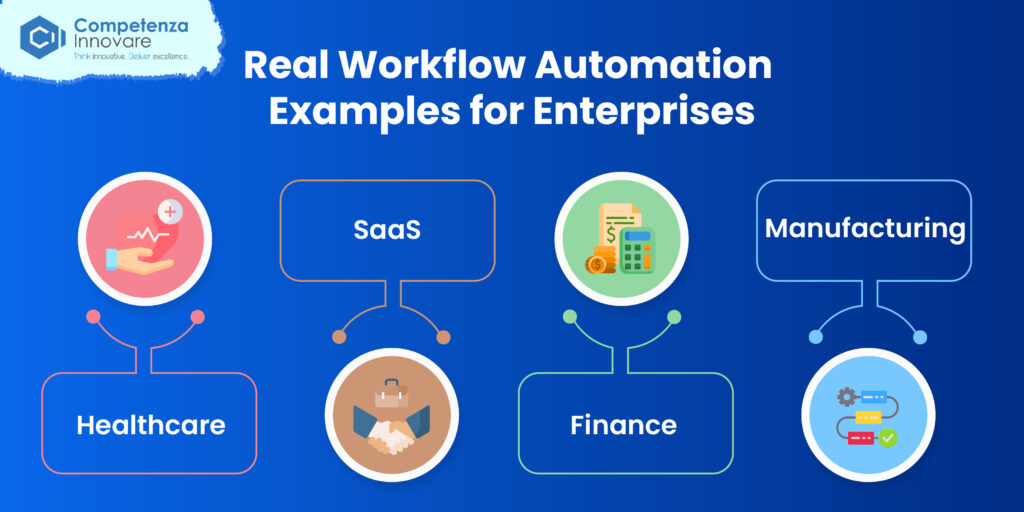
Real Workflow Automation Examples for Enterprises
Automation of workflow assists the companies to automate business processes, minimize manual work, and enhance efficiency in all industries. In fields as diverse as healthcare or manufacturing, all kinds of businesses employ robots to streamline the process and make it better and more efficient every day.
Healthcare
Workflow automation in healthcare continues to enhance healthcare services and cut down on administrative duties in the organization.
Common Examples:
- Patient scheduling
- Claims processing
- Appointment reminders
SaaS
Business automation is employed by SaaS companies to enhance customer experience by scaling their business operations in a relatively shorter period.
Common Examples:
- Customer onboarding
- Support automation
- CRM workflows
Finance
Automation of the workflow can help finance teams obtain lower risks and rewards as well as enhance input through automation of critical processes.
Common Examples:
- Fraud monitoring
- Compliance workflows
- Invoice approvals
Manufacturing
Enterprise automation can be employed in manufacturing businesses to enhance efficiency and optimization.
Common Examples:
- Supply chain automation
- Inventory workflows
- Production scheduling
Examples of these workflow automations demonstrate how companies are automating their business to create faster, smarter, and more efficient operations.
The Future of Workflow Automation in 2026 and Beyond
The future of the automation of the workflow is being determined by AI, intelligent automation, and enterprise automation. Automation is no longer a game as businesses continue to automate their business processes further.
Key Future Trends:
- Hyperautomation – This is where AI is paired with robotic process automation (RPA) and other vigorous technology to automate the business processes.
- AI-First Welcomes – AI will automate the business and make work processes and decisions smarter and faster.
- Predictive Automation – Predict by using data and analytics and automate in real time.
- Independent Enterprise Extensions – Autonomous development of self-management systems with the least human involvement.
Businesses investing in workflow automation and business automation at an early stage will have a colossal competitive advantage in the years 2026 and beyond because of superior performance, a decrease in expenses, and faster expansion.
Ready to automate smarter? Let Competenza transform your business workflows.
How to Choose the Right Automation Strategy
The choice of the correct automation strategy depends on your business requirement, business operations, and the future goal. Each business faces its unique problems, and, accordingly, the corresponding workflow automation solution should allow for ensuring efficiency, scalability, and development. At The Competenza, our work is to help businesses to choose automation solutions to improve their productivity as well as streamline their business processes.
Key Factors to Consider:
- Business Size: Choose automation according to the size and complexity of the business.
- Existing Processes: Busy with manual and repetitive processes.
- Budget: Choose those solutions that can be seen to have business value.
- Technology Stack: Make sure of compatibility with the existing systems.
- Growth Goals: Invest in automation to aid future growth.
The proper business automation plan helps companies to enhance efficiency and lower the expenses and develop smarter businesses.
Conclusion
Automation of workflow is assisting enterprises to become efficient, less manual, and grow faster. From simple automation to AI-based workflows, the appropriate automation strategy can refine the business processes and enhance productivity. Knowing the four categories of workflow automation enables companies to select the appropriate solutions depending on their workflow, requirements, and expansion objectives. Whether business automation will further develop in 2026 and beyond, early investment in it would give the enterprise greater efficiency and reduce its expenses, as well as a competitive edge.
Frequently Asked Questions
What is business workflow automation?
Workflow automation acts of software and AI as well as automation tools to have business processes transitioned with less manual effort. It assists corporations to gain efficiency and minimize redundant processes and work patterns.
What are the four kinds of workflow automation?
There are four workflow automation types: Basic Process Automation (BPA), Workflow Automation (WFA), Intelligent Process Automation (IPA), and Autonomous Automation. Both types enable the different business requirements depending on the complexity of the workflow and the maturity of automation.
What is the significance of automating workflow to enterprises?
Workflow automation assists businesses to enhance the efficiency with which they operate, lower the number of manual works, and decrease inaccuracies, as well as speed up decision-making. It also facilitates scale as well as long-term business development.
What business processes ought businesses to automate first?
First of all, businesses need to automate repetitive processes, rule-based processes, processes that are time-consuming, and high-volume processes. The most common are employee onboarding workflows, customer support workflows, invoice approvals, and CRM updates.
What is the difference between workflow automation and business process automation?
Workflow automation is the automation of tasks, movement, approvals, and notifications, whereas business process automation improves the business processes of the company as a whole in each of the departments.
What are common workflow automations?
The employee onboarding, document approvals, invoice processing, support ticket routing, lead management, and payroll processing are some of the common workflow automation solutions.
What are the benefits of AI in enhancing workflow automation?
AI business automation expands workflow automation; it allows predictive analytics, smart decisions, and optimization of processes. It assists the business with automating more complex workflows.
What industries does workflow automation help the most?
Automation of workflows assists industrial organizations in many aspects, especially due to the significant portions of workflow redundancy and complexity present in the areas of healthcare, SaaS, finance, manufacturing, retail, and logistics.
How does a business choose a suitable strategy of automation?
Some of the factors that businesses should consider prior to picking an automation strategy include the complexity of the workflow, business size, budget, technology stack, and growth goals.
What is the future of workflow automation?
Hyperautomation, AI-first automation, predictive automation, and autonomous enterprise automation are the future of workflow automation. Such technologies will spur intelligent and scalable automation of busine