

Technology continues to evolve at a rapid pace and has started to shape how businesses operate, offer services, and even stay in business. Digital solutions that businesses intend to practice to improve efficiency and hence growth include cloud platforms and robotic solutions, artificial intelligence, and information-driven insights. However, keeping up with the change is not easy, and most organizations continue to contend with outdated systems, paper-based operations, and mounting customer demands.
The successful introduction of new technologies is not the only thing required to adapt successfully to this new digital landscape. It must possess a well-defined plan tying in the investments in technology with the business goals. Digital transformation consulting may come in handy here. With the assistance of experienced consultants, enterprises will be able to analyze their existing ways of operation, discover areas that might be enhanced, and develop effective modernization strategies.
Consultants can assist organizations to make the transformation journey smoother and facilitate their processes, enhance their productivity, minimize their operational difficulties, and provide more positive customer experiences. Having the right digital transformation strategy will enable the business to effectively sail through the technology change and establish a better platform that will allow the business to grow over a long period and remain innovative.
What Is Digital Transformation Consulting?
Digital transformation consulting assists companies to apply technology to enhance their operations, become more efficient, and contribute to their growth. The role of a digital transformation consultant is to analyze the current systems, define the aspects to be improved, and suggest appropriate solutions.
With the digital transformation consulting services, companies are able to revise their processes, embrace the new technologies, and align digital efforts with their priorities. Having access to the right digital transformation services, organizations will be able to change more successfully and remain competitive in a digital-only world.
Why Enterprises Need Digital Transformation Consulting Services
Technology keeps changing, and most organizations are struggling to upgrade their operation and embrace newer digital solutions. Digital transformation consulting services offer the skills required to manage the change effectively, mitigate the risks, and produce improved business results.
Managing Complex Technology Ecosystems
Most businesses are dependent on a variety of software platforms and legacy systems and unlinked tools. Such systems are able to introduce inefficiencies and make it hard to share data across departments. Technology Transformation Consulting helps businesses to enhance systems integration, upgrade old systems infrastructure, and establish a more interconnected technology environment.
Accelerating Innovation
Enterprises need to quickly adapt to new technologies to remain competitive. Digital transformation specialists assist companies to embrace emerging technologies at a higher rate, enhance business flexibility, and act better on the evolving market needs. This underpins successful enterprise digital transformation and long-term growth.
Improving Operational Efficiency
Increased efficiency is considered one of the greatest gains of digital transformation. Consultants assist companies to pinpoint areas in their processes that induce logistic hindrances, streamline their methodologies, and automate the areas that require it. Organizations are able to enhance productivity and invest more in strategic ventures due to the minimization of human-based activities and optimization of operations.
Enterprise technology consulting helps businesses to undertake the change in technology with greater confidence and achieve better performance and establish a better base to succeed in the future.
Common Challenges Enterprises Face During Digital Transformation
Digital transformation brings both great advantages, but nonetheless, there are numerous obstacles that may halt the process and influence the outcome of different organizations. These challenges are the basis of a successful enterprise digital transformation.
- Limitations in earlier Infrastructure: Majority of the businesses still use earlier systems that were not even developed to suit the current business requirements. Such legacy technologies may be costlier to maintain, challenging to re-upgrade, and incapable of meeting the expanding business needs. Consequently, they tend to constrain scalability, as well as decelerate innovation processes.
- Resistance to Organizational Change: Technological change can demand adaptation amongst workers in terms of both new tools and procedures and different ways of working. Certain members of the team might be reluctant towards such changes, and others might not be competent to use new technologies, which are effective. The change and proper training are significant to the successful transition.
- Data Silos and Integration Problems: There are various systems in which data are stored and which lack communication in most organizations. This causes information silos, decreases visibility, and creates difficulties in teams gaining access to accurate information. A major aspect of digital transformation in business is the integration of systems and enhancing the flow of data.
- Lack of Digital Transformation Strategy: In the absence of a clear digital transformation strategy, businesses will not be in a position to prioritize initiatives, allocate resources, and measure success. Failure to step plan properly may result in irrelevant expenditures, time wasted on the project, and other results that deviate from business interests.
By finding and overcoming these challenges in their early stages, organizations may lay a smoother road to successful digital transformation and business expansion in the long term.
Also Read: Agentic AI vs RPA: Which Automation Approach Is Right for Your Business?
How Digital Transformation Consultants Guide Technology Change
Especially to large enterprises, technology change may be complex. Digital transformation consulting services take businesses through this process with a clear plan in place to make sure technology spending is in place to both address today’s needs and strategize new growth.
Assessing Current Business and Technology Infrastructure
Consultants analyze the current systems, workflows, and technology environment prior to making changes. This assists in determining the outdated processes, gaps in running the business, and where an improvement in the process can lead to increased efficiency and business value.
Developing a Digital Transformation Roadmap
An effective change begins with the right direction. Consultants spelled out business objectives, priorities, and the development of a roadmap to be implemented in a stepwise manner and precise schedules. This method enables organizations to be focused and prevent expensive delays.
Recommending the Right Technologies
Depending on the business requirements, consultants will pick the most appropriate solutions to digital transformation. It can be the cloud technologies, automated platforms, artificial intelligence-based tools, or data analytics solutions, which can contribute to greater productivity and decision-making.
Managing Implementation and Adoption
Technology adoption is best when employees and other stakeholders are willing to adopt change. Consultants help to drive training, communication, and risk management plans to help organizations to make better transitions and deliver better.
Technology Transformation Consulting helps companies transform operations, improve performance, and implement digital transformation projects successfully through collaborating with strategy, technical expertise, and change management.
Key Areas of Enterprise Digital Transformation
Successful enterprise digital transformation goes beyond adopting new technologies. It is centered on bettering the way businesses conduct their activities, decision-making, and value delivery to the customers. Some of the most significant areas that transformation has the most effect are given below.
- Business Process Automation: Automation helps businesses to unify processes and reduce the presence of repetitive manual tasks. Routine processes can also be automated so that the business workflow efficiency can be improved and failures minimized and so that the worker can do more useful work.
- Cloud Transformation: Cloud technologies are malleable and can be more salable to growing organizations. They assist companies in maximizing IT expenditure and enhance the system performance and economic access to applications and data wherever a firm wants to support a more connected workforce.
- Modernization of Data and Analytics: Modern companies are based on data to make informed decisions. Modernizing the data management and analytics will enable the organizations to quickly acquire real-time information, enhance reporting, and understand business performance and customer behavior better.
- Customer Experience Transformation: Customer demands keep changing in the digital world. Firms are investing in digital tools and platforms to offer personal experiences to the consumers, generate seamless experiences through which channels communicate with each other, and improve every step of the customer process.
- AI and Emerging Technologies: AI and other emerging technologies help companies generate innovations. These technologies alone assist in reaching more efficient operation and long-term growth based on intelligent automation and predictive analytics and more advanced decision-making skills.
The areas of interest would enable the organizations to accelerate the process of digital business transformation, improve operational efficiencies, and present digital transformation solutions that can enable business sustainability.
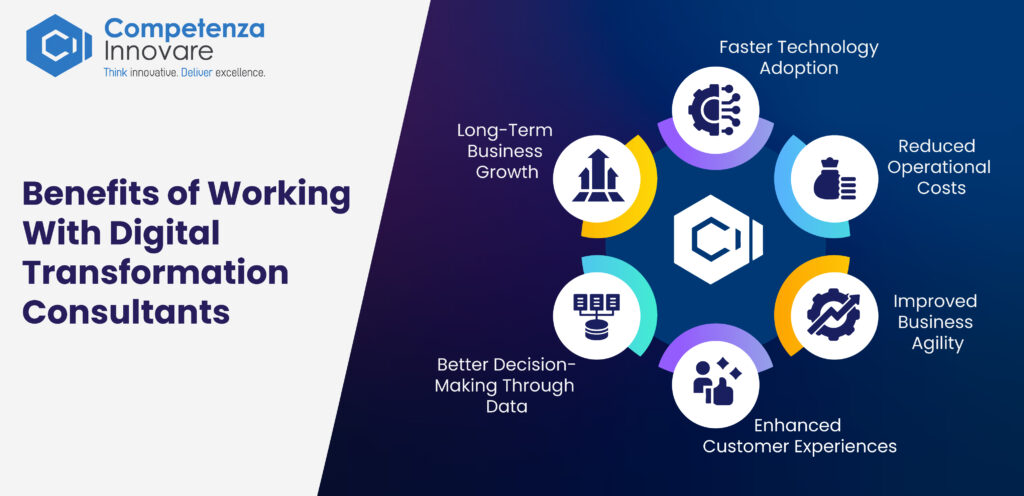
Benefits of Working With Digital Transformation Consultants
Cooperation with experts on digital transformation advisory services could help companies to change the technology transition in a more cost-effective manner and achieve high results. Through their experience and guidance, organizations can be able to modernize operations and decrease risks and create maximum value.
Faster Technology Adoption
Digital transformation consultants assist companies in making general choices and deploying the appropriate technologies more effectively. Their experience helps eliminate delays and facilitates a process of transition to new digital resources and systems.
Reduced Operational Costs
Consultants assist organizations to cut down on manual work, improve on resources, and reduce operational costs in the long term through identifying inefficient processes and automation opportunities.
Improved Business Agility
Contemporary business organizations must learn to be flexible to market dynamics. With the help of consultants, it is able to form flexible technology environments that enable organizations to react quicker to new opportunities and challenges.
Enhanced Customer Experiences
Digital transformation initiatives may also aim at enhancing customer interaction. Systems and process modernization helps businesses to offer ever-smoother, personalized, and correlated experiences through digital channels.
Better Decision-Making Through Data
The consultants help the companies in improving data management and analytics. Availability of real-time, accurate information helps leaders to make improved decisions and see areas of improvement.
Long-Term Business Growth
Effective digital business transformation lays a solid foundation towards future success. Enterprise technology consulting helps companies to enhance efficiency and competitive advantage and ensure sustainable long-term business growth.
These advantages qualify digital transformation consulting as an excellent investment choice for enterprises aiming at streamlining operations and thriving in an increasingly digital business world.
Essential Components of a Successful Digital Transformation Strategy
To have a successful digital transformation strategy, it is more than implementing new technology that is needed. Organizations need a process that is systemic and smoothly advances the business goals and culminates in long-term results.
- Clear Business Objectives – Determine specific objectives and expected outcomes in order to have transformation initiatives that add quantifiable business value.
- Leadership commitment – the management has been quite committed in aiding the change, managing the provision of the resources well, and keeping the transformation initiatives geared towards the organizational requirements.
- Motivating employees – When employees are engaged in the process, they will be motivated to embrace change, they will work together better, and they will resist change.
- Data-Driven Decision-Making – With the help of valid data and insights, businesses will be able to make reasonable decisions and see where to develop.
- Scalability of Technology – Flexible and salable solutions will be picked to ensure that the business is adaptive to future changes and new market segments.
- Continuous Betterment – Digital transformation is a lifelong process. When the processes are regularly reviewed and improved, it assists the organizations in getting maximum returns out of their technology investments.
- Performance Measurement – Monitoring important measurements and results assists businesses in assessing their progress and keeping their transformation undertakings on the correct pathway.
With these fundamental factors, organizations will be able to empower their enterprise digital transformation efforts and build a strong base towards successful digital business transformation.
Choosing the Right Digital Transformation Consulting Partner
Choosing an appropriate partner is a crucial process in realizing an effective digital transformation. The appropriate consultant can assist the companies to minimize risks, enhance the implementation, and enhance the results.
- Industry Knowledge – Find a digital transformation consultant that has worked in your industry and understands its opportunities and threats well.
- Expert Digital Transformation – Choose one partner who has a track record of successful digital transformation initiatives at the enterprise level.
- Technology Capabilities – To ensure that the provider is proficient with current technologies, such as cloud platforms, automation, data analytics, and AI-based solutions.
- Skills in Strategic Planning – A good partner should have the ability to formulate a legal map so that the technology projects will be drawn within the business objectives.
- Change Management Skill – Change will need to be embraced by the workers and organizational readiness. A smooth transition can be facilitated with the help of good change management support.
- Long-Term Support and Optimization – Digital transformation is a constant journey. Locate a partner that makes its offerings of limitless support, performance control, and performance optimization.
Through the right provider of digital transformation consulting services, companies can advance their transformation initiatives, convert technology investments to maximum success, and increase long-term success with professional enterprise technology consulting services.
Future Trends Shaping Enterprise Digital Transformation
Technology is transforming, and companies are shifting towards that to improve efficiency, innovation, and interaction with the customers. Such tendencies are likely to contribute significantly to the future of the digital business transformation.
AI-Powered Business Operations
Through artificial intelligence, organizations are automating processes and decision-making and increasing productivity. More and more businesses are turning to using AI to simplify things and provide more efficient services.
Hyperautomation
Hyperautomation is a compound of automation technology, AI, and machine learning to automate intricate business operations. This helps the organizations in reducing the amount of manual labor, augmenting accuracy, and optimizing the efficiency of the operations.
Advanced Data Analytics
The data is essential in making decisions in modern businesses. Beyond basic analytics technology, advanced solutions offer better understanding of customer behavior, business performance, and market trends and enable organizations to be smarter about strategic decisions.
Cloud-Native Transformation
Cloud-native provides companies with the capacity to develop competitive and lean digital infrastructure. The strategy enhances agility and makes innovation feasible and helps organizations to react fast to varying business requirements.
Intelligent Customer Experiences
Consumers are demanding customized smooth customer experiences. Businesses are leveraging digital technologies, AI, and data insights so that they can design more interesting customer experiences and create better experiences on the various channels.
With the growth in these trends, any organization that invests in the appropriate digital transformation solution and adopts innovation is likely to succeed in the long term. Through highly qualified technology transformation consulting, businesses are in a better position to be more change-oriented and remain competitive in an ever-changing digital environment.
Ready to accelerate your digital transformation? Connect with our experts to build a smarter, future-ready business today.
Conclusion
Digital transformation is no longer an option for businesses that want to remain competitive and expand. When equipped with an appropriate strategy and guidance of an expert, companies will be able to enhance efficiency, shift to new technologies, and establish superior customer experiences. The Competenza assists business parties in the process of managing technology change by offering viable digital transformation solutions beneficial in innovation, business development, and sustainability.
FAQs
What is digital transformation consulting?
Digital transformation consulting services assist companies to embrace and utilize digital technologies to enhance operations, customer experience, and general business performance. Consultants can be a source of advice about strategy and the choice of technology used and the way it can be implemented and improved.
Why is digital transformation important to enterprises?
Digital transformation assists businesses to be more productive, cheap to operate, make their customer experiences better, and compete in a rapidly changing digital environment.
What does a digital transformation consultant do?
The work of a digital transformation consultant is to review the current structures and processes, see ways in which they can be upgraded, design transformation plans, suggest the appropriate technologies, and make it easier to implement and use them.
What are the key areas of digital transformation?
The most common of them include the following: the automation of business processes, cloud transformation, data and analytics modernization, customer experience, and the management of AI and new technologies.
Why is digital transformation consulting service useful to businesses?
Digital transformation consulting services enable businesses to speed up technology adoption, enhance operational efficiency, streamline operations, make improved decisions by data, and facilitate the growth of their businesses over time.
What are the difficulties that organizations may undergo in digital transformation?
The commonest traps include aged systems, organization refusal to change, data segregation, integration troubles, insufficiency of digital skills, and an enhanced digital transformation roadmap.
How is the duration of a digital transformation project?
The time varies depending on the organization size, its goals, and their complexity. These initiatives may be done within several months, and more significant enterprise-wide changes can require several years.
What is the process of the selection of an appropriate partner in digital transformation consulting?
The expertise in the industry, project experience, good technology, strategic planning skills, change management skills, and continuous support services should be sought by businesses.
What are the common technologies of the digital transformation?
Cloud computing services, automation, artificial intelligence, data analytics, business intelligence, and customer experience technologies are some of the other services that organizations seek to transform.
What does The Competenza do to help with digital transformation?
The Competenza assists organizations in the development of effective digital transformation strategies, modernization of business processes, implementation of new technologies, and sustainable development of the business with the assistance of specific digital transformation solutions.