

Software is essential in every business today to operate effectively, and the right solution can be a challenge. The best-known contrast is custom software vs. off-shelf software, where companies have to decide on whether to create a specific solution or purchase a ready-made product. Custom software development aims at designing software tailored to the specific workflow, objectives, and scalability requirements in the long term of a company.
Off-the-shelf software, on the other side, refers to software that is ready to use and is common in the market. Their tools are normally faster to implement, and some need less startup capital, hence being appealing to many small and medium enterprises. The overall cost of software implementation, flexibility, and scalability in the future, however, takes a significant role in the final decision.
Businesses also tend to compare SaaS to custom software and do calculations on the overall cost of ownership to make a decision. Building vs. buying software is determined by the complexity of business, growth strategies, and necessary customization. This blog will make this choice easier and enable you to know when you need to go custom and when going off-the-shelf software is a better choice.
What Is Custom Software?
Custom software is a software application designed to address a single business with a specific set of requirements, workflows, and objectives. It is custom designed by use of custom software development to meet certain issues that cannot be adequately addressed by the available solutions.
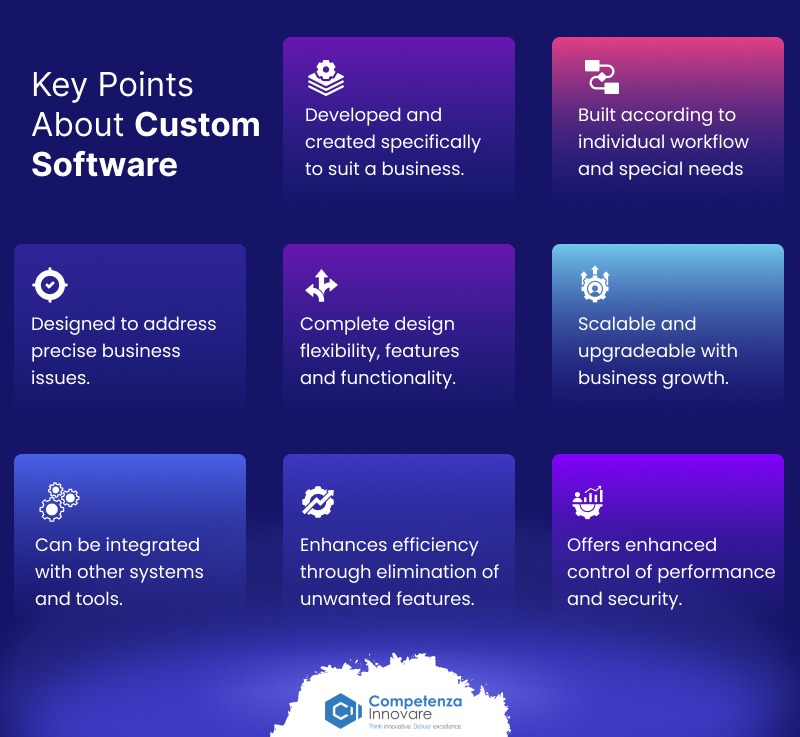
Key Points About Custom Software
- Developed and created specifically to suit a business.
- Built according to individual workflow and special needs.
- Designed to address precise business issues.
- Complete design flexibility, features and functionality.
- salable and upgrade able with business growth.
- Can be integrated with other systems and tools.
- Enhances efficiency through elimination of unwanted features.
- Offers enhanced control of performance and security.
Innovative software is usually applied within industries of medical care, logistics, finance, e-commerce, and management of enterprises where ready options are not sufficient. It assists businesses to operate in a more efficient manner since it is designed precisely around their operations rather than merely making them adapt to a rigid system.
What Is Off-the-Shelf Software?
Off-the-shelf software is a ready-made software solution designed to serve a broad audience and organizations. It is per-built and can be employed without any programming. They are a set of tools designed to address the typical business requirements with subscription or licensing options.
Key Points About Off-the-Shelf Software
- Ready-to-use and immediately available.
- Constructed for general business, rather than workflow.
- Application in the various businesses and industries.
- Easy to put in place and apply.
- Usually offered as a subscription software or licensed software.
- Regular upgrade and maintenance of the vendor.
- Limited customization options
- Relevant to common business processes.
Ready-to-use software is commonly used in regular business functions, which cover accounting, customer management, communication, and project management. It is a simple alternative to the companies that would like to have a cheap and fast solution without the necessity to spend time on its development.
Custom Software vs Off-the-Shelf Software: Key Differences
The primary distinction between custom software and off-the-shelf software is the way the software is created and the way it fulfills business requirements. One of them is that custom software is designed to fit just one business, whereas off-the-shelf software is designed to suit numerous users who have generic needs.
| Feature | Custom Software | Off-the-Shelf Software |
| Purpose | Constructed around one line of business. | Constructed to serve a general market. |
| Customization | Fully customizable | Limited customization |
| Implementation Time | Longer development time | Immediately ready to use. |
| Cost | Higher upfront investment | Less expensive upfront, usually on a subscription basis. |
| Scalability | Very easy to scale up with expansion. | Poor scalability depending on vendor. |
| Integration | Easily integrates with existing systems | May need maneuvers or additional equipment. |
| Ownership | Complete control and ownership. | Vendor owned and controlled. |
| Updates & Maintenance | Controlled by business / development team. | Periodic contributions made by supplier. |
| Flexibility | Very flexible features and changes. | Fixed features with few changes. |
Cost Comparison: Which Option Delivers Better Value?
One of the things that have the greatest importance in comparing off-the-shelf software and custom software is the cost of a business. The initial price is, however, not the only matter of the real decision; it is the long-term value, flexibility, and roil.
Custom Software Costs
- Increased initial investment due to new design and development.
- Includes planning, development, testing, and implementation costs.
- The continuous upgrade and maintenance could involve extra investment.
- No annual subscription costs to use the product.
- Long-term value is incremental with the growth of the business and the reuse of the system.
Off-the-Shelf Software Costs
- Reduced start-up price and fast access to subscription or license.
- Monthly or annual subscription costs.
- Extra costs on top-quality features or users or upgrades.
- Other paid tools can be necessary with customization or integration.
- The price will begin to increase as they are used in business.
Total Cost of Ownership (to)
Off-the-shelf software can seem cheaper in the short run, but this could end up being more costly in the long run with financial periodic charges and limits. Conversely, custom software may require additional initial time investment but, in most cases, may yield better long-term roil because it is tailored specifically to the requirements of a business.
Pros and Cons of Custom Software
When comparing custom software and off-the-shelf software, one should be aware of the advantages and drawbacks of custom-written programs. Even though custom software can be very strong with regard to flexibility and scalability, it is also more responsible in terms of cost and time spent on its development.
Pros of Custom Software
- Tailored to business requirements and functions created based on business processes.
- Extremely add, modify, or remove any time flexibility.
- New scalability to facilitate business growth and expansion.
- Automatic modifications into the existing systems and tools.
- Enhanced efficiency due to elimination of needless functions in generic tools.
- A higher level of security management suits definite business requirements.
- Competitive advantage, such as unique functionality, over the long term.
Cons of Custom Software
- More expensive to write at startup than off-the-shelf software.
- Increased development period was through planning, design, and testing.
- Continued maintenance liability as far as upgrades and improvements are concerned.
- Needs proficient development team or vendor assistance.
- More upfront planning to specify clearly what is required.
Pros and Cons of Off-the-Shelf Software
Comparing custom software with the off-the-shelf software, one should get familiar with the benefits and shortcomings of the ready-made solutions. Off-the-shelf software is very popular in that it is quick to install and inexpensive, yet it does not necessarily fit each business need.
Pros of Off-the-Shelf Software
- Fast deployment because it is deployed instantly.
- Reduced initial expenditure as opposed to in-house software development.
- User-friendly and easy setup by most businesses.
- Routine updates and maintenance by the vendor.
- High reliability, which is in use by many businesses.
- Large support and documentation availability.
- Best suited to the typical business operations such as accounting, cm, and project management.
Cons of Off-the-Shelf Software
- A limited number of customization based on business needs.
- Ongoing subscription or licensing fees, which escalate with time.
- Dependency with vendors on updates, features, and support.
- Scalability constraints of expanding or complicated companies.
- Integration problems with current internal systems.
- Additional expense of premium features or add-ons.
Also Read: How to Estimate a Software Development Project
Custom Software vs. Off-the-Shelf Software: Which Is Best to Choose?
The truthful response is the decision of custom software or off-the-shelf software rests on the place of your business today and your business’s future.
- Off-the-shelf software when you are a small business and you have to act fast and you simply can not afford extended development times. It performs most effectively where what you need is standard and is already well served by existing tools, where budget is a constraint, and the use case is not very mission-critical. It is also an astute decision when you are still validating your business concept and are interested in testing the market before allocating resources towards creating full-blown software.
- Custom software solutions where business processes are unique, intricate, or inefficient to control with off-the-shelf solutions. The reason is that it is more appropriate when your industry is regulated and needs a high degree of adherence or when there are already tools in place that are not satisfying your growth and are becoming ineffective or slow. Custom software is also the best option where you prize complete ownership of your technology stack as a long-term business asset or where you are developing a platform where the software is the heart of your business.
The hybrid approach is adopted in most real-life situations by businesses. They take off-the-shelf software to do common functions such as email or accounting or HR and then develop customized solutions to the processes that can actually make them stand out in the market and generate a competitive advantage.
Need the Right Software for Your Business? Let’s Build a Solution That Scales.
When Should You Choose?
Custom software vs. off-the-shelf software is not a question of which one is superior in general but of which one is suited to your business context and stage of growth. All options offer value in various situations.
When Choose Off-the-Shelf Software
Off-the-shelf software should be used when it is a speedy and simple process rather than customized. It is perfect for start-up businesses that require a quick launch, as it does not consume time on development. It also suits well when your business processes are standard and already there exist existing tools in the market that run them. Off-the-shelf would give you a good place to start in case you are trying out an idea, have a small budget, or the software is not part of your core operations.
When Choose Custom Software
Custom software development is something to consider in case business operations are unique in nature and cannot be fully managed using ready-made solutions. It is necessary when you have to get deep integration in several systems, get stronger data control, or be industry compliant. When the tools you use are slackening expansion or constraining productivity, individual software development will prevent those weaknesses and create a framework tailored to your custom workflow.
Build vs Buy Software: A Simple Decision Framework
The build vs. buy software decision This is the choice to decide to undertake custom software development or off-the-shelf based on your business needs, budget, and long-term plans. Depending on the uniqueness of your processes and the speed at which you require launching, the correct decision will be made.
Buy (Off-the-Shelf Software)
Use off-the-shelf software where you seek a fast and inexpensive solution. It is effective in the case of businesses that have standard needs that are already tackled by existing software such as cm, accounting, or project management systems.
The right decision is also when you are new to business, trying out an idea, or have next to no budget. Ready-made tools can assist you in these situations to jump straight to kick-started fast development without establishing high-cost software development.
Build (Custom Software)
Custom software solutions are selected when your business requirements are distinctive and cannot be completely met by the per-made tools. It is a more suitable choice in case you need more complex integration, automation, or industry-specific options.
Custom software is also very suitable where your business is evolving and the off-the-shelf tools have begun to hamper the performance, flexibility, or scalability of the tools. It provides you with all the access to features, data, and upgrade benefits.
Final Verdict: Custom Software vs Off-the-Shelf Software
Whether you should purchase bespoke software or off-the-shelf software will depend on your business objectives, capital, and where you are in terms of growth. At The Competenza, the suggestion depends on the one that provides the maximum long-term value and scalability to your particular requirements. When you require the speed of an off-the-shelf product and you are on a tight budget with basic functionality, then most early-stage companies would be well-begun with off-the-shelf software. Nevertheless, when your business needs more specific workflows, full integration, and exclusive control of your system, custom software development would be the more viable solution in the long run. It assists you in developing scaled as well as adaptable systems selected for your operations. Competenza tends to suggest a mix-and-match approach of off-the-shelf tools when simple tasks are needed and custom software in the face of core business operations that generate growth and competitive advantage.
FAQs
What is custom software vs. off-the-shelf software?
Specific software is crafted based on businesses with consideration of the unique business workflow, goals, and requirements of a particular business. Off-the-shelf is a recreated solution that is used in the generic application through various enterprises. Flexibility and level of customization are the prime differences.
What does off-the-shelf software mean?
Ready to use software It is off-the-shelf software and ready to be used without any form of development. It is meant to support some standard business requirements such as cm, accounting, HR, or project management. It is typically licensed or subscription-based and employed by numerous companies.
What is custom software development?
Custom software development refers to the creation of software to implement a certain business. It is designed to fit exact workflows, business goals, and business needs. It is also long-term, totally controlled, scaled, and flexible in its development.
What is the best choice between custom and off-the-shelf software?
They will demand the needs of your business, not all of them being the best everywhere. Ready-made software is faster, cheaper, and generic. Fully custom software would be better suited to complex needs, scalability, and long-term expansion of the business.
When does a business desire off-the-shelf software?
Ready-to-use software can best be used in situations where one has need of a fast and low-priced solution. It applies to small firms or startups that have typical requirements. It can help you get things moving quickly, without investing in development.
When can a business use custom software?
Custom software would be suitable when your business processes are unique or complicated. We also need it when you need integration or automation or scalability. It comes in when current tools are restricting your productivity or development.
Is custom software going to be more costly?
Yes, custom software will most probably be costlier to invest in initially since it will be hand-crafted. Nevertheless, it might turn out to be more cost-efficient, as it will remove the subscription fees and make the processes more efficient. It is more likely to provide a higher roil in the long term.
What is SaaS vs. custom software?
SaaS is a subscription software that is based on clouds and is utilized by various businesses. Developed software is created on a one-on-one business basis and owned by the business. Newer SaaS is deployed quicker, vs. where custom software provides more control and customization.
What is the total cost of ownership (to)?
The costs will include setting up the system, licensing, maintenance and upgrades, and scaling, which will sum up to the total cost of ownership. It may seem cheap in the short term but can prove to be costly in the long term since ready-to-buy software is found out to be cheap. Bespoke software can be more cost-effective in the long term.
Is it possible to adopt both custom and off-the-shelf software in business?
Of course, there are quite a number of businesses that adopt a hybrid strategy. They employ off-the-shelf software to carry out routine activities and develop software to adopt major processes. This helps to strike a balance between the cost, pace, and scalability.