

Cloud migration has become essential in today’s IT processes as organizations are pushing for digital transformation at a higher rate. The cloud environment offers the ability to scale apps, data, and infrastructure; cut operational costs; ensure high security; and enable business agility.
But it’s not enough to shift workloads from on-premises to the cloud; it takes a clear plan for successful migration. All applications have specific business needs, technical requirements, and modernization budget considerations. Some workloads can be moved with little modification, whereas other workloads may need extensive changes as part of a wider 7R’ s of app modernization approach. That is particularly true for organizations that have greater complexity in their legacy environment and are embarking on long-term enterprise application modernization projects.
Cloud providers introduced 6 R’s of cloud migration to help businesses assess and transition workloads effectively. Rehost, Replatform, Repurchase, Refactor, Retire, and Retain are strategies for evaluating applications and determining which strategy is best for migrating. It is also a base for road mapping for modern applications and closely models the more recent journey methodology AWS 7Rs, which applies to large-scale cloud transformation projects.
In this guide, we’ll look at the 6 R’s of cloud migration, discuss major strategies like rehost, replatform, refactor, and much more, and dive into why organizations can seize the opportunity for cloud migration and software modernization to drive future growth.
What Is a Cloud Migration Strategy?
A cloud migration strategy is the plan followed by an organization to transition its existing infrastructure (data, applications, services, and other resources) to the cloud. The first step in migration is to develop a sound strategy. The objective is to harmonize the workloads’ migration. from on-premises to the desired cloud infrastructure without affecting availability or affecting day-to-day operations.
The path to the cloud, however, is unique for each organization and doesn’t have a single, standard migration plan. IT assets to migrate are all unique when it comes to their cost, performance, and complexity. That’s not something you can do with all components at the same time. Furthermore, there are certain workloads that can be migrated.
Therefore, the creation of a roadmap to migration addresses all the ‘what, how, and when’ questions of migrating these components. This is where cloud migration strategies come into play. The 6 R’s encompass all the questions of how to migrate your IT asset to the cloud, broadly referred to as the 6 R’s of migration. Each strategy has been briefly explained below with use cases and benefits of having a migration strategy.
Understanding the 6 R’s of Cloud Migration
The 6 R’s of cloud migration will enable organizations to understand how to make the most effective move to the cloud. Business goals, technical requirements, and modernization goals are different among each strategy. Using these six approaches to evaluate applications will enable organizations to develop a migration pathway that considers cost, risk, performance, and scalability.
Rehosting (Lift-and-Shift)
Rehosting, more commonly known as “lift-and-shift,” is the process of migrating an on-premise application to the cloud without making significant changes to the architecture or code. It is the quickest way to reduce infrastructure expenses, scale better, and start their migration to the cloud. Rehosting can accelerate migrations, but those migrations might need more optimization for them to reap the benefits of cloud-native features.
Replatforming (Lift-Tinker-and-Shift)
Replatforming is small changes of an application during migration to enhance performance and efficiency in the cloud. Typical updates include switching to managed database services or containerizing workloads. This scheme is an optimal option to balance between quick migration to modernity and the cost and complexity.
Repurchasing
“Repurchasing” is when a legacy application is phased out for a cloud-based software-as-a-service (SaaS) offering. Instead of modernizing the old system, they switch to a more modern one that offers similar functionality with less upkeep. This can cut down excess overhead in the operation and make use of new features with ease.
Refactoring (Re-Architecting)
Refactoring is about recoding an application in order to optimize its cloud-native capabilities. This can be advantageous in critical applications that require increased scalability, performance, or flexibility. Refactoring requires a longer time and more investment but can create business value over the longer term.
Retiring
Its concept: to identify and remove applications that are no longer necessary. Of course, eliminating unnecessary or unused systems will also cut costs as well as help to make IT management more manageable and help businesses focus on programs that achieve business goals.
Retaining
Retaining is to keep an application in the existing environment and defer its migration. This is usually used in applications that are dependent, have compliance requirements, or are newly created infrastructure investments. These applications can be revisited at a later date if feasible, and it would be beneficial to migrate these applications.
Comparing the 6 R’s Migration Strategies
Choosing the right cloud migration option is one of the 7Rs of application modernization strategies. The 6R’s provide a variety of ways to move and modernize workloads, each with varying business objectives, technical decisions, and costs. For enterprise application modernization, it makes sense to know about these techniques and to define the right application modernization roadmap and minimize the risks of application migrations.
| Strategy | Best Use Case | Complexity |
| Rehost | Quick cloud migration with minimal changes | Low |
| Replatform | Improve performance with minor optimizations | Medium |
| Repurchase | Replace legacy software with a SaaS solution | Medium |
| Refactor | Modernize applications using cloud-native technologies | High |
| Retire | Remove outdated or unused applications | Low |
| Retain | Keep applications on-premises temporarily | Low |
Rehost vs Replatform vs Refactor
One of the most common decisions when on the 7Rs of application modernization journey is the decision of rehost vs. replatform vs. refactor.
- Rehost is the fastest migration option involving the migration of applications to the cloud without changing the existing architecture.
- Replatforming is a small improvement, such as bringing in managed databases or packages, without altering the core application itself.
- Refactoring is the process of redesigning applications to take full advantage of cloud native services, microservices, or serverless.
Compared to rehosting, refactoring can provide the highest long-term value in all aspects of legacy application modernization, including speed. Re-platforming offers a middle ground where there are benefits of modernization but a reduced migration effort.
How to Choose the Right Cloud Migration Strategy
Selecting an appropriate strategy for cloud migration is crucial to a successful app modernization approach. It is really best to know what type of environment you’re in already, what your business goals are, and what budget you have. Carefully considering these factors can help organizations develop a successful application modernization strategy that will enable their digital transformation and long-term growth.
Assess Your Current IT Infrastructure
Look at your current servers, databases, applications and network infrastructure first. Pin down applications’ dependencies, storage requirements, security requirements, and any custom configurations that might affect the migration.
Assessments are a critical part of 7R’s of application modernization process to help organizations decide if to rehost, replatform, refactor, retain or retire workloads. It also illuminates opportunities for legacy app modernization and aids in more effective migration planning.
Define Business Goals
Make sure you have defined your goals before choosing a migration strategy. Talking about cloud migration can mean a reduction in costs, better performance, scalability, enhanced security, or support for innovation.
Migration of enterprise applications should be based upon the overall business goals and future technology needs of the project. In understanding these goals, you can choose the best migration strategy for each of your applications.
Evaluate Costs and Timelines
Each migration strategy has varying implementation timelines, resource needs, and costs. A migration over time and cost, for instance, in a rehost when speed is a paramount consideration, is a more viable option than a refactor, which is longer-term and more expensive.
Considerations for identifying software modernization sustainability include cloud software runtime costs, migration costs, licensing costs, and infrastructure costs.
Select the Right Migration Approach
When deciding on an application modernization strategy, keep in mind the importance of business value, complexity of the app workload, and future scaling requirements. Thanks to the AWS 7Rs migration framework, many organizations can make decisions, and all the migration options are taken into consideration, such as rehost, replatform, and refactor.
Selecting a strategy per application can help level the playing field on both risk and effective use of the cloud and ensure a successful modernization phase.
Building a Successful Cloud Migration Roadmap
A cloud migration roadmap should include a roadmap to move apps and workloads to the cloud and should be part of the goal for app modernization. By implementing a strategic plan, organizations can minimize risk, optimize processes, and maximize the value of their cloud investments.
- Perform a thorough assessment: Perform a full assessment of infrastructure, applications, and their dependencies. It can help you to identify workloads likely to benefit from cloud modernization and direct you about your cloud journey.
- Classify Workloads Strategically: Stratify Workloads in terms of business value and then complexity and migration readiness. Focusing on critical applications first allows organizations to develop a viable path toward achieving application modernization and achieve faster results.
- Plan the migration using phases: package it up and make plans for a migration sequence. A phased approach will only cause little disruption and will allow the project to be completed successfully as well as be easy to manage.
- Test & Validate Extensively: Test it before entering the live environment, its function, performance, security & integrity. This will minimize threats to migration and facilitate an easy transition.
- Reduce Downtime and Business Disruption: Know how to deal with business disruption, backups, failovers, and migration best practices to minimize them in a migration.
- Optimize Costs & Resources: Make sure all workloads are optimally migrated to the cloud. Thanks to software asset management software, a viable investment strategy for software modernization can be realized by eliminating wasteful expenditures.
- Track & Optimize: Once migrated, monitor the application’s performance, begin to use the application, and assess application security metrics, thus identifying optimization opportunities.
- Facilitate LT Modernization Objectives: take or acclimate enterprise applications to best practices with cloud-native services and automation and leverage scalable architectures to future-proof all technology advances.
- Transform for continuous improvement: Endless review of the cloud environment and modernization for continued alignment as needed in response to business & technology requirements.
Best Practices for Cloud Migration Success
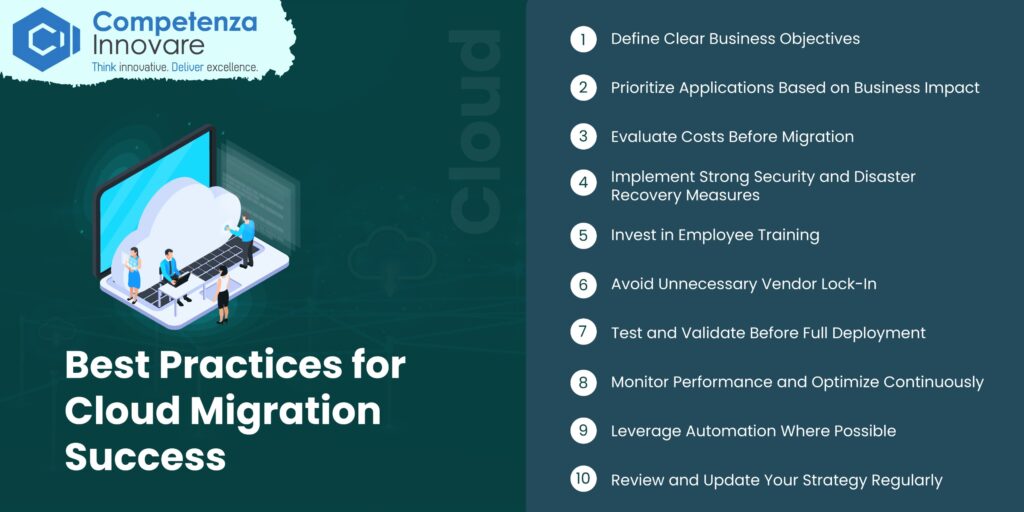
Deciding which cloud migration strategy to take is only the first step. A structured approach is required, matching the technical needs to business needs, so it can help with the long-term application modernization efforts. To mitigate risks, manage costs and make a smoother transition to the cloud, these best practices need to be followed.
Define Clear Business Objectives
The first step to cloud migration is to come up with the goals for the migration. Common goals encompass reduction in infrastructure costs; enhancement of safety measures; expansion of scale and innovation, among others. By comprehensively supporting migration initiatives, their overall 7 Rs of the application modernization plan will help you achieve improved business results and value.
Prioritize Applications Based on Business Impact
Migration can occur at any time. Prioritize application efforts based on information complexity, complexity components, and business value, allowing for a realistic plan for application modernization. Presuming that some applications are more risk tolerant or have more critical value may help in gaining early success without causing too much disruption to your organization.
Evaluate Costs Before Migration
The willingness to accept the financial implications of cloud migration is essential. Prior to migration, estimate costs of migration, resource requirements, expense costs, and licensing requirements. By planning carefully, organizations can create a resilient software modernization strategy without surprises as much as possible.
Implement Strong Security and Disaster Recovery Measures
Security is considered a crucial element in any migration project. Prior to migration, define access control and backup compliance policies and disaster recovery plans. This helps a business to continue in case there is an unexpected disruption to the business and protects vital business information.
Invest in Employee Training
A new skill or process is typically needed for cloud technologies. With multi-cloud deployments in the mix, IT team training can be instrumental in improving overall cloud adoption, reducing operational headaches, and ultimately helping IT departments complete cloud enterprise application modernization initiatives.
Avoid Unnecessary Vendor Lock-In
When choosing a cloud platform, always consider scalability, flexibility, and business needs. This provides flexibility and the ability not to be hammered by any single cloud provider since many enterprises have embarked on the multi-cloud or hybrid cloud model.
Test and Validate Before Full Deployment
Testing is a crucial element of the 7R’ s of application modernization process. Look for performance, security, and functionality before migrating production workloads to the cloud. Think about embarking on a ‘flight test’ to identify issues at an early stage and reduce risks involved with implementation.
Monitor Performance and Optimize Continuously
Cloud migration does not occur in a step; it’s a process. More monitoring of applications after migration for performance, usage, security, and costs. In the future, optimization of the cloud can maximize its value and help modernize out-of-the-box legacy applications.
Leverage Automation Where Possible
One way to address consistency issues, reduce manual work, and eliminate manual errors is to automate multiple migrations. Organizations monitor their automated processes for provisioning, deployment, monitoring, and scaling with efficiency metrics throughout the migration lifecycle.
Review and Update Your Strategy Regularly
Cloud technologies are still evolving and developing. Regular migrations and modernizing goal assessments continuously keep your cloud environment aligned with changing business needs and practices. An organization that has adopted the AWS 7Rs migration strategy typically revisits workloads on a regular basis to look for additional migration opportunities.
Ready to simplify your cloud journey? Talk to our experts and build a smarter migration strategy today.
Benefits of Implementing the Right Cloud Migration Strategy
The 7R’s can help the organizations in their application modernization strategy and goals, and then through an appropriate cloud migration strategy, they can shift their goods to the cloud and move their applications efficiently.
Key benefits include the following:
- Cost savings: Cut down infrastructure, maintenance & operations expenses.
- Enhanced Scalability: Scale up or down as needed for your business.
- Enhanced Performance: Make an application more reliable, faster, and more available.
- Accelerate Modernization: Support modernization & cloud for legacy applications.
- Quick Applications and Update Deployments: Deploys applications and updates in less time.
- Bigger security and compliance capabilities supplied in the cloud.
- Business Continuity: Enhance business disaster recovery and minimize business downtime.
- Simplify Management: Use of managed cloud services to manage the IT system.
- Sustainable Growth: Create a long-term plan for app modernization that enables future innovation.
Plan Your Cloud Migration with Competenza
Choosing the right cloud migration strategy is essential to reduce risk, manage cost, and achieve enterprise success. Leveraging the work done with organizations at The Competenza, this exercise can help you evaluate your applications, identify the most appropriate migration strategy, and decide on a migration roadmap. Whether you’re rehosting or replatforming, or you’re thinking about the 7R’s of application modernization, our experts ensure a smooth migration to the cloud while ensuring you are scalable, high-performing, and growing in the public cloud.
Conclusion
A successful cloud migration begins with the selection of the right migration approach for each application and each workload. The 6 R’s of cloud migration can help organizations have information to consider when deciding on a cloud migration based on cost, performance, and business objectives: rehost, replatform, repurchase, refactor, retire, and retain. From early in your cloud journey to being in the middle of 7R’s application modernization, a comprehensive cloud migration strategy can serve as a way to minimize risk, to maximize efficiency, and to provide an actionable foundation for your future innovation and growth.
Frequently Asked Questions (FAQs)
What are the 6 Rs of cloud migration?
These 6 R’s for cloud migration are rehost, replatform, repurchase, refactor, retire, and retain. These strategies are in place to assist organizations in deciding how to deploy their applications and workloads to the cloud.
What is the Cloud Migration Strategy?
A cloud migration strategy is a roadmap to help you move your applications, data, and infrastructure to the cloud that starts with a plan and helps you minimize the risk, cost, and business disruption.
What’s the difference between rehost and replatform?
Rehosting will transform an application to the cloud with minimal application code changes; replatforming will involve making small changes to an application (e.g., small changes to managed services) to optimize its performance or efficiency.
Which option is better—rehosting, replatforming, or refactoring?
There are many choices according to the goals. The difference between rehosting and replatforming versus refactoring is that rehosting is most expedient, replatforming has a little better ROI (Return on Investment), and refactoring offers the best long-term ROI.
Which cloud migration strategy should I pick?
Analyze existing infrastructure, business needs, application requirements, complexity of business requirements, budget, and expandability requirements to help identify the migration approach for each workload.
How many 7Rs are there for application modernization?
The 7Rs of application modernization is the journey of application modernization from legacy application to modern application on cloud, scalable, high-performance, and maintainable architecture.
What is the AWS 7Rs migration framework?
The AWS 7Rs migration framework extends the well-known 6 Rs philosophy and introduces extra migration choices to help organizations make more informed decisions for migration and modernization to the cloud.
Why is a cloud migration roadmap important?
A cloud migration roadmap is a collection of steps that helps organizations assess, prioritize, and shuttle their workloads to the cloud with minimal risks and to accomplish their modernization goals.
What are the advantages of moving to the cloud?
The cloud migration can offer a range of advantages, such as cost reduction, scalability, security, efficiency, and business expansion.
What is the number one problem on cloud migration?
Independence of applications, security and compliance requirements, cost control, risk of downtime down the road, and migrating complex legacy applications are ubiquitous problems.