
The artificial intelligence systems are advancing, most notably with the emergence of autonomous agents able to think, plan, and even carry out activities independently. The systems constructed by such systems are based on the various Agentic AI architecture types, depending on the way the tasks are handled and implemented. These are the two most used ones known as single-agent systems and multi-agent systems. A general AI agent undertakes the complete task, start to finish. Within a multi-agent system, a set of agents collaborate, each of which specializes in a given aspect of the task. The difference is relevant when designing, scaling, and managing systems in an application.
It is important to learn about single-agent and multi-agent systems, as each of the techniques has its benefits. Multi-agent AI systems are more suitable to complex tasks that involve coordination, collaboration, and distributed decision-making compared to single-agent systems.
The correct agentic AI architecture will be up to your application, including the complexity of tasks, scalability requirements, and systems flexibility. A single-agent paradigm works in certain instances, and in other cases, a multi-agent framework provides increased performance in terms of its AI workflow orchestration and task-specific work.
Through this blog, we will deconstruct both architectures, compare and contrast their differences, and explain how you can know when to employ the multi-agent systems and in which cases to cling to a single agent based on your needs.
What Are AI Agent Systems?
AI agent systems are AI systems that allow software agents to comprehend tasks and decide and perform actions independently. Such agents are made to operate with some degree of autonomy, and that is why they are termed autonomous agents. The fundamental components of these systems are an agentic AI Solutions architecture that determines how an agent thinks and plans, as well as how he/she manages to think and act. It assists the system in simplifying the complex tasks into smaller steps and accomplishing them in a systematic manner.
LLMs (Large Language Models) are some of the most common sources of modern AI agents. Such agents based on the LLM can learn natural language, reason over problems, and plan their next course of action and can be used to automate complex workflows. Simply put, AI agent systems are autonomous decision-making systems capable of planning and carrying out tasks in lieu of merely providing one-time responses. This forms the foundation of the single-agent and multi-agent systems.
What Is a Single-Agent System?
A single-agent system is a type of artificial intelligence (AI) system in which a task is fulfilled to completion by one agent. It involves a barebones process: there is a need to have one model or agent to interpret the input and make decisions and act upon them. This is a single-agent design that is constructed as simplistic and can best suit the situation when operations are not overly complex and when interactions are not required between several systems. In a single-agent system, the decisions made are centralized. It would mean that a workflow is driven by a single agent, which would be easier to maintain and debug. Its movement is normally linear, and an agent will follow a sequence until the task is done.
Key Characteristics of Single-Agent Systems
- One controlling agent handles the entire task
- Linear execution flow from input to output
- Simple architecture with fewer dependencies
- Easier to debug, maintain, and deploy
- Lower system complexity compared to multi-agent setups
Use Cases of Single-Agent Systems
Simple and well-defined tasks are best applied to single-agent systems like:
- Chatbots and customer support assistants
- Basic automation workflows
- Content summarization systems
- Simple Q&A or information retrieval systems
What Is a Multi-Agent System?
A multi-agent system is an artificial intelligence configuration in which more than two smart agents collaborate to achieve a task. There is a designated role of each agent, and they work together to address complicated issues. This multi-agent building is based on a distributed intelligence design, which implies the distribution of decision-making among several agents other than a single system. In this system, work is divided into smaller units, and every agent is assigned a given unit. This allows parallel operation of the system and complex workflows to be dealt with.
Key Characteristics of Multi-Agent Systems
- Multiple agents working together on a task
- Task decomposition into smaller subtasks
- Parallel execution for better efficiency
- Requires coordination and communication between agents
- More flexible but also more complex than single-agent systems
Use Cases of Multi-Agent Systems
Multi-agent systems are best suited when the application to be handled is complex and large-scale, as in the following:
- Complex business process automation
- AI research and analysis systems
- Autonomous coding and development agents
- Enterprise-level AI automation systems
- Multi-step decision-making workflows
Single-Agent vs Multi-Agent Systems (Key Differences)
An overview of single-agent vs. multi-agent systems is relevant in selecting the appropriate AI agent architecture that fits your project. Both are common to present-day agentic AI systems, though they vary in their approaches to tasks, decision-making, and scalability of the system.
Due to the single-agent system having followed a simple model, the agent in charge of the entire process is one. In a multi-agent system, however, the tasks are shared between various agents, and these agents communicate. This variation has a direct influence on performance, scalability, and complexity.
Key Comparison:
| Feature | Single-Agent System | Multi-Agent System |
| Architecture | Centralized | Distributed |
| Complexity | Low | High |
| Scalability | Limited | High |
| Coordination | Not required | Required |
| Performance | Sequential | Parallel |
| Maintenance | Easy | Complex |
| Cost | Low | Higher |
Agentic AI Architecture Explained
The agentic AI architecture is one architecture by which AI systems may be constructed so that agents are able to think, plan, and even perform tasks independently. These systems are step-driven towards achieving a goal rather than merely providing answers. It is the foundation of current AI agent architecture employed in both single-agent and multi-agent systems.
What is agentic AI architecture?
The agentic AI architecture implies the creation of AI systems that are independent. The agent is familiar with a task, subdivides it into steps, and determines how to accomplish it. This enhances the utility of AI in applications in the real world and automation.
How Agents Work in LLM Systems
In contemporary semantic LLM-based agent systems, it is not too complicated. First, the agent has the knowledge of what to do. Thereafter, it strategizes on the next step. Following that, it executes itself with instruments or information. A step-by-step flow can facilitate the orchestration of AI workflows and make the system more structured.
Role of Planning, Reasoning, and Execution
Planning assists the agent to make decisions. Rationality assists it to select that which is correct to do. Execution is the real execution of the task by the agent. The three steps combined facilitate easy work of agents.
Traditional AI vs Agentic AI
Conventional AI just answers and does not look ahead. Agency AIs have the ability to think and plan independently. This gives them more advantages in complex tasks, automation, and current AI agent development systems.
Differently put, agentic AI architecture assists the AI systems not only in answering the questions but also in solving tasks step-by-step. It forms the basis of a single-agent and multi-agent system.
Orchestration in AI Agent Systems
Orchestration within AI agent systems describes how various AI agents, tools, and processes are handled and synchronized to accomplish a task effectively. Orchestration is significant in the current LLM agent architecture to ensure that tasks are performed in the right sequence and by the agents that are appropriate.
What is Agent Orchestration?
The process where AI agents’ development services are governed to cooperate to execute a workflow is known as agent orchestration. Agents are organized by a structured flow of work; each agent has its role. They do not work randomly.
Within AI workflow orchestration, the system manages to assign tasks, perform tasks, and generate completed tasks in a streamlined and structured manner. This is particularly critical in multi-agent systems where coordination among the various agents is needed.
AI Orchestration Layer Explained
The AI orchestration layer is a component of the system, which impacts the interactions between agents, as well as the system with the external tools. It is similar to the layer that controls and decides the following:
- Which agent should handle a task
- When a task should be passed to another agent
- How results are combined
The layer plays a vital role in the scalability of the agent architecture of AI models, particularly in highly automating systems.
How Agents Communicate
Information sharing, results, and task updates are the means through which agents in a multi-agent system communicate. One agent can send data on to another agent to proceed with the workflow. This communication is either direct or is controlled by a central system.
This is an organized interaction that contributes to a better workflow orchestration of AI using tasks or tasks divided into smaller components and managed in parallel.
Role of Coordination Frameworks
A coordination framework is a framework that coordinates the functions of multiple agents. It makes sure that all its agents understand their job and do not have to overlap and replicate each other. The frameworks constitute an important component of framework design and are extensively applied in the agent architecture of LLMs to facilitate multi-agent cooperation and guided decision-making.
To put it in easy-to-understand terms, orchestration in AI systems is what holds all the agents to work together in an organized manner. It is a balance of communication, task flow, and cohesion in such a way that complex problems can be effectively addressed through AI workflow coordination and built agent systems.
When to Use Single-Agent Systems
Single-agent systems are suitable when a task lacks complexity and does not require coordination of a large number of agents. The workflow of a single-agent architecture is directly operated by a single AI agent, which is easier to develop, operate, and maintain. This is a good process that can be employed where the process is linear and it does not require complicated decision-making.
The cost-sensitive nature of a single-agent system is also advantageous in that it consumes fewer resources and less infrastructure than a multi-agent system. They have a long history of application in simple AI agent architecture designs wherein simplicity and speed are of greater value than scalability.
Ideal Scenarios for Single-Agent Systems
Single-agent systems are best applied in practice in situations where users need easy answers like FAQ bots, text summarization engines, and simple automation pipelines that operate in a fixed order. Multi-agent systems are not needed in these use cases, and they do not demand complicated coordination; hence, single-agent systems tend to be an appropriate choice.
When to Use Multi-Agent Systems
Multi-agent systems are also useful in heavy and complicated tasks in which one agent cannot undertake them. Multi-agent architecture involves a group of agents, which perform various tasks within the work. This further enhances the workflow flexibility and power of the system.
These are best suited to multi-step reasoning, application at the enterprise level, and cases involving interaction among agents. Multi-agent AI systems are typically applied in environments that place a premium on scalability, parallel processing, and coordination due to their distributed nature.
Ideal Scenarios for Multi-Agent Systems
Multi-agent systems are typically found in research assistants that combine and process data via many sources, AI programming agents that decompose and solve programs, business process automation systems that process complex workflows, and autonomous decision systems that demand stepwise reasoning and coordination.
Multi-Agent Architecture Patterns
Multi-agent systems apply various patterns of system design to enact the collaboration of agents. These patterns determine the task division, agent communications, and decision-making process in a multi-agent architecture.
Hierarchical Agent Systems
- The agents are arranged in layers such as a worker and a manager.
- An agent of the upper level delegates tasks to agents of the lower level.
- Agents have their subtask toward which they are oriented.
- Typical in organized systems of AI workflow orchestration.
- Applicable in enterprise applications when control is a concern.
Swarm Intelligence Systems
- Several agents operate individually but with the same objectives.
- No control tower; action occurs as a result of cooperation.
- Based on precedents in nature such as ants or birds.
- Good to distribute the problems of AI agent architecture.
- Applied in optimization, search, and large-scale simulations.
Collaborative AI Agents
- Agents are communicative and share results.
- All the agents bring different abilities or functions.
- Performs best in multi-agent AI systems that require collaboration to work.
- Helps enhance precision and performance in complicated activities.
- Usually used in research and multi-step reasoning processes.
Planning + Execution Separation
- A group of agents is interested in task planning.
- A different set deals with the performance of such tasks.
- Helps enhance order and organization in workflow.
- Minimizes the mistakes in coordination systems of the agents.
- Widely used in modern LLM agent architecture systems
So simply, multi-agent systems can be built in various forms based on the case of usage. Others are strictly hierarchical; some resemble swarms, and others are collaborative or isolate planning and execution. Such patterns render multi-agent systems versatile and robust to manage complex AI tasks.
Benefits and Limitations of Single-Agent and Multi-Agent Systems
There are both single-agent systems and multi-agent systems with positive and negative implications in the current AI agent architecture. The appropriate selection hinges on how much ease you require or the degree of depiction in your system.
Single-Agent Systems
Single-agent systems are easy to construct and do not require many agents since the system is performed by one agent through the whole process. This simplifies the system and makes it easier to administer.
- Poor design: The architecture is not complex to implement since it is based on a single controlling agent.
- Simple debugging: There is only one agent involved, and therefore it is easier to track down problems and correct them.
- Poor scalability: Single-agent systems do not fare well in complex or large-scale tasks because any task is dependent on a single agent.
Multi-Agent Systems
Multi-agent systems are better and strong because a team of agents works together in completing work. This enables them to be well adjusted in complex and large-workflow multi-agent AI systems.
- Very scalable: It has several agents that can execute various tasks at the same time, thereby increasing performance.
- Specialization of work: The system is more effective, as every agent will be able to accept a specific job.
- Complex coordination: Agents are required to coordinate and communicate with each other, so the system is complex.
- Increased price: Such systems are more resourceful, infrastructural, and maintainable than single-agent systems.
Simply put, single-agent systems are optimal in simple and low-cost applications, whereas multi-agent systems are optimal in complex and scalable applications. The decision will be based on the needs in your AI agent architecture and the degree of coordination the system needs.
Challenges in Multi-Agent Systems
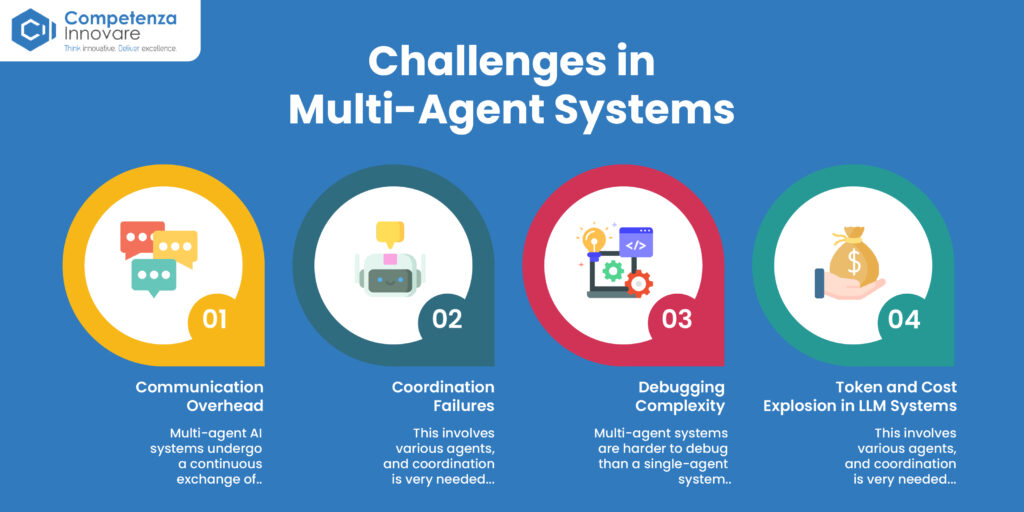
Although multi-agent systems are strong and scalable in the end AI agent architecture, they are also associated with a few challenges. The system is harder to design, manage, and optimize when multiple agents are involved than in a single-agent system.
Communication Overhead
Multi-agent AI systems undergo a continuous exchange of information among the agents to accomplish tasks. This kind of communication generates overhead, which may increase performance in case of excessive messages or interactions. When the system is larger, it is harder to regulate this type of communication, and it may simply cause a decline in efficiency in orchestrating an AI workflow.
Coordination Failures
This involves various agents, and coordination is very needed. When agents fail to align themselves or communicate with the correct information, the workflow may break. Such coordination problems occur frequently in complicated agent coordination structures, most particularly in situations where work is extremely reliant on one another.
Debugging Complexity
Multi-agent systems are harder to debug than a single-agent system since the agents are operating simultaneously. Whenever an issue arises, it is not always evident what agent caused the problem. This increases the troubleshooting time in complex LLM agent architecture designs.
Token and Cost Explosion in LLM Systems
In agent systems that are based on LLMs, every agent can utilize tokens to process reasoning, communication, and execution. In cases where there are several agents in operation, there is high token consumption, which results in the increased operation cost. This is a significant issue in the large-scale AI workflow orchestration and enterprise.
Simply put, multi-agent systems are more complex and powerful to manage. They are difficult to optimize due to issues such as overhead in communication, lack of coordination, difficulty in debugging, and increased cost in AI agent architecture.
Decision Framework (How to Choose)
The decision between single-agent systems and multi-agent systems is based on your task and system requirements in AI agent architecture.
- Task Complexity: Simple tasks are easy with only one agent. Multi-agent systems are more appropriate in complex tasks requiring several steps to be taken.
- Workflow Steps: In the case of a linear workflow deployment, a single agent. When there are multiple actions or steps to be performed simultaneously, its architecture should be multi-agent.
- Cost: The single-agent systems are cheap and easy to implement. Multi-agents are also more costly, as they need additional processing and coordination.
- Scalability: Simple to intermediate tasks can be used with a single agent. Multi-agent systems provide more scalability to AI workflow orchestration at scale and at the enterprise level.
A single-agent system is a simple system that deals with low-cost work, and a multi-agent system is complex work that is scalable.
Hybrid Approach (Best of Both Worlds)
Hybrid AI agent architecture is a two-way approach in AI-based agent architecture that brings the two features of simplicity and scalability together. Systems do not pick either and employ both based on the types of tasks required.
When to Combine Single + Multi-Agent Systems
A hybrid model would come in handy when one side of the work is easy and the other one is complex. Single-agent systems are simple tasks, whereas multi-agent systems are complex processes with multiple steps. This will aid in efficiency without unnecessary complexity everywhere.
Practical Enterprise Scenarios
Customer support, data processing, and automation pipelines often employ hybrid systems in the real-world enterprise AI workflow orchestration. E.g., one agent can be used in the simple user queries, and several agents can collaborate in more intricate analysis or decision-making processes.
Orchestration Between Both Models
In a hybrid system, a layer called orchestration is in charge of the interaction between single-agent and multi-agent AI systems. It determines what work only one agent gets and what needs more than one agent. This enhances flexibility, performance, and cost-effective systems in the large-scale systems.
A hybrid model is based on the simplicity of single-agent systems and the strength of multi-agent systems. It is a popular approach to enterprise AI agent architecture, as it balances performance, cost, and scalability.
Conclusion
Both single-agent systems and multi-agent systems play a key role in modern AI agent architecture. Single-agent systems are cheap, easy, and suited to simple tasks, whereas multi-agent systems are more suitable to challenging workflows that involve coordination, scalability, and AI workflow orchestration. In most real-life situations, a hybrid solution is tolerable since both systems are shared with respect to the task needs. Proper choice will rely on your use case, complexity, and the levels of scale required. The Competenza can help businesses efficiently and intelligently develop scalable AI solutions with the appropriate agent-based systems to realize their goals.
FAQs
What is the difference between a single-agent and multi-agent system?
Single-agent systems are those that involve one AI agent to carry out the full task as compared to multi-agent systems that have more than one agent. Single-agent systems are less complicated, whereas multi-agent systems are more suitable to complex workflows and scalable architectures of the AI agents.
What is the purpose of a single-agent system?
Simple work, such as chatbots, frequently asked questions, content summarization, and simple automation, should be done under a single agent system. It performs optimally when the workflow is linear, and the process does not involve the coordination of several agents.
When should I apply a multi-agent system?
Multi-agent systems are suitable when dealing with complex tasks like automation of an enterprise, AI investigations, code agents, and decisions through multiple steps. These are best in cases where you require teamwork and sophisticated AI workflow management.
What is agentic AI architecture?
Agentic AI architecture This is a system design in which AI agents are able to think, plan, and execute tasks on their own. It forms the basis of single-agent and multi-agent systems that are applied today in AI.
What are the advantages of multi-agent systems?
Multi-agent systems have high scalability, division of tasks, and enhanced performance of complex workflows. They are very popular in the progressive AI agent systems where multiple processors have to engage and coordinate.
What are the issues of multi-agent systems?
The primary issues could be the overhead in communication and issues in coordination, the complexity of debugging, and the high cost because of the increase in the usage of tokens achieved through the introduction of the LLM-based systems.
What is AI workflow orchestration?
AI workflow orchestration involves the management of AI agent interactions, task allocation, and workflow execution to enable workflow completion in an efficient manner. It promotes good coordination among the single- and multi-agent systems.
Is it possible to have both single and multi-agent systems interact?
Yes, there is a combination system used in most of the existing systems. Simple jobs are handled by one agent, whereas complex jobs are handled by many agents to be more scalable and be able to perform well.
Which is better: single-agent or multi-agent system?
Neither is necessarily better. Multi-agent systems are more helpful with complex and scalable applications, whereas single-agent systems are more helpful with simple and low-cost task solutions. It depends on your system requirement