

Build vs. Buy Agentic AI has been listed among the most significant technology choices businesses will need to make in 2026. Organizations are investing in customer support, workflow automation, analytics, operations, and decision-making AI agents, yet numerous leaders continue to pose the same query: Should you build or buy AI agents?
Others have a preference for in-house agentic AI or use a platform in the form of speed and budget. Others opt to use custom agentic AI vs. platform solutions since they require more integration and security or offer a competitive advantage. The difficulty lies in the fact that both options may be more than successful as well as fail when selected due to a mishandling of reasons.
This guide contrasts custom agentic AI (versus off-the-shelf agentic AI options) and costs and risks and offers you a practical framework to choose whether to develop in-house. Agentic AI or a platform, depending on your business.
What Is the Build vs. Buy Decision in Agentic AI?
In the context of agentic AI, the decision to build or buy is either developing your own agentic AI agents directly or substantially using your own engineering capabilities versus purchasing an existing agentic AI platform as an agent framework, orchestration layer, tool integrations, and management infrastructure.
It differs with the wider adoption of AI decisions. You have already decided to use agentic AI. The question here is whether you arrive at that by developing proprietary systems that your organization owns and maintains fully or by installing a platform that has been developed by yet another party that your organization configures, customizes, and executes upon.
Both channels have the potential to generate competent, production-quality agentic AI. The difference lies in what you sell to get there.
What Is Custom Agentic AI Development?
Custom agentic AI development refers to the process of your engineering team, in-house or an expert development partner, designing and creating AI agent systems that directly match your business processes, data environment, and operational needs.
Custom agents are usually created based on open-source architecture, like LangChain, LlamaIndex, AutoGen, or CrewAI, as technical underpinnings, and proprietary orchestration logic, tool integrations, memory systems, and governance controls are implemented over it. The large language models behind it could be commercial (GPT-4, Claude, Gemini) or open-source (Llama, Mistral) and can be served either through an API or self-hosted based on data privacy needs.
Custom development provides you with a system that is designed specifically around the way your business operates, your data model, your business processes, your security needs, and your brand voice as opposed to having to fit your business to what a platform offers you.
What Are Off-the-Shelf Agentic AI Platforms?
More rapid deployment, more capabilities, reduced ownership.
Agentic AI platforms are products in commerce that offer delivered infrastructure to deploy, run, and scale AI agents. Examples are Microsoft Copilot Studio, Salesforce Agentforce, ServiceNow AI Agents, and Google Vertex AI Agent Builder and a rapidly expanding number of specialist platforms, including Relevance AI, Voiceflow, and Letta.
Such agentic platforms offer the orchestration layer, tool integration library, memory management, monitoring dashboards, and deployment infrastructure by default, greatly lessening the amount of engineering needed to get agents into production. You are configuring and customizing within the scope of the platform, as opposed to working on first principles.
The trade-off is that you are able to operate within the platform architecture, price model, integration constraints, and roadmap priorities but not be in control of all of the elements.
Build vs. Buy Agentic AI: The Core Trade-offs
The dimensions that establish the course of action that would be logical to your organization.
Control and Customisation
Custom agentic AI provides absolute control over agent architecture, memory systems, access and tools, decision logic, and all other aspects of the system. Unless your business operations are simple, proprietary, or highly differentiated, in the event that your competitive advantage resides in the way that your operations work, that control is truly valuable.
AI agentic platforms provide customization, albeit to a considerable degree. The vast majority of enterprise-grade platforms are now capable of custom tool integration, configurable prompting, and workflow-specific logic. But the ceiling is there. When a platform lacks, does not have, or does not support a particular architecture pattern that you require, you can either work around it or provide a different architecture pattern or accept the constraint.
Speed to Production
Here, agentic AI platforms are easily victorious. An agentic AI workflow on production grade can run on an established platform with existing integrations with CRM, ERP, ticketing, communication, and other data systems just a few weeks away.
Developing a custom agentic AI using proper methods and methodical testing, security examination, and reliability design should require months. For organizations in a situation where they must show AI competence sooner than their competitors, whether due to competitive policies, board pressure, or market timing, the shorter duration between creation and purchase will be a real business factor.
Cost Structure
The cost to build agentic AI in-house and to purchase a platform appears quite different at varying time scales.
Platform costs are fixed in format, commonly charging users, agents, or operations, and may increase very rapidly as a function of scale. Inexpensive platforms at pilot scale tend to become costly at scale, and multi-year platform contracts result in vendor dependence that is very hard to escape.
Custom agentic AI development incurs more initial costs in terms of length of engineering time, infrastructure, and maintenance but no platform fees on a per-transaction basis. On the one hand, the platform pricing approach can be unsound, which is why in the organizations with high agentic workflows, the long-term microeconomic perspective of custom development is sometimes superior to the platform option despite the significant initial costs.
A realistic example: a commercial-grade custom agentic AI system that has a single high-volume application could cost between $150,000 and $500,000 to develop and $50,000 to $150,000 per year to run. A similar platform solution could cost between $30,000 and $100,000 to set up and install but $100,000-$400,000 a year in platform charges on an enterprise scale. The break-even point is very dependent on the volume, complexity, and time intended to operate the system.
Data Privacy and Security
The data-handling properties of agentic AI platforms are of immense importance to organizations in regulated sectors, such as financial services in the US and UK, enterprises subject to HIPAA regulations, and government contractors with data sovereignty policies.
Aggressive agentic AI may be custom-built at the beginning so that the information remains fully in your surroundings. There is no data that abandons your environment unless you expressly plan when. This is the most robust data privacy and compliance posture.
Platform deployments are quite different. Most enterprise solutions come with a private deployment model, data processing contracts, and compliance standards, but requires at least some of the computing is to be reliant on the security measures and data protection methods of the vendor.
In the case of organizations in the EU with GDPR and UK companies with ICO control or US healthcare organizations with HIPAA, data-handling due diligence of the deployment on any platform must be exhaustive and documented.
Scalability and Performance
You have full control over how your custom AI agent systems are implemented such that they can be scaled to any volume in advance; you can do horizontal scaling, efficiently built inference infrastructure, caching layers, and cost-efficient model selection.
The scalability of the platforms is based on the infrastructure of the vendor. The majority of enterprise platforms are built to scale to high operations, whereas bottlenecks at the platform level, rate limits, process queues, and common infrastructure can impact production performance in aspects you cannot directly control to fix.
Vendor Lock-in Risk
Any agentic AI platform generates a level of dependence on vendors. Proprietary platform abstractions, agent configuration in vendor format, and integration based on platform-specific APIs can all at best be hard to migrate off of in case the vendor prices out, features are abandoned, or the vendor is acquired.
The custom agentic AI, which is based on open-source, can be more portable by its very nature; code, models, integrations, and the data will always belong to you. This does not remove the factor of dependency on commercial LLM APIs but spreads out that dependency.
Also Read: Single-Agent vs. Multi-Agent Systems: Which Architecture Fits Your Use Case?
When to Build Custom Agentic AI
The situations in which the in-house agentic AI development is always more successful.
Your processes are really their property: In case your competitive advantage is in the way your processes operate, the essence of your approval logic, your model of interaction with your customers, or your data pipelines, no platform will recreate that very closely. The only way to get an agent that really represents you and not a generic version of your business is to have the agent developed custom.
Third-party processing is barred by data privacy requirements: The data processing boundaries of platform deployments may be both commercially and legally restrictive to financial institutions, healthcare providers, and defense publishers in the US, UK, EU, and APAC. The only possible construction that meets all the requirements of the strictest data sovereignty is the custom development with self-hosted models.
You have a high workload: Agentic AI workflows with millions of transactions or interactions each month: In most platforms, the cost structure of operations per operation becomes much more expensive than owning the infrastructure. When sufficiently large, the build math usually wins.
You already have AI engineering capacity: Organizations that possess good AI engineering—data scientists, ML engineers, and software architects who have worked with LLM systems—can develop and maintain bespoke agentic AI at substantially lower cost than organizations that do not. Whenever there is capability, it is usually cheaper to utilize the capabilities productively than to pay platform fees forever.
The end is long-term differentiation: When agentic AI is a strategic capability, not a move to automate something but to develop proprietary AI-based products or services, custom development yields property that you own, control, and can compound over time.
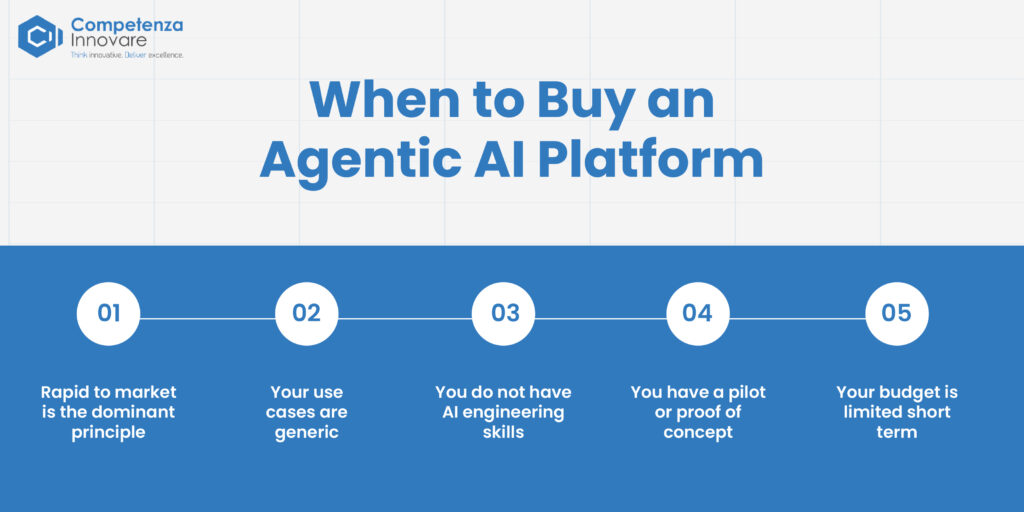
When to Buy an Agentic AI Platform
The situations in which platform deployment tends to evidence better ROI.
Rapid to market is the dominant principle: When proving agentic AI prowess in a brief timeframe to end-users, to the board, or to the market is the main goal, no development system procurement can provide beneficence as rapidly as a prudently picked platform rollout. Weeks to production cannot be done out of thin air.
Your use cases are generic: Customer service intelligence, knowledge search within an organization, document intelligence, IT service intelligence, and sales processes intelligence are all exquisite examples of use cases that enterprise agentic AI systems can address effectively. In the event that you are automating a standard business thing and not a proprietary one, the limit of customization of a platform is seldom achieved.
You do not have AI engineering skills: Agentic AI development Custom agentic development: DARPA has identified that certain expertise is needed to build an agentic AI: particular skills (agent orchestration, reliability engineering, and continuous model management) that many organizations do not have and cannot acquire quickly. The prerequisite engineering is minimized by platform deployment.
You have a pilot or proof of concept: It is always a good idea to test whether agentic AI is and can be useful in a given use case before investing in it on a full scale. That test can be performed in the quickest and least expensive way using platforms. In a scenario where the use case is justified, you are able to re-examine the build vs. buy decision with actual performance data opposed to estimations.
Your budget is limited short-term: In the case of organizations where capital spending is down and operating spending is more easily accessible, platform subscription pricing is frequently the only commercially feasible way to get agentic AI into production anywhere at all.
The Hybrid Approach: Build on Top of Platforms
The direction that most enterprise organizations are taking.
Practically, build vs. buy agentic AI decisions no longer remains binary. The hybrid model, where platforms are used to deliver standard, non-differentiated use cases and to develop a custom agent to serve the workflows that are very proprietary or face irrational constraints because of the platform restrictions, is the most prevalent business model in 2026.
A financial services company may use Salesforce Agentforce to automate standard CRM and develop its own agents to perform risk assessment processes that operate on self-hosted models within its own secure infrastructure. A patient scheduling application could be a platform that a healthcare organization uses to schedule patient appointments while also developing bespoke agents that can conduct clinical documentation workflows that may not interface with external systems.
This hybrid agentic AI approach takes advantage of speed-to-production attractiveness in systems where it is most cognizant, without losing the control and differentiation that purposeful development offers to the use cases where it is actually required.
Also Read: Agentic AI vs RPA: Which Automation Approach Is Right for Your Business?
Build vs. Buy Agentic AI: Decision Framework
Six questions identifying the correct path to take your organization to ensure decisions are made on whether to use a custom-made or prebuilt agentic AI platform.
| Question | Build | Buy |
| Is the workflow proprietary or differentiating? | Yes | No |
| Do data privacy requirements prevent third-party processing? | Yes | No |
| Is speed to production the primary priority? | No | Yes |
| Do you have AI engineering capability in-house? | Yes | No |
| Will you operate at high volume long-term? | Yes | No |
| Is upfront capital expenditure constrained? | No | Yes |
When you find that your responses lie mostly in the Build column, then custom agentic AI development is probably the correct course of action. When they lean much to the buy side, an actual deployment of a platform will provide a higher ROI. When mixed, which is the most frequent case, a hybrid approach should be given strong consideration.
Ready to choose the right Agentic AI strategy? Talk to our experts for tailored guidance.
Common Mistakes in the Build vs. Buy Decision
Scaling platform costs down: Platform prices that are cheap on a pilot program become costly on a volume basis. Also adjust the cost of ownership per user, per agent, and per operation, including three years’ total cost of ownership, before using any platform.
Extrapolating in-house potential: Construction of production-scale agentic AI is significantly harder than construction of a proof of concept. Organizations that have successfully completed an LLM demo often drastically underestimate the engineering effort needed to make a system reliable, secure, and maintainable on a production scale.
Selecting a platform without considering data handling: Data residency, processing location, subprocessor disclosure, and breach notification requirements all should be considered within the context of your regulatory needs prior to entering into a platform contract, not afterwards.
Creating a custom one where a platform will do the following: Custom development is not required in all agentic AI applications. Organizations that cannot engineer and take several months to build what a platform can provide in weeks are not winning but rather postponing the value creation process.
Disregard of the talent requirement: The talent implication of both paths. Platforms need individuals who comprehend the platform intimately, which might not be general software development. LLM engineering is needed in the custom development. Consider factors like talent availability and cost.
Conclusion
There is no general right answer to the build vs. buy agentic AI decision, but there is a right answer in your organization, your use cases, your data requirements, and your commercial position. The framework herein this guide provides you with the structure to locate it.
Begin with privacy of data and regulations; this will rule out any other form of evaluation even before any such analysis is done. Then consider the level of workflow differentiation in your target scenarios. Then fairly present the model three-year total cost of ownership with the talent cost on the build side and the scale cost on the buy side.
The solution in 2026, in the majority of organizations, is a form of hybrid platforms where they are appropriate in mission or purpose and where true differentiation or data control is needed. Those organizations like The Competenza that can think well about it will use money better than those that allow themselves to become trapped by single-mode approaches.
Frequently Asked Questions
How is it different between the construction and purchase of agentic AI?
Developing agentic AI custom involves creating agentic systems owned and fully controlled by your organization. Buying implies the deployment of a commercial platform that offers ready pre-built infrastructure that is configured and customized.
What is the price of developing agentic AI internally?
A production-level, single-purpose application agentic artificial intelligence system in a high-volume application generally costs $150,000 to $500,000 to develop and $50,000 to $150,000/yr to support. Prices will differ widely according to complexity, the team composition, and the models and infrastructure in the question.
Which agentic AI platforms are best for business?
In 2026, the main enterprise agentic AI platforms will be Microsoft Copilot Studio, Salesforce Agentforce, ServiceNow AI Agents, Google Vertex AI Agent Builder, and specialized platforms, such as Relevance AI and Letta. The correct option is based on your technology stack, data needs, and desired use cases.
When is it better to develop custom AI agents rather than a platform?
Write your own AI agents when the workflows are truly proprietary; the data privacy necessities cannot be processed by third-party agents; your workload is high; and unit economics on platforms are unfavorable, or when differentiation as a business strategy is strategic through proprietary AI capability.
What is the risk of building vs. buying agentic AI platforms?
These risks are most associated with the vendor lock-in processes and platform integrations based on proprietary platform abstractions, which are challenging to migrate and cost an explosion at scale. Nonspecialized risks in custom development are the complexity of the engineering underestimation and the fact that the talents needed to maintain that development will be required.
Can we have a hybrid agentic AI approach?
Yes, and it is the most typical way of enterprise. The practice of deploying standard and non-differentiated workflows using custom agents deployed to proprietary workflows offers both the speed of deployment of what is critical to platforms and the retention of control and differentiation where it truly counts.
What is the impact of data privacy on build vs. buy agentic AI decisions?
In regulated industries, financial services, healthcare, government, or systems operating under GDPR, HIPAA, or other types of data sovereignty, they must carefully undertake due diligence on the data handling peculiarities of their platform deployments. The only way towards total data sovereignty is custom development with self-hosted models.
What is the time frame to develop custom agentic AI versus a platform?
With typical applications, it can take weeks or even months to have a production-grade platform deployment. The development of a custom agentic AI designed to be production (or other) quality and tested, security checked, and reliability engineered normally requires three to nine months based on complexity.