

As technology continues to change, most organizations would realize that their old-fashioned application cannot match the demand of the business world. Older systems are also likely to increase the maintenance costs, reduce innovation, increase security threats, and decrease scalability. This is why it is necessary to have a proper application modernization checklist, which CTOs can use when intending to modernize their application environment.
A clear application modernization plan enables organizations to evaluate current applications, focus on modernization effort, and develop a roadmap to support long-term business objectives. Alternatively to actual overhauling of an entire system, CTOs can adopt a gradual integration that helps alleviate the risk, enhances business operations, and brings about more value to the business.
In this guide, we will discuss the necessary phases of the application modernization process, such as evaluation of the legacy systems and development of the appropriate strategy for application of best practices. Whether you are beginning your initial modernization program or are updating your current solution, the following is a checklist that will assist you in making quality decisions and creating a scaling, future-proof application ecosystem.
What Is Application Modernization?
Application modernization is the procedure that is carried out to upgrade and enhance the performance, security, scaling, and compatibility of the old applications with the recent technologies. Cloud-native architecture, APIs, microservices, and containers, as well as DevOps practices, are being used by businesses to add to existing applications to meet evolving business needs rather than replace an entire system.
To reduce maintenance costs, increase their agility, and prepare their applications to be the object of AI-driven innovation, different organizations are fond of modernization. Migration takes an application and places it into a new environment, and modernization makes the architecture and functionality of the application better. Equally, rebuilding begins at square one, and modernization references business logic and data of value.
By using the right application modernization services, companies can evaluate legacy systems, articulate a clear modernization strategy, and create scalable and future-ready applications to drive long-term growth.
Why CTOs Need an Application Modernization Checklist
Application modernization to CTOs is not just a technology upgrade but a strategic investment that underpins business expansion, enhances business efficiency, and lowers risk in the long term. An explicit application modernization plan assists in prioritizing the appropriate applications, optimizing the resources, and making sure that the modernization initiatives generate quantifiable business benefits.
Reduce Technical Debt
Most legacy applications use old frameworks and software that are not supported but add new costs to maintain and develop them. Moving towards modern systems can contribute to decreased technical debt and easeful maintenance and allow development teams to concentrate on innovation rather than on addressing old problems.
Improve Security & Compliance
The older applications may not have up-to-date security measures and might not comply with the updated policies. The advantages of modernization include enhanced identity and access management, the underpinning of Zero Trust security principles, enhanced data protection, and assisting organizations in meeting the industry regulations.
Accelerate Innovation
DevOps and continuous delivery practices in modern applications allow software releases to be made faster. They also facilitate the inclusion of new technology like AI, automation, and high-end analytics to enable businesses to swiftly react to evolving customer and market demands.
Increase Scalability
As the business expanded, the applications needed to be able to meet the growing workloads without compromising the performance. Modernization of the enterprise applications helps in enabling cloud infrastructure, Kubernetes, and elastic scaling of the applications to help them address the business needs of the organization and remain reliable and efficient.
The Complete Application Modernization Checklist for CTOs
An effective modernization initiative demands proper planning, appropriate selection of technology, and constant enhancement. This application modernization checklist assists CTOs in developing a realistic application modernization strategy that reduces risk and helps the business grow over time.
Define Business Objectives
Begin by deciding what you have to attain by modernization. There are some examples of what you would like to accomplish, such as enhancing the experience of the customers, reducing expenditures on infrastructure, a shorter release cycle, and enhanced security facilitated by AI. Business priorities and modernization will be backed by the use of simple targets.
Prioritize Applications
All applications do not have to be updated simultaneously. Thoroughly analyze an application portfolio to determine the relative worth of each system on business value, technical complexity, risks, and benefits projected by ROI. This helps in giving priority to those projects with the greatest impacts.
Choose the Right Modernization Strategy
The degree of the state of your application and the demands of your business condition determine the selection of the approach. Some of the strategies that can be included in your application modernization roadmap include the following:
- Rehost: Migrate the application to the cloud with minimum modifications.
- Replatform: Do slight enhancements during the move to a modern platform.
- Refactor: Make changes to the current code to enhance performance and scalability.
- Rearchitect: Repackage the application to be cloud-native and operated as microservices.
- Rebuild: Develop the application using the modern technologies.
- Replacing: The retirement of a SaaS or commercial solution.
- Retire: Drop out of the business-focused applications.
Design a Modern Architecture
Design scalable and flexible applications with the use of microservices, event-based architecture, APIs, containers, Kubernetes and serverless. These new designs are more reliable and revised subsequently.
Plan Your Cloud Migration
Choose the most appropriate cloud provider for your company between AWS, Microsoft Azure, Google Cloud, or hybrid clouds. Cloud & DevOps Services can be used when mapping your cloud migration to create a secure and scalable migration roadmap.
Modernize Databases
Test the existing databases that you have and decide on SQL or NoSQL depending on the current workloads based on the modern workloads. Protect data and information that is classified as secure; duplicate and store data and retrieve data in case of disaster so that businesses do not go offline.
Implement DevSecOps
Incorporate security into all phases of development through adoption of practices of DevSecOps. CI/CD pipelines must be automated, and Infrastructure as Code (IaC) must be utilized as well as continuous testing to develop software at a high rate without compromising security. Get familiar with how the DevOps consulting services are the ones that could aid in your simplified process of development and deployment.
Strengthen Security
Prevent the usage of outdated applications with zero trust principles, identity and access management (IAM), multi-factor authentication (MFA), encryption, secrets management, and API protection. Security should be borne in mind when undertaking the modernization lifecycle and not just occasionally.
Optimize Performance
Improve application responsiveness by adding autoscaling, content delivery networks (CDNs), caching, and load balancing. The optimizations aid in sustaining performance in peak traffic as well as assist in business development.
Perform Comprehensive Testing
Complete functional, performance, regression, and security testing and user acceptance testing (UAT) of every application used before deployment. Massive testing helps identify issues early, as well as reduce the risk of issues during the deployment.
Enable Continuous Monitoring
The observability tools allow monitoring of the health of applications by monitoring real-time alerts and logs, application performance monitoring (APM), and metrics. Having the teams monitor at all times helps the teams to identify and rectify problems before they reach the users.
Upskill Your Teams
Train on cloud technologies and DevOps, Kubernetes, and modern-day development tools to prepare the developers and operations teams. Competent teams can manage and optimize the modern applications effectively.
Continuously Optimize
Application modernization is not a project but rather a continuous process. Periodically review the performance of applications, security, costs, and business requirements to maintain your systems as effective, sound, and ready to enhance more innovation in the future.
Application Modernization Roadmap
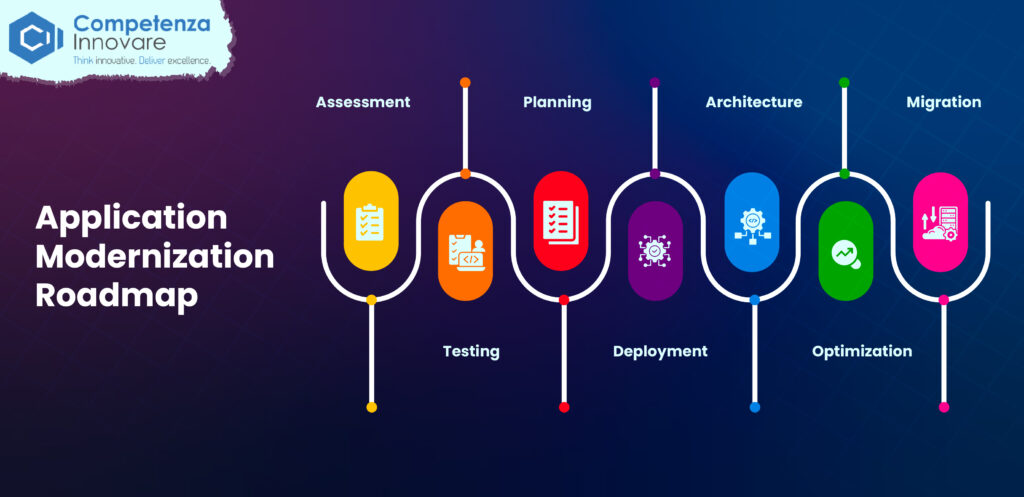
A clear application modernization roadmap assists CTOs to successfully implement modernization projects in a well-organized and low-risk fashion. Instead of engaging in great changes at a go, organizations will be in a position to seek a progressive model that helps to scale up technical upgrades to business aims. Effective modernization planning of the applications is also useful in reducing downtime, keeping costs down, and making the implementation successful.
Phase 1: Assessment
Test the existing applications, infrastructure, technology stack, and dependencies. Technical debt, security gaps, performance problems, and the most valuable working applications are found.
Phase 2: Planning
Establish sensible business targets, establish priorities in a project, choose suitable models of modernization, allocate resources, create a realistic program, and establish realistic success metrics that are attainable.
Phase 3: Architecture
Build a current architecture on cloud-native solutions, APIs, microservices, containers and Kubernetes to enhance scalability, flexibility, and performance of applications.
Phase 4: Migration
Move applications, databases, and workloads to current cloud-native environments with minimal downtime impact, data security, and business continuity.
Phase 5: Testing
Enhance performance, security, compatibility, and functionalities of applications; verification and testing are accomplished thoroughly before going into production.
Phase 6: Deployment
Develop applications with automated CI/CD pipelines, track the performances in the system, and experience a graceful transition with the least interference to the business activities.
Phase 7: Optimization
Perform continuous performance monitoring of applications, enhance the security, architect applications to be cost-efficient, and add frequent updates to ensure continued business relevance, efficiency, and performance of the applications.
Common Challenges in Legacy Application Modernization
Each legacy application modernization project is associated with distinct challenges. Early identification of these difficulties can assist CTOs in mitigating these risks and eliminating expensive delays and constructing an effective application modernization plan.
Budget Overruns
- Issue: A modernization project usually takes a larger budget since there are unforeseen technical problems and a redefinition of the requirements.
- Impact: As the prices are higher, the speed of projects and business priorities should be decreased.
- Best Practice: Spend money realistically; high-value applications should be prioritized, and modernization should be done gradually to regulate the cost.
Downtime
- Problem: Also, any kind of migration or upgrade of the applications can disrupt the important business processes.
- Impact: May cause loss of productivity and customer experience and revenue as a result of downtime.
- Best Practice: Roll out. Carry out maintenance when traffic is not present and devise a means of returning to a previous condition.
Legacy Dependencies
- Issue: Many of the old systems utilize old software, databases, or highly integrated systems.
- Influence: These interdependences render modernization challenging and bring a high probability of adoption.
- Best Practice: A thorough analysis of the application should be done so that the dependencies are identified before undergoing the modernization process.
Security Risks
- Issue: The old systems may lack more recent security controls and may be vulnerable to the nature of the old systems.
- Effects: This poses a risk to internet attacks, information leakages, and adherence.
- Best Practice: Security needs to be included throughout the modernization process through the use of zero trust, encryption, and regular security testing.
Data Migration
- Problem: Transfer of data between old and new systems can be very complex and inexact.
- Impact: The data may also be lost or corrupted, which impacts the business processes of the organization and decision-making.
- Best Practice: Test data prior to migration, ensure secure backups and thoroughly test migration.
Skill Shortages
- Issue: Teams might be untrained on cloud technologies, DevOps, containers, or microservices.
- Impact: The inadequate skills may halt the modernization efforts and make them more dependent on the outside sources.
- Best Practice: Invest in employee training and certifications, and in case of necessity, invest in modernization partners.
Change Management
- Issue: The employees might be resistant to the use of new equipment, processes, or technology.
- Impact: This may be at the expense of lack of sufficient adoption and slow down project success.
- Best Practice: Market the key benefits of modernizing, engage the stakeholders early on, and support and train them along the way.
Vendor Lock-in
- Issue: Intense dependency on one of the cloud providers or technology platforms may decrease flexibility.
- Impact: The subsequent migrations are likely to be more costly and technologically difficult.
- Best Practice: Resort to open standards and portable, multi-cloud or hybrid cloud approaches where warranted.
Application Modernization Best Practices
Adherence to established application modernization best practices assists the CTOs to mitigate the risks, enhance efficiency, and optimize the long-term value of the modernization projects.
- Modernize Incrementally: Do not modernize all applications simultaneously. Start doing high-priority work and work down in importance to cause the least disturbance and provide faster results.
- Construct API-First: API-based applications are constructed with the aim to support integrations and flexibility and allow other emergent technologies to be used, such as microservices and cloud-native services.
- Automate Deployments: CI/CD pipelines and automation have to offer quicker deployments and a rate of lowering manual mistakes and deployments to the environment.
- Adopt DevSecOps: Integrate security throughout the entire process more than development, DevOps, automated tests, operations, and ongoing monitoring.
- Monitor: Ongoing: Track application health, logs, measures, and alerts; identify when performance is uncharacteristic and prevent it along with tracking the health of the machine.
- Measure Key Performance Indicators (KPIs): Track number of deployments, availability of applications, response time, costs of cloud and time of incident resolutions to gauge success of modernization.
- Focus on Business Results: Drivers are expected to engage in those activities that do add value to customer experiences, operational efficiency, cost, and long-term business aims.
- Design to Scale: Deploy applications in a cloud-native platform, containers, and microservices in a manner that can prevent the degradation of performance with higher workloads.
- Minimize the cost of clouds: Audit cloud services regularly, shut down unused applications, and perform autoscaling to achieve a performance-cost balance.
KPIs Every CTO Should Track
Measuring the effectiveness of application modernization efforts by tracking the appropriate Key Performance Indicators (KPIs) will assist CTOs. These metrics would give insights on the application performance, the operational-efficiency, security and business results.
| KPI | Why It Matters |
| Application Availability (Uptime) | Maintains the availability and reliability of the applications. |
| Deployment Frequency | Action to determine the rate of updates and features. |
| Change Lead Time | Monitors speed of delivery of code to production. |
| Application Response Time | Determines the speed and user-friendliness of measures. |
| Mean Time to Recovery (MTTR) | Measures speed in which problems are addressed. |
| Cloud Infrastructure Costs | Helping with cloud management. |
| Security Incidents | Provides reports of vulnerabilities and incidents of security. |
| Application Performance | Troubleshoot application resource and performance issues. |
| Customer Satisfaction (CSAT/NPS) | Measures user experience and user satisfaction |
| Return on Investment (ROI) | Assesses the value of business due to modernization efforts. |
Ready to modernize legacy applications? Get a tailored modernization roadmap from The Competenza today.
Why Choose The Competenza for Application Modernization?
A successful application modernization project implementation involves the appropriate strategy, experience, and implementation. We assist them in evaluating the old applications at The Competenza and develop a simple modernizing plan and deploy applications to enhance the performance, security, and scalability.
Application modernization assessment and cloud migration, DevOps implementation, CI/CD automation, and development of custom applications—our cross-functional engineering teams cover every phase of the modernization process. Having an orientation towards long-term optimization and business results, we assist organizations to both modernize their legacy applications with assurance and create future-reliable digital solutions.
Conclusion
The legacy application modernization is an investment in the future of your organization that goes beyond a mere technology upgrade. Having a clear application modernization checklist CTOs are able to evaluate current systems, prioritize modernization efforts, minimize the technical debt, and establish secure and scalable applications to support long-term business objectives.
The key to success lies in the planned course of action, including the proper evaluation and the development of a clear roadmap to follow or the adoption of the latest architectures, DevSecOps, or the constant optimization of applications. With these best practices, organizations will be able to enhance their efficiency in operation, increase innovation and remain competitive in a digitally changing and fast environment.
Frequently Asked Questions (FAQs)
What is an application modernization checklist?
The Application Modernization Checklist is a stepwise guide that assists CTOs to examine their aged apps, establish modernization priorities, select an appropriate strategy, and adopt new technologies. It makes sure modernization efforts are planned at an affordable cost and meet long-term business objectives.
Why is application modernization important?
Application modernization is utilized to enhance the performance of an application, enhance its security, lessen the maintenance expenditures, and allow the organization to grow the business. It also allows the businesses to go cloud-native, automate deployments, and provide digital experiences that are better.
What is the difference between application modernization and cloud migration?
Cloud migration is an area of concern that involves moving the applications to the cloud, whereas application modernization improves the architecture, performance, and functionality of the application. A modernization effort may involve cloud migration, but modernization is broader than that and involves infrastructure enhancements.
What are the 7 Rs of modernizing the application?
The 7Rs are rehost, replatform, refactor, rearchitect, rebuild, replace, and retire. All the strategies cater to a wide range of business and technical needs and assist organizations in selecting the most appropriate one to use to modernize the legacy applications.
What are the priorities of CTOs to modernize applications?
CTOs usually consider applications in terms of business value, technical complexity, security risks, maintenance cost, dependencies, and anticipated return on investment (ROI). This helps to prioritize those applications that have the highest business replacement.
What is the process of developing an application modernization roadmap?
The modernization roadmap application starts by evaluating the current application, setting up business goals, choosing the appropriate approach to modernization, designing the architecture, planning the migration, testing the systems, and continually refining the applications once they have been built.
What are the greatest challenges of modernizing legacy applications?
Typical pitfalls involve technical debt, legacy tie-ups, runaway budgets, downtime, data migration, security risk, skills, change management, and vendor lock-in. These risks can be minimized with the help of a gradual modernization strategy.
Which are the popular technologies to modernize applications?
Modernization efforts are typically scaled, made more flexible and efficient in terms of operations and scale through the execution of cloud-native architecture, microservices, APIs, containers, Kubernetes, DevOps, CI/CD pipelines, serverless computing, and automation tools.
What role does DevSecOps play in modernizing applications?
DevSecOps introduces security in the software development life cycle. It combines auto-testing, CI/CD pipelines, around-the-clock monitoring, and security measures to deliver applications quicker without influencing compliance and reducing the security risk.
How can The Competenza help in modernizing applications?
The Competenza would help organizations to review old applications, develop a distinct modernization strategy, modernize their cloud and app architecture, become DevOps, and ensure that the current applications work with even better performance, security, and scalability over time.