

The availability of the modern digital economy has ensured that businesses generate gigantic amounts of data in matters concerning customer relations, operations, sales activities, and other varying technologies. Although such data is very instructive, a great number of organizations are unable to transform it into practical actions that contribute to growth and efficiency. Conventional reporting systems tend to offer historical data, and, therefore, it becomes challenging for businesses to react promptly to a fluctuating AI business intelligence environment.
This is where AI-based business intelligence is changing the manner in which enterprises utilize data. Through the combination of artificial intelligence, machine learning, and advanced analytics, companies are able to process large volumes of data instantly, identify trends, predict trends in the future, and make more intelligent decisions on a smaller time scale. Modern AI business intelligence solutions do not only stop at the fixed display but also offer actionable information to organizations that steer them towards improving their performance, reducing risk, and creating new opportunities.
With the increasing demand for real-time business intelligence, businesses are investing in AI-powered business analytics and intelligent data platforms to ensure a competitive advantage. Through automated reporting and predictive analytics down to intelligent decision support, AI is helping businesses transform intricate enterprise data into real-time insights used to produce smarter results. This blog discusses the use of AI-based business intelligence in assisting organizations to turn data into strategic decisions and define the future of analytics through an enterprise.
What Is AI-Driven Business Intelligence?
AI-based business intelligence refers to artificial-intelligence-based transformation of business data that allows an action to be taken on it. Compared to the traditional enterprise business intelligence tools that are aimed at previous reports, AI is able to analyze large amounts of data, recognize trends, and provide information in real time.
It is possible to employ machine learning, automation, and AI-powered business analytics as suitable solutions to enable business monitoring, anticipate the trends, and make more timely decisions. The recent AI reporting and analytics applications also ensure the automation of reporting and reflecting opportunities and threats as they arise.
AI-driven business intelligence enables organizations to increase efficiency and make smarter decisions and extract more value out of their enterprise data with real-time insights and analytics of smart data.
Why Traditional Business Intelligence Is No Longer Enough
Over the years, conventional enterprise business intelligence systems have assisted businesses to analyze data and follow their performance. Nevertheless, modern organizations produce more data than ever and require a quicker way of providing data on their decisions to make. Conventional BI tools tend to fail to provide such requirements by a variety of factors:
- Report Generation: Report generation can be extremely time-intensive and manual, reducing the speed of decision-making and productivity.
- Slow Insights: Conventional BI primarily uses past information, which implies the probability that the business will have insights injected once an opportunity or even an issue has cropped up.
- Silos of Data in Each Department: Data is typically held separately in departments from each other to obtain a whole-counter picture of business performance.
- Challenge in Analysis of Large Data: With the increasing amount of enterprise-wide data, standard BI software might become ineffective in processing and analyzing large amounts of data.
- Reactive rather than proactive decision-making: The classic BI is oriented to the interpretation of the past, whereas the business of the modern times requires predictive information to project trends, threats, and opportunities.
In order to remain competitive, real-time business intelligence and AI business intelligence solutions are being embraced in organizations. The technologies are faster in insight and automate data analysis, along with assisting businesses in making proactive decisions based on real-time information.
How AI Turns Enterprise Data Into Actionable Intelligence
AIs assist enterprises in transforming bulk enterprise data into insights. Instead of going through data and making a decision manually, organizations can get AI to execute tasks faster, identify significant trends, and assist decision-making.
Automated Data Collection and Integration
AI can merge and integrate information between CRM systems, ERP systems, cloud applications, and databases into one point. This helps to eliminate the data silos and form a consistent image of business operations.
Intelligent Data Analysis
On the one hand, with the help of AI to analyze data of enterprises, it is possible to analyze large volumes of data within a short period of time, finding any trends and revealing suspicious actions and any valuable patterns. This enables companies to be informed quicker and make sound decisions.
Predictive and Prescriptive Analytics
AI is also able to forecast past developments using historical and real-time data. It is capable of prescribing, obviating, and facilitating smart business decision-making, enabling businesses to enhance planning and performance.
An AI data analytics platform provides organizations with the means to convert raw data into actionable intelligence and business value by integrating automation, analytics, and predictive insights.
The Role of Real-Time Business Intelligence in Modern Enterprises
Businesses of today require information in real-time. Real-time business intelligence enables organizations to observe the operations and keep track of performance, as well as to make quicker decisions with live data.
- Continuous Performance Monitoring: Businesses are able to monitor major metrics and business operations in real time.
- Real-Time Dashboards: Real-time dashboards show the current state of business performance and valuable data.
- Realtime Alerts and Notifications: Teams can get an instantaneous notification regarding the changes, risks, and opportunities that are critical.
- Quicker Response to Market Change: Real-time information enables companies to quickly respond to shifts in market demands and evolving market conditions.
- Better Operational Efficiency: Due to access to up-to-date data, the organizations detect problems more quickly and enhance their daily routine.
Benefits of Real-Time Business Intelligence
- Shorter Decision-Making Delays: Teams will be able to make decisions using available information, rather than waiting to have information reported to them.
- Improved Customer Experiences: Improved insights can enable businesses to better respond to customer expectations.
- More Precise Allocations: Real-time data analytics will help to make better plans and predictions of the future.
- Increased Competitiveness: The businesses can access faster speeds than theirs and act swiftly in response to new opportunities.
AI reporting and analytics are included; in combination with real-time business intelligence, organizations can use the information to create actions and smarter business decisions as soon as possible.
Key Technologies Powering AI-Driven Business Intelligence
The existing AI business intelligence systems are grounded on several advanced technologies that transform the data provided by enterprises into valuable information. Such technologies can help businesses to automate the analysis, improve the way of decision-making, and access the data faster.
| Technology | Role in Business Intelligence | Key Benefits |
| Machine Learning | Analyzes data and identifies patterns. | Predictive insights, trend detection, continuous improvement. |
| Natural Language Processing (NLP) | Facilitates users to work with data with simple language. | Search enabled by artificial intelligence, easy access to information, chat robots. |
| Generative AI | Creates reports and business summaries automatically. | Faster reporting, executive insights, improved productivity. |
| Cloud-Based Analytics Platforms | Stores and processes data in a centralized environment. | Scalability, real-time access, and faster data processing. |
These technologies combined enable the current AI reporting and analytics solutions to help organizations work on their data more effectively and deliver actionable insights. An efficient AI data analytics platform will integrate all these so that it can aid in smarter and quicker business decisions.
Major Business Benefits of AI-Powered Business Analytics
AI-based business analytics assists organizations in transforming data into useful insights that enhance organizational performance, efficiency, and decision-making. The AI can help the business react quicker to an opportunity or threat by analyzing the data in real-time.
Faster Decision-Making
Businesses are able to gain insights in real-time rather than have to wait to get manual reports. The teams can make fewer decisions faster using real-time business intelligence since they are based on the existing data and changing business needs.
Improved Accuracy
AI reduces the risk of human error since it can automatically analyze big amounts of data. This leads to enhanced insights, prediction, and enhanced business planning.
Increased Operational Efficiency
Robotic tasks are handled by AI, comprising collecting, reporting, and analyzing data. This will save time and increase productivity, and the employees will be able to do work that will add value.
Better Risk Management
Against any suspicious activity and even potential issues, AI can detect them at an initial level before it becomes a severe backlash. Well, this early risk identification helps companies to be proactive and to enable making smarter business decisions.
Business analytics based on AI can help organizations make wiser decisions and provide more effective business results by means of minimizing friction, improving precision, boosting efficiencies, and improving effective risk management.
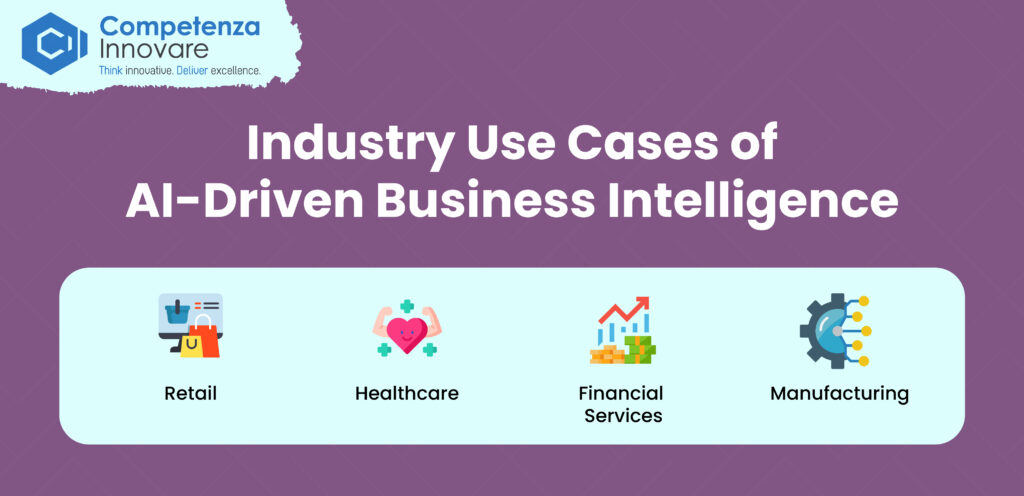
Industry Use Cases of AI-Driven Business Intelligence
The industrial businesses are using AI-based business intelligence to process data, simplify operations, and make smarter decisions. With AI-based insights developed on enterprise data and real-time insights, organizations will be in a position to extract more value out of their data.
Retail
Retail companies use AI-based business analytics to better understand their consumers and buying behavior. AI helps businesses in predicting demand, managing inventory and products availability, leading to customer satisfaction and increased sales volume.
Healthcare
Applied AI insights assist healthcare organizations in analyzing patient outcomes, enable them to plan resources better, and become more efficient in their operations. This will help hospitals and healthcare providers to provide quality care at a low cost and optimize resources.
Financial Services
Enterprise business intelligence that can be driven by AI is deployed by banks and other financial institutions to analyze risks, detect fraud, and predict revenues. AI is capable of detecting suspicious activities, evaluating the financial risk, and contributing to more accurate business planning.
Manufacturing
Manufacturers apply AI to keep track of the equipment performance, anticipate the maintenance requirements, and streamline production. The supply chain visibility can also be enhanced with the help of AI-driven insights to enable businesses to reduce downtime as well as operational efficiency.
These practical examples demonstrate how business intelligence utilizing AI assists companies in turning data into actionable insights that enhance growth, efficiency, and improved decision-making.
Essential Features Every AI Business Intelligence Solution Should Include
Choosing the proper AI business intelligence solutions is applicable in order to turn data into useful business data. Getting ready to review an AI-based BI solution, companies will consider such features:
- Real-Time Analytics Dashboards: Report on important metrics and business performance in real-time.
- Predictive Analytics Capabilities: Can help in forecasting the future trends, opportunities, and risks.
- Automated Reporting: Automated reports will be automatically created and save on manual labor or time.
- Data Visualization Tools: Data visualization, which is difficult to explain by the use of easy-to-use charts, graphs, and data dashboards.
- AI-Driven Recommendations: Current realistic information and recommendations.
- Conversational analytics: Customers will be able to ask questions in their natural language and receive answers in real-time.
- Enterprise Data Integration: Integrate the data of Interconnect CRM, ERP, cloud systems, and other enterprise systems and see one picture.
- Security and Compliance Controls: protect business information (keep secure) and assist in the compliance with business laws.
These features should be combined in a contemporary AI data analytics solution to enable organizations to better understand their data, make better decisions, and derive maximum value from their data. Developed AI reporting and analytics services also allow companies to make quicker and smarter decisions.
Future Trends Shaping AI-Driven Business Intelligence in 2026 and Beyond
The future of AI-driven business intelligence will aim at providing quicker, smarter, and automated insights as business continues to generate increasingly large amounts of data. A number of developing technologies are defining the future of business intelligence.
- Generative AI-Based Reporting: AI will serve to produce reports, summaries, and insights, removing the manual reporting and improving productivity.
- Conversational Business Intelligence: Business intelligence can be easily accessed by the user with the help of natural language and will assist them to comprehend it even without the experience.
- Independent Analytics: AI will also be able to automatically learn and analyze information and identify trends and deliver any meaningful insights with a minimum of human input.
- Enterprise Decision Support Agentic AI: The intelligent AI assistants will assist companies in their data monitoring, activity recommendations, and aid with complex decision-making.
- Augmented analytics: AI will enhance the analysis of data to bring forward patterns, opportunities, and threats that could not have been plainly seen even in large amounts of data.
- Hyper-Personalized Business Insights: Businesses will receive a highly personalized insight depending on the requirements of their goals, departments, and activities.
- Real-Time Predictive Intelligence: AI will be implemented along with real-time data analytics to allow organizations to predict the future and take quicker reactions to the changes.
These technologies are making the AI business intelligence solutions smarter, proactive, and useful. With increasing adoption, businesses can convert enterprise data into quicker insights, enhanced decisions, and sustainable competitive advantages.
Turn your enterprise data into smarter decisions with AI Business Intelligence solutions built for growth.
How The Competenza Helps Businesses Build AI-Driven Business Intelligence Solutions
The Competenza assists the organizations to unleash the full potential of their enterprise data with tailored AI-driven business intelligence solutions. It is through the fusion of AI, analytics, and new data technologies that we are able to assist businesses in turning raw data into actionable bits of information that will aid in faster and more intelligent decision-making.
Our services include:
- Tailored AI-based business intelligence development to individual business objectives and needs.
- Enterprise Data Integration Solutions are a combination of data among CRM, ERP, and cloud systems with other business systems into an integrated ecosystem.
- Implementation of a real-time analytics dashboard to provide real-time visibility of business performance and essential measures.
- Predictive Analytics Implementation assists businesses to prepare and forecast trends and opportunities and minimize risks.
- Artificial intelligence to report and automate their reporting processes to get smoother reports and give them faster information.
- Business intelligence platforms are flexible, scalable, and relatively safe to access data and are cloud-based.
- Scalable enterprise analytics like that to meet the increased volumes of data and business needs.
- Intelligent decision-support systems that offer data-driven suggestions to deliver improved business.
Being experienced in creating new AI business intelligence solutions and present-day AI data analytics platform features, The Competenza is capable of assisting organizations in becoming more efficient and insightful and making more secure business choices.
Conclusion
AI-driven business intelligence is aiding enterprises in transforming enterprise data into real-time insights and smarter decisions. By using AI-based analytics, predictive intelligence, and automated reports, businesses can gain a better understanding of their operations, extract opportunities, and leap into responding to emerging business needs.
With the ever-increasing data, companies require quicker and smarter methods of analyzing information. Modern business intelligence offers the visibility and insight that are required to improve efficiency, aid growth, and help make confident decisions.
The earlier an organization invests in AI-centered business intelligence, the more organizations will have a stronger foundation to optimize performance, to be agile, and to gain a competitive edge in the future.
FAQs
What is AI-driven business intelligence?
AI-driven business intelligence is the usage of artificial intelligence, machine learning, and advanced analytics to transform business data into useful information. Unlike the classic business intelligence systems where most real-time activities are based around historic reporting, AI-based systems have the potential to generate extensive data in real-time, identify trends and anomalies, and provide recommendations. This helps organizations to make quicker, smarter, and more data-driven decisions.
What are the benefits of AI to conventional business intelligence systems?
The use of AI in enhancing the business intelligence of traditional business intelligence is through automating data collection processes, analyzing them, and reporting. It has the ability to run mass data in a short time, revealing concealed patterns and making predictive insights that would otherwise prove challenging to find out manually. AI also saves time on reports and assists businesses to transition to making decisions based on real-time information rather than being reactive in the preparation of reports.
What are the advantages of real-time business intelligence?
Real-Time Business Intelligence enables any business to gain access and study data in real-time as the data is derived. This aids organizations in keeping track of performance, rapidly reacting to market changes, and enhancing efficiency in operations, as well as in shortening decision-making times. On-the-fly insights help in enhancing customer experiences, proper prediction, and business agility.
What does AI do to the enterprise data?
AI finds applications with a combination of data sets that are collected using different business applications to make meaning of enterprise data, e.g., CRMs, software, databases, and cloud applications. This information is then introduced to machine learning algorithms in order to ensure that trends are set, suspicious patterns identified, and valuable information presented. This helps businesses to learn their business better and make sound decisions with the help of the correct data.
What is an AI data analytics platform?
An AI data analytics platform is a solution that builds upon artificial intelligence, data analytics, and automation to help companies collect, process, analyze, and access data. These tools provide organizations with live dashboards, predictive analytics, automated reporting, and data visualization capabilities, enabling easier organization to gain insights and promote improved business performance.
How can business analytics based on AI help in decision-making?
AI-based business analytics can help business stakeholders make the right decision and be predictive and timely. It helps businesses to understand where they are currently, which trends to expect in the future, and to observe business opportunities and threats. Having access to data-backed suggestions, leaders are able to make quicker and more decisive decisions that are in line with business goals.
What industries making the most use of AI-driven business intelligence?
The use of AI in applying business intelligence has been in retail, health, finance, manufacturing, logistics, and e-commerce, among others. Customers and inventory are analyzed with retail AI; patients and operations to know more about risk management and fraud detection in financial services; and manufacturers can use AI to optimize their production and supply chain.
What are the features of AI business intelligence solutions that businesses need to consider?
In choosing AI business intelligence solutions, companies need to consider real-time analytics dashboards, predictive analytics, automated reports, data visualization, conversational analytics, AI-based recommendations, enterprise data integration, and built-in security. Such abilities enable companies to make the most out of their data and enhance decision-making.
How does predictive analytics enhance the performance of the business?
Predictive analytics uses historic and current data to give the forecast of what is ahead. It helps businesses forecast the demand, understand the trends in the market, capitalize on their resources’ data, and reduce the potential of risks they may be exposed to. With an understanding of what is likely to happen next, organizations can proactively make decisions that will maximize performance in areas like effectiveness, profitability, and overall performance.
Why would AI-powered business intelligence be of importance to businesses in 2026?
As the amount and complexity of the enterprise data continue to increase, businesses need advanced tools that would convert the data into business insights. AI-powered business intelligence assists organizations in streamlining analytic processes, having access to real-time data, enhancing operational efficiency, and making more expedited judgments. It will be essential to assist enterprises and keep them competitive, agile, and data-driven in 2026 and beyond.