

Artificial intelligence is transforming how individuals learn, teach, and create content. With individual course recommendations and artificial intelligence tutors, automated tests, modern learning platforms are getting smarter and more people-centered. With the rising trend of online education, businesses, startups, and higher institutions are exploring alternative methods of providing interactive learning experiences that can address the needs of the current learners. An AI-based learning platform integrates educational resources with the best technologies like machine learning development, natural language processing, and generative AI to enable more effective and interactive learning. These platforms, instead of the ones accessible to everyone, can be adjusted to the learning style of each user, track their progress, and support them immediately by proposing the most relevant materials created depending on the goals and performance of a specific person in learning.
By 2026, the need to solve AI-driven education is likely to rise to new levels because organizations will be interested in enhancing the interaction with learners, decreasing the number of administrative activities, and providing high-scale, tailored, and specific learning methods. It could be an online learning course, a corporate training platform, or an educational mobile application; the AI is assisting in the establishment of smarter and more efficient learning spaces.
In this guide, we will look at how to create an AI-driven learning platform in 2026, its main features, technologies, the development process, cost, and best practices related to this development. You will also hear how to develop a scalable and future-ready platform in the education machine that creates value on both sides: learners and educators.
What Is an AI-Powered Learning Platform?
An AI-based learning platform is a platform that makes use of artificial intelligence to create more personal and interactive learning experiences. It could help learners identify the right content, obtain instant help, and learn at their learning speed and could help the teacher to improve the learning outcomes by assisting them.
Definition and Core Concept
An AI-based learning management system incorporates learning content and AI to facilitate smarter and more effective learning. It can personalize the learning paths, automate monotonous processes, and use data to improve learning.
How AI Is Changing Online Education
AI is enabling educational platforms to be effective and interactive. Students can also customize their recommended instructions and support according to their learning requirements as opposed to a set of rules to adhere to when learning.
Some common AI-powered capabilities include:
- Adaptive learning that adjusts content based on performance
- AI tutors that provide instant guidance and answers
- Automated assessments and faster feedback
- AI-generated quizzes, summaries, and learning materials
- Real-time support through chatbots and virtual assistants
Difference Between Traditional LMS and AI-Powered Learning Platforms
The traditional learning management systems are concentrated mainly on offering and administering courses. The intelligent platforms powered by AI assist the learners to acquire knowledge with improved information, efficiency, and effectiveness.
| Traditional LMS | AI-Powered Learning Platform |
| Static content | Personalized content |
| Manual grading | Automated assessments |
| Fixed learning paths | Adaptive learning journeys |
| Limited analytics | Predictive insights |
| Basic support | AI tutors and chatbots |
AI-based education software provides learners and instructors with a more personalized learning experience that is more efficient and data-driven because of its effectiveness compared to traditional systems.
Why AI-Powered Learning Platforms Are Growing in 2026
The market of AI-powered learning platforms is actively expanding as organizations seek more efficient methods of providing an individualized and interactive experience in learning. These platforms are used to enable learners to deliver higher outcomes and to make the process of learning more productive by implementing automation, data insights, and intelligent recommendations.
Personalized Learning at Scale
Among the most significant opportunities offered by an AI-powered eLearning platform, one can distinguish personalizing learning for each user. AI interprets skill level, learning behavior, learning progress, and performance and suggests the appropriate content and develops the tailor-made learning paths.
Increasing Student Engagement
AI facilitates the maintenance of the excitement of learners by providing personalized and interactive experiences. The fact that AI-driven recommendations, gamification, smart feedback, and interactive content can be used motivates learners to remain motivated to stay engaged in their courses.
Operational Efficiency for Educators
The educational AI solutions save educators time on repetitive tasks. The grading process can be scaled using intelligent software, and they can be assisted in creating learning materials, monitoring attendance, and learning insights to provide the educator with more time to teach and support the students.
Growing Demand for Digital Education
There is a continuous rise in adopting digital learning across industries. Businesses are resorting to AI-enabled systems in corporate training, universities are improving their online education experience, and professionals are acquiring certifications, and organizations are investing in upskilling and reskilling programs in order to adapt to evolving workforce requirements.
Key Features Every AI-Powered Learning Platform Needs
The features that a purposeful modern AI-driven learning platform needs to have to produce a personalized and effective learning experience should help increase engagement, automate due processes, and contribute to improved learning outcomes. Such features can be used to build a better learning and teaching experience.
Personalized Learning Paths
Personalized learning is among the most significant components of a custom AI learning platform. AI assesses the level of learner performance and behavior to tell the most pertinent lessons and activities.
AI recommendations are based on:
- Student performance
- Learning goals
- Knowledge gaps
AI Virtual Tutors and Assistants
AI tutors ensure end-to-end support and directing through the learning process. They help learners to find answers incredibly within a short period and make them keen on the courses they are taking.
Capabilities include:
- Answering student questions
- Explaining complex concepts
- Providing study recommendations
- Offering 24/7 support
Intelligent Course Recommendations
The most suitable content in terms of interests, progress, and career goals is provided to the students via AI recommendation systems.
Recommendations may include:
- Courses
- Learning modules
- Skill development plans
Automated Assessments and Grading
By helping teachers to conserve time and to be consistent, AI will then be able to assess and deliver the results automatically and quicker.
Key benefits include:
- Faster evaluations
- Reduced educator workload
- Consistent scoring
AI Content Generation
Generative AI development can assist instructors more cost-efficiently, creating learning materials and educational content.
AI can generate:
- Quizzes
- Assignments
- Course summaries
- Learning materials
Learning Analytics Dashboard
A dashboard based on learning analytics will offer useful information on the performance of the learner and the effectiveness of the platform. These lessons can guide teachers in making data-driven choices and enhance learning outcomes.
Common metrics include:
- Engagement metrics
- Course completion rates
- Skill progression
- Learning outcomes
Together, these attributes render AI education app development more effective and efficient by developing personalized, scalable, and engaging learning activities that address the demands of contemporary learners.
Choosing the Right AI Technology Stack
The choice of technology stack constitutes one of the most important stages in the construction of the scalable and high-performance learning platform based on AI. The technologies you use will influence the performance of your platform, user experience, security, and capability in future scalability. An expert AI development company can help in making the decision in the tools and architecture that will be used based on your business goals and platform requirements.
Frontend Development
Tech Stack:
- React
- Next.js
- Angular
- Flutter
Backend Development
Tech Stack:
- Node.js
- Python
- FastAPI
- Django
AI and Machine Learning Technologies
Tech Stack:
- OpenAI
- Claude
- Gemini
- Llama Models
AI Frameworks
Tech Stack:
- LangChain
- LlamaIndex
- CrewAI
- AutoGen
Cloud Infrastructure
Tech Stack:
- AWS
- Azure
- Google Cloud
Database Solutions
Tech Stack:
- PostgreSQL
- MongoDB
- Pinecone
- Weaviate
- ChromaDB
DevOps & Deployment
Tech Stack:
- Docker
- Kubernetes
- GitHub Actions
- Jenkins
Security & Authentication
Tech Stack:
- OAuth 2.0
- JWT
- Auth0
- AWS Cognito
Analytics & Monitoring
Tech Stack:
- Google Analytics
- Mixpanel
- Grafana
- Prometheus
Combined, these technologies fall under the heart of contemporary education software development, wherein organizations will be capable of constructing secure, scaled, and AI-assisted learning environments that offer personalized experiences and can be expanded in the future.
Step-by-Step AI Learning Platform Development Process
Developing an AI-based learning platform will demand a structured process that will integrate learning objectives, current technologies, and artificial intelligence features. Such a platform, which is developed through the right development process, creates a platform that has brought about personalized learning experiences and long-term value.
Step 1 – Define Educational Objectives
The identification of what the AI learning platform will accomplish is the initial step in developing the platform. The set of distinct goals can assist in direction feature development and implementation of AI and business strategy in general.
Key areas to define:
- Target audience
- Learning outcomes
- Business goals
Step 2 – Conduct Market and User Research
Knowing learners and the competitive environment is the key to development. Research assists in determining what the user wants, what the market wants, and what allows the platform to shine.
Research should focus on:
- Student needs
- Competitor platforms
- Industry gaps
Step 3 – Design Platform Architecture
Good architecture guarantees that the platform is able to sustain AI, increasing users, and future upgrades. Early planning will minimize the difficulties in development in the future.
Important considerations include:
- User roles
- Data flow
- AI integration strategy
Step 4 – Build Core Learning Features
After the finalization of the architecture, the development starts with the core features, which will support the learning experience and platform management.
Core features include:
- Course management
- User dashboards
- Assessment modules
Step 5 – Integrate AI Models
The use of AI imparts wisdom to the learning platform and offers personalization of learning. The phase revolves around execution of AI-powered functionality, which enhances interaction and learning success.
Common AI implementations include:
- Recommendation systems
- Chatbots
- AI tutors
- Generative AI features
Step 6 – Train and Optimize Models
The AI models are supposed to be continuously trained and optimized to give quality and accurate reports. Optimization assists in enhancing the quality of recommendations and content generation and learner support.
Focus areas include:
- Accuracy
- Personalization
- Performance
Step 7 – Testing and Quality Assurance
The site should also be thoroughly tested before the launch to allow the site to provide a secure and easy user interface. This can be used to detect problems and enhance general reliability.
Testing should validate:
- Functionality
- Security
- Scalability
Step 8 – Deployment and Continuous Improvement
When implemented, there is a necessity to follow the performance sustainability and be sensitive to the needs of the learners by continually monitoring and optimizing the performance. The ongoing advancements are useful to maintain the platform as effective and competitive.
Key areas to monitor:
- User behavior
- AI performance
- Platform growth
By adhering to these steps, organizations can create scalable and successful AI-driven learning that allows participants to experience the learning in a personal way and enables future innovation and growth.
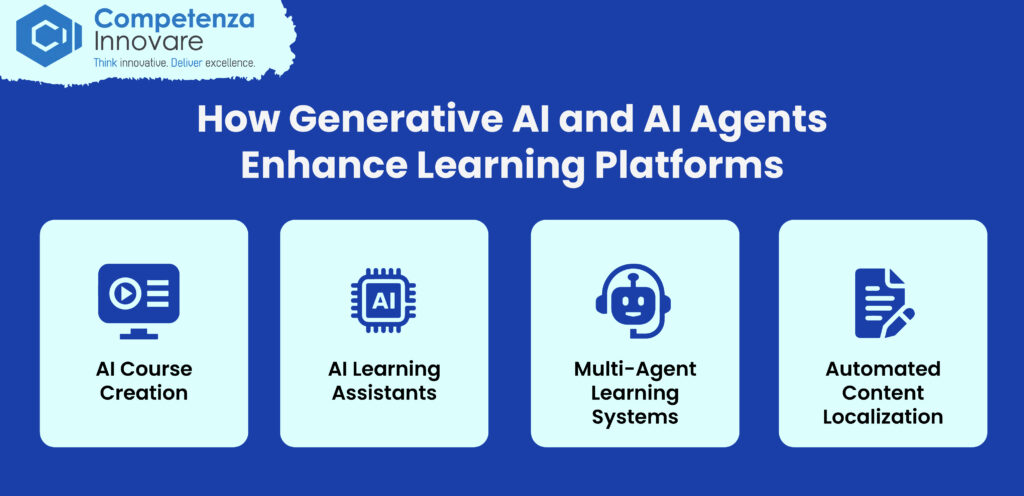
How Generative AI and AI Agents Enhance Learning Platforms
Generative AI and AI agents are contributing to the smarter and more personalized learning platforms. Learning is made efficient and more enjoyable as they are able to come up with content, assist learners, and mechanize a lot of activities.
AI Course Creation
Generative AI can create outlines of courses, learning materials, quizzes, and assessments. This assists teachers to save time and provide new and up-to-date material to students.
AI Learning Assistants
AI tutors are instant support and guidance systems. They will be able to respond to questions, describe subjects, and suggest learning materials in accordance with the needs and progress of a learner.
Multi-Agent Learning Systems
An AI-powered learning platform can have several AI agents collaborating to assist learners. They are able to monitor the evolution, suggest helpful material, measure the knowledge, and keep students occupied during their educational course.
Automated Content Localization
Generative AI can be used to translate learning material into different languages to help provide courses to students worldwide and help businesses access more audiences.
Businesses can also use generative AI and agents based on AI to design smarter educational AI solutions enabling them to offer a more personalized and engaging learning experience.
Security, Privacy, and Compliance Considerations
Security and privacy of any AI-based education software are important. Since learning platforms handle information related to the students and their learning history, protection of this data would be essential in not only building confidence but also attaining compliance.
- Student Data Protection: These must encrypt data, store it in a secure place, and have role-based access to student data. Such solutions will prevent any unauthorized access and protect confidential data.
- Compliance Requirements: Learning platforms should be compliant with legislation such as GDPR, FERPA, and COPPA (and other local data protection laws). Adherence to instructions helps in the privacy and proper management of students’ data.
- Responsible AI Practices: AI systems should be transparent, fair, and responsible. Empowering a more plausible learning experience is just possible through dropping biases, increasing levels of transparency, and using explainable forms of artificial intelligence.
Organizations can implement safer and more reliable AI-powered learning platforms by focusing on the principles of security, privacy, and compliance.
Cost to Build an AI-Powered Learning Platform in 2026
The prices of AI education platform development depend on the features of the platform, the AI capabilities, the integrations, and the scalability needs. The simple platforms containing the necessary learning features will be cheaper, whereas the sophisticated ones with AI tutors, individual learning plans, autoboosting content, analytics, and multilingual systems demand more investments.
Estimated Development Costs
| Platform Type | Estimated Cost |
| MVP Platform | $30,000 – $75,000 |
| Mid-Scale Platform | $75,000 – $200,000 |
| Enterprise Platform | $200,000 – $500,000+ |
Besides the costs of development, businesses are to consider the continuous costs of using AI models, hosting, maintenance of the platform, monitoring of security, and updates in features. The resulting price will be determined by the sophistication of the platform and the degree of AI capabilities needed to provide a personalized learning experience.
Common Challenges and How to Overcome Them
To have a great AI learning platform development, a handful of challenges will need to be tackled to guarantee an effective learning process.
- Data Quality Problems: AI systems require quality information that is up to date to provide meaningful suggestions. Repeated practice in manipulating the data can lead to increased learning ability and performance.
- Precision of AI models: AI models must continually undergo trials and optimizations to make valid recommendations and personalized care.
- User Adoption Problems: It is worth mentioning that through a simple interface and appropriate instructions, easily using AI-driven functionality can be learned by users (learners and instructors).
- Scalability Implication: Cloud-based infrastructure makes the platform more resilient to serve more users with no loss in performance.
- Integration Complexity: It may be easier to add AI functionality to existing systems and tools using APIs with pre-planning.
When they are overcome, organizations will be able to create an effective and scalable AI-powered learning platform that will produce superior learning experiences.
Future Trends Shaping AI Learning Platforms in 2026 and Beyond
The AI-powered technologies that will shape the future of learning platforms will ensure learning is more personalized, interactive, and accessible. The trends will assist organizations to achieve positive learning experiences and also enhance learner outcomes.
Agentic AI in Education
Through agentic AI, tasks and decisions can be made in regard to the needs of the learners. It is capable of recommending content, monitoring, and offering a personalized learning experience.
Voice-Based Learning Assistants
Voice assistants enable students to engage with learning material in a natural conversation, making the learning process more comfortable and accessible.
AI-Powered Skill Assessments
Artificial intelligence can be used to examine the performance of learners and diagnose skill deficiencies to make them more incisive about the areas to work on and improve.
Real-Time Personalized Learning
Learning routes can be sustained in continuous adjustment, driven by the achievement and actions of a learner and his/her objectives, which are offered through AI.
Immersive Learning Experiences
AI and technologies like AR and VR will be capable of producing interactive learning settings, which enhance the level of engagement and knowledge retention.
Autonomous Learning Agents
Autonomous AI agents have the capacity to assist learners, suggest materials, and support them through the process of learning with minimum human involvement.
As the technology advances, AI-based eLearning platforms of the future will offer more intelligent, interactive, and incredibly personalized learning experiences.
Build your AI-powered learning platform today with expert guidance, scalable technology, and personalized solutions.
Why Partner with an AI Development Company for Learning Platform Development
An AI-based learning system requires proficiency in AI tools, programming, scalability, and security. Cooperation with an experienced AI development company helps businesses accelerate the process of development, reduce the risk, and create more learning experiences.
The Competenza assists the organizations to develop custom AI learning platform solutions with features including, but not limited to, generative AI integration, AI agent development, machine learning implementation, and scalable cloud-native architecture. This allows companies to provide users of their sites with engaging, personalized, and future-ready learning experiences.
Conclusion
AI is transforming digital learning to include individualized learning experiences, smart tutoring, auto-assessment, predictive analytics, and AI-inspired content generation. These features can be used to design more interactive and effective learning processes and enhance educational achievement.
With the demand on digital education constantly on the rise, the need to invest in an AI-driven learning platform will serve organizations to provide smarter learning experiences, gain more learner engagement, and remain competitive in the dynamic edtech market.
FAQs
What is an AI-based learning platform?
The AI-based learning platform will provide AI personalization and recommendation of content, automation of assessment, and AI tutor and assistant functions to support learning in real-time.
What is the cost of the AI-powered learning platform?
The cost varies on the platform’s functionality, the AI user, integrations, and scale. The cost of a simple MVP might be from $30,000 to $75,000, and complex business platforms can cost $200,000 to $500,000 or more.
What is the time frame to come up with an AI learning platform?
The time to develop is based on the complexity of the platform. The creation of a basic platform can be completed within several months, and the creation of an AI learning platform with its features and more sophisticated personalization, AI tutors, analytics, and integrations can take 6-12 months (or even longer).
What types of AI technologies are adopted in learning platforms?
Some of the popular technologies include generative AI, machine learning, natural language processing, large language models (LLMs), recommendation systems, AI agents, and predictive analytics.
What is the difference between a traditional LMS and an AI-powered LMS?
A traditional LMS provides course management, user management, and assessment management. A basic LMS driven by artificial intelligence goes one further and provides guidance and a learning experience rooted in personal needs, suggested studies by an artificial intelligence engine, automatic tests, artificial intelligence teachers, and learning strategies.
How is AI tutoring used to improve online learning?
AI tutors provide one-on-one instructions, clarification of complex concepts, recommended learning content, and instant solutions on the progress and needs of a student.
Is it possible that AI can develop courses and learning material?
Yes, generative AI can assist in creating course outlines, lesson materials, quizzes, assessments, summaries, and practice questions; it saves time on the amount of time spent on creating the content.
Does an AI learning platform enable personalized learning?
Yes, among the learners, AI is capable of comparing and contrasting their performance, advanced behavior, and goals to suggest appropriate content and modify the course of learning based on a person.
What are the industries that can utilize AI-enabled learning platforms?
Employees can be offered AI-powered learning platforms to train, upskill, reskill, or have professional development within the education industry, corporate education, healthcare education, technology, finance, and other areas.
What benefits can businesses get by investing in AI-powered learning?
The AI-based learning applications can be used to improve the learning experience of learners, automate certain things such as learning repetitions, provide a personal learning experience, and provide insights that have value in the learning process. This makes them handy in organizations that are interested in increasing digital education and training at scale.