

most of the organizations continue to use manual systems to carry out activities like data entry, document approvals, processing invoices, onboarding employees, and reporting. These actions are tedious and time-wasting activities, which expose people to human error and workflow slacks, which slow down automate business processes.
At this point automation of business processes becomes a necessity. Workflow automation software helps an organization automate simple tasks, simplify approvals, integrate various systems, and design automated business processes that can operate with minimum human intervention. With the advent of task automation software and documentation automation software, and further on, AI workflow automation and Robotic Process Automation (RPA), contemporary automation software assists companies in gaining greater accuracy, productivity, and operational efficiency.
With the current pace of digital transformation that is transforming the industries, organizations are now spending on process automation software to streamline workflows in every department, including finance, human resources, sales, customer service, and operations. Rather than reducing the number of manual work tasks performed, automated workflows also provide enhanced visibility of the processes, which helps the teams to make faster and more informed decisions.
This guide will discuss a step-wise guide on how to automate business processes. You will know how to recognize automation opportunities, find the correct workflow automation solutions, realize AI-powered automation solutions, and continue to optimize workflows to lead to sustainable business growth and efficiency.
What Is Business Process Automation?
Business process automation (BPA) is the process of automation of business processes, business workflows, and repetitive activities typically performed manually by using technology. It helps organizations reduce the size of the manual tasks and improve accuracy and efficiency since normal processes could be performed automatically.
Understanding Business Process Automation
Manual tasks that are time-consuming are replaced by automated processes through automation in business processes. Software takes functions according to predefined rules instead of having employees accomplish each step. This saves the businesses time, reduces error, and simplifies daily operations.
The Role of Workflow Automation Software
Workflow automation software provides businesses with the ability to manage and automate processes through a single platform. It links the teams, systems, and data to facilitate the flows in tasks across departments. This removes the time wastage and enhances cooperation and provides effective automated business processes.
Key Technologies Behind Modern Automation
- Workflow Automation Tools: Automate workflow, approvals, and notifications.
- Automation Software: Automates the whole of the business.
- AI Workflow Automation: Applies AI in making a decision and creating an optimized workflow.
- Robotic Process Automation (RPA): Bots are software programs that can be used to carry out a sort of routine work.
- Documentation Automation Software: Automates the development, approval, and control of documents
Collectively, these technologies assist organizations in automating the business processes, enhancing business efficiency, and speeding up digital transformation.
Why Businesses Need to Reduce Manual Work
Manual processes may be tiresome, time-consuming, and hard to be managed as the business expands. Monotony, slowness of work approvals, and lack of work flow connection can reduce output and work problems. Business workflow automation assists organizations in easing the processes involved, cutting down on personal labor, and enhancing business effectiveness.
Common Problems with Manual Processes
Examples of issues that are often encountered in daily operations through the workflow that is operated manually include:
- Errors in Data Entry: Manual processing of data may result in errors and inaccurate data.
- Approval Delays: The email approvals and follow-up can delay crucial processes.
- Poor Visibility: The businesses might not be able to monitor the workflow progress and detect problems.
- Repetitive jobs: There are repetitive tasks that the employees do in more than one system.
All these challenges complicate the ability of businesses to ensure high and efficient operations.
Business Impact of Inefficient Workflows
Poor workflow processes may result in high costs, low output of employees, and poor customer experience. The more teams are engaged in repetitive behaviors, the more limited time they have to carry out strategic processes. Lack of coherent data and documentation may cause compliance risks as well because of manual processes.
Benefits of Business Workflow Automation
Business workflow automation assists businesses in eliminating manual processes and replacing them with effective automated work processes. The automation software can be employed to accelerate and enhance the accuracy of and collaborate on workflows in organizations.
Key benefits include:
- Rapid Process: Processes are automated (tasks, approval, and notifications).
- Greater Precision: Limits the amount of mistakes and eases work.
- Improved Collaboration: Links groups and increases the visibility of workflow.
- Increased Productivity: Cuts down human labor and leads to improvement of the business.
Businesses are able to optimize their processes with automated business workflows, increase productivity, and enable digital transformation.
Step 1 – Identify Processes Suitable for Automation
The initial one in the automation of business processes is in identifying activities that require too much time and that can be enhanced by automation. Businesses are supposed to concentrate on processes that are repetitive, rule-oriented, and manual-intensive.
Characteristics of Good Automation Candidates
Repetitive activities, cleaning processes of high volumes, and task approval procedures are good areas of automation. Manual work is minimized, precision enhanced, and productivity is boosted using automation of such activities.
Business Processes Commonly Automated
Typical automation processes adopted by the businesses include staff recruitment, payment invoices, purchase requests, customer service, document management, and reporting CRs. Such automated business processes assist groups to accomplish work with ease and expediency.
Prioritizing Automation Opportunities
Automation should be a priority of businesses in terms of business impact and complexity. Initial quick-win processes can be used to bring faster outcomes, whereas bigger automation can be used to optimize the business processes in the long term.
Step 2 – Map and Analyze Existing Workflows
Businesses should have a grasp of their current workflow before automation of processes. Process analysis assists in finding areas of improvement and developing more effective automated processes.
Document Current Processes
Process mapping assists businesses to know how workflows in their companies travel among teams, systems, and approval functions. The diagrams of the workflow help to find out the dependencies and the points where the automation can be beneficial.
Identify Bottlenecks and Inefficiencies
The typical workflow issues that should be identified by business include delayed approvals, manual data transfers, or duplicate data entries. Eliminating such problems aids in developing quicker and more dependable processes.
Set Automation Goals
Defined objectives are used to quantify automation effectiveness. Businesses have the opportunity to concentrate on the reduction of manual labor, enhancing work speed, making the workflow more visible, and making the customer experiences better.
Step 3 – Choose the Right Workflow Automation Software
The choice of the appropriate workflow automation software plays a role in developing scalable and efficient automated processes. The solution must be the appropriate one based on the business needs and at the same time be compatible with the current systems.
Essential Features to Look For
An efficient workflow automation tool must be able to allow certain features such as easy workflow creation, process monitoring, reporting dashboards, and workflow management capabilities. Such features assist companies in controlling and enhancing automated processes.
Integration Capabilities
Workflow automation solutions ought to integrate with existing business applications and channels, such as ERP, CRM, accounting platforms, and cloud applications. The clean integration promotes the effectiveness of data flow and process efficiency.
Scalability and Flexibility
A scalable automation system ought to help the business expand, and it should be capable of automating various departments. Scalable workflow management is useful in enhancing operations in organizations as the demands increase.
Step 4 – Implement AI Workflow Automation and RPA
AI Workflow Automation and Robotic Process Automation (RPA) are used to make businesses more intelligent and more precise in automating complex processes.
How AI Workflow Automation Enhances Processes
Accounting firms are automating their systems with AI to make smarter decisions, help in navigating tasks, provide advice, and automate document processing. It allows work procedures to be more timely and efficient.
The Role of Robotic Process Automation (RPA)
RPA entails implementation of software bots to make repetitions such as data entry, extraction of data, system updates, etc. It is able to save manpower and increase the precision of operations.
Combining AI and RPA for Intelligent Automation
End-to-end automation can be achieved when AI and RPA are working together. This enhances efficiency, requires less human intervention, and makes smarter working processes for the business.
Step 5 – Automate Documentation and Data Management
Paper work and data management can be cumbersome with regard to the speed of doing business. The automation software of documentation assists businesses in arranging, processing, and managing information more effectively.
Why Documentation Automation Matters
Automation of documentation saves paper-based work, increases the speed of approvals, and enhances compliance through correct and orderly records.
Benefits of Documentation Automation Software
Automation of documentation assists in document creation, versioning, secure storage, and a conditioned approval process. It saves on management time and advances productivity.
Automating Data Collection and Reporting
The automation of the collection of data lends real-time reporting, minimizes manual tasks, and assists businesses in making improved and quicker choices.
Step 6 – Test, Monitor, and Optimize Automated Workflows
The automation needs to be tested on a regular basis and enhanced to achieve the optimal outcome. Workflow monitoring is a technique that assists businesses to be efficient and enhance performance.
Workflow Testing Best Practices
To determine the presence of errors and smooth workings of automated workflows, businesses are encouraged to test them using pilot programs and user testing.
Tracking Automation Performance
One way that organizations can quantify the success of automation is by monitoring the reduction of cycle times, cost reduction, productivity increases, and completion of workflow.
Continuous Business Process Optimization
Periodic monitoring, updating work flows, and scaling successful automation projects are all aimed at assisting businesses to streamline processes and attain long-term efficiency.
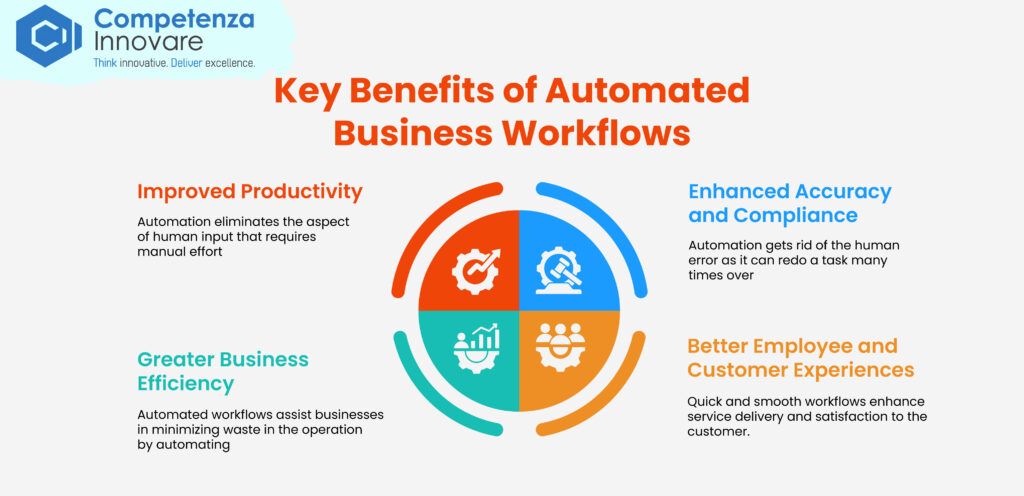
Key Benefits of Automated Business Workflows
Business automated processes assist an organization in streamlining its operations to lessen the repetitive work and enhance the company performance. Workflow automation software allows a business to develop new, efficient, more precise, and quicker processes.
Improved Productivity
Automation eliminates the aspect of human input that requires manual effort, as repetitive work is automatically done away with. The staff is able to save on time wastage in doing routine tasks and concentrate on the goals of performing significant business. Workflows that are automated are also useful in speeding up work because they save time and enhance the speed of a process.
Greater Business Efficiency
Automated workflows assist businesses in minimizing waste in the operation by automating the processes and eliminating the unnecessary steps. They also enhance resource allocation since teams are able to utilize their time and abilities better.
Enhanced Accuracy and Compliance
Automation gets rid of the human error as it can redo a task many times over. Standardization of processes assists the businesses to remain accurate, enhance data quality, and facilitate improved compliance management.
Better Employee and Customer Experiences
Quick and smooth workflows enhance service delivery and satisfaction to the customer. The collaboration is also enhanced through automated processes as teams, systems, and information are successfully linked in a more efficient manner.
Business Processes That Deliver the Highest Automation ROI
Automation processes will be most useful in businesses that target processes that involve repetitive business activities, manual approvals, and high-volume operations. These automated workflows are designed to minimize the manual work, enhance business efficiency, and provide quicker business results.
| Process Area | Automation Opportunity | Business Benefit |
| Finance | Invoice Processing | Faster Payments |
| HR | Employee Onboarding | Reduced Administrative Work |
| Sales | Lead Management | Faster Follow-Up |
| Customer Service | Ticket Routing | Improved Response Times |
| Operations | Approval Workflows | Increased Efficiency |
| Documentation | Document Management | Better Compliance |
Businesses can automate the most important departments like finance, HR, sales, customer service, and operations to streamline the daily workflow as well as enhance productivity. The automation of workflow software assists teams in working more quickly, minimizes errors, and designs more effective business processes that can work toward long-term growth.
Common Challenges in Business Process Automation and How to Overcome Them
Business process automation can assist a company to minimize manual processes and enhance efficiency, but effective deployment should be planned. There can be issues with people, processes, technology, and data among businesses. Overcoming these challenges contributes to developing effective and scalable automated workflows.
- Resistance to Change: The employees may not easily accept the new automation systems since they are unfamiliar with the new ways of doing things. With proper training, adoption is capable of improvement to explain the advantages of automation and to involve the teams in the process of implementation.
- Poor Process Documentation: Lack of proper process documentation can make process automation a challenge. Businesses ought to map the existing workflows, define process steps, and find areas of improvement before automating processes.
- Integration Problems: Automation devices may have a problem with connecting with the existing systems. The choice of workflow automation software that is compatible with ERP, CRM systems, accounting systems, and cloud applications helps to make sure that the process of data flow is efficient.
- Data Quality Issues: Wrong or poor quality information can affect the performance of the automation. Cleaning data, enhancing the practice of data management, and establishing data standards enable business organizations to have reliable results.
- Automation Strategy: A business might not meet the expected results due to a lack of automation strategy. Goal setting, concentrating on high-value processes, and creating an automation road will help achieve a successful implementation.
The Future of Business Process Automation
Automation of business processes is becoming more than the automated execution of simple tasks; it is becoming a smarter workflow capable of withstanding time, analysis, and adaptation to better itself. Now, businesses can reduce a significant amount of manual work, improve their flexibility and generate smarter processes with the application of AI, automation software, and advanced technologies.
AI-Driven Workflow Orchestration
The AI workflow orchestration is used to help businesses automate complex processes with the assistance of AI in data analysis, conclusion making, and in the automatic navigation of processes. It enhances workflow, accuracy, and better management of the processes.
Hyperautomation Strategies
Hyperautomation is a pact between technologies such as workflow automation software, AI workflow automation, and RPA to automate various business systems. It assists institutions in achieving efficiency and having additional automation prospects.
Intelligent Process Automation
Intelligent process automation utilizes AI and machine learning to operate more complex operations and streamline the processes. It enables businesses to design smarter processes to enhance decision-making and cut down the manual work.
Low-Code and No-Code Automation Platforms
It simplifies the process of automation by means of low-code and no-code platforms, which enable companies to design workflows requiring less expertise. These solutions facilitate fast automation of teams and scaled processes, departmentally.
End-to-End Digital Transformation
Automation has a significant part in digital transformation because it bridges systems, enhances workflows, and forms smoother operations. The trend of businesses embracing smart automation systems to help facilitate growth and efficiency is increasing.
Ready to automate workflows? Partner with The Competenza for smarter business automation solutions.
Conclusion
Business process automation assists organizations to decrease the number of manual operations, enhance effectiveness, and simplify day-to-day operations. Repetitive tasks, error reduction, and enhancing productivity can be achieved by using workflow automation software (AI workflow automation), RPA, and documentation automation software.
The key to successful automation is to begin with existing workflow understanding, a proper selection of solutions, and the optimization of workflows around the clock. The Competenza helps companies build intelligent automation designs in a way that can be leveraged to create efficiency, scale, and digital transformation that is sustainable.
Frequently Asked Questions (FAQs)
What is business process automation?
Business process automation is defined as the process of automating business processes by using technology and automating business processes that are time-consuming and repetitive. It allows organizations to replace cumbersome processes with automated processes that help to make them faster, more precise, and more efficient. With workflow automation software, businesses can now automate work in the organization, such as approvals, data processing, document handling, and reporting, and reduce the number of manual efforts.
How can workflow automation software reduce manual work?
The workflows are turned into automated operations to reduce the amount of manual labor involved and minimize the number of repetitive operations, approvals, and notifications along with integrating different business systems. The workers do not have to manually track or transfer data between systems; the workflows are automated to be faster and more standardized. This helps organizations to be time-saving, reduce mistakes, and overall improve on productivity.
What are some of the business processes that can be automated?
Automating a vast variety of processes in a broad range of departments can be done by businesses. Typical ones are invoice processing, the onboarding process of the employees, purchase approvals, customer support requests, managing leads, document management, reporting processes, and entry operations. Automation of such processes assists companies in enhancing efficiency and developing smoother business processes.
What is the distinction between AI workflow automation and RPA?
In AI workflow automation, the artificial intelligence is applied to the workflow to become smarter by analyzing data, giving recommendations, and helping in making decisions. RPA (Robotic Process Automation) is made to monitor the routine and rule-based tasks such as data entry, the transfer of data, and the updating of systems. The combination of AI and RPA helps companies build intelligent automation, which is more precise and effective.
What are some of the processes that can be automated?
Businesses are encouraged to seek out processes that are repetitive and time-consuming and those that often involve a manual process. Jobs that have clear rules, are transaction-intensive, require approval procedures, or have data processing repeatability tend to be suitable to automation. The study of the current workflows can assist organizations in determining the fields where automation can provide the most significant contribution.
What are the benefits of automated business processes?
Automated business processes have enabled organizations to manage to reduce manual work, improve their productivity, and complete their tasks faster. They minimize failures, improve visibility of the processes, improve higher collaboration, and allow employees to focus on strategic activities. Automation also allows businesses to be efficient and expandable through the streamlining of operations.
What does documentation automation software do to enhance efficiency?
Documentation automation software is used to automate business in terms of document creation and approvals, storage, and updates to enhance efficiency through document management. It reduces the amount of work that is conducted through paper and improves accuracy of documents, version control, and compliance requirements. This will enable a team to access and handle vital information more effectively.
What are the features that I should seek in workflow automation software?
An efficient workflow automation system must have the following features: workflow builders, process monitors, reporting dashboards, system integrations, task automation, and scalability. The solutions that can assist businesses in AI capabilities, data protection, and compatibility with the current business applications are also worth thinking of.
What role can automation play in digital transformation efforts?
Automation facilitates digital transformation by assisting organizations in ensuring that their processes are modernized, the systems are interconnected, and operations become more efficient. Through AI workflow automation, RPA, and workflow automation software, the organizations can develop smarter workflows, better decision-making, and more flexible processes to suit the demanding nature of the business.
What is the ROI of process automation in a business?
The automation ROI can be assessed by the business through metrics like productivity, speed of processing, cost, and error reduction. Insurance metrics such as enhanced speed of task execution, customer response time, support of reduced administrative effort, and enhancing workflow performance are other imperative metrics. Through these insights, the organizations can comprehend the long-term worth of their automation investments.