

Today, businesses are producing enormous volumes of data on sales, marketing, interactions with customers, business processes, and digital platforms. Although this data can be used to make improved decisions, most organizations continue to use fixed reports that can only show them the picture of the previous performance. By the time such reports are considered, the information could already be old, and thus the teams will find it hard to support new opportunities or market developments, as well as new risks, with a swift response. The current levels of business dynamics and competitiveness mean that an organization must have access to correct insight in a real-time manner. A critical role is a place for an AI intelligence dashboards. In contrast to more traditional reporting tools, an AI intelligence dashboard continually gathers, interprets, and visualizes real-time data (across a variety of sources), giving business institutions up-to-date information whenever needed. These tools not only visualize metrics but also employ AI to detect trends and anomalies and propose actionable recommendations.
The increased use of AI-powered business intelligence is altering the way organizations process information to make strategic decisions. Business leaders can also track performance in real-time and key performance indicators (KPIs) and swiftly respond to any changing conditions rather than waiting to receive weekly or monthly reports. AI-driven dashboards enable organizations to make more decisions about sales projection and operational monitoring to analyze customer behavior and make faster decisions.
Consequently, real-time business intelligence solutions offering real-time visibility and deeper insight are becoming the replacement for traditional reporting modes used by many businesses. In this blog, we shall discuss what an AI intelligence dashboard is, how it works, and why real-time analytics are seen as the more preferred option compared to a static report in current-day enterprises.
What Is an AI Intelligence Dashboard?
An AI intelligence dashboard is a sophisticated analytics system that processes business data in real time using artificial intelligence to gather, analyze, and display the data. It helps the organizations to track their performance and identify trends and make decisions quicker, depending on the correct insights.
Unlike the classic business intelligence dashboard, the standard version, the majority of which displays the data as previous reports and measurements, an AI-based dashboard processes data in real-time, setting the trends, discovering issues, and offering recommendations. It utilizes machine learning, predictive analytics, and automation to transform raw data into business-usable intelligence.
An AI business dashboard is an intelligent analytics tool used to assist a business in decreasing the amount of paperwork used in areas such as reporting, increasing the visibility of the augmented data, and determining clear and smooth decisions based on real-time data.
Key Components of an AI Intelligence Dashboard:
- Real-Time Data Collection: This is to be integrated with other databases of the data which will include sales, customer, finance and operational systems to get real time data. It also keeps its metrics up to date with current information on the business performance.
- AI-Powered Analytics: This works with artificial intelligence processing data, identifying the trends, detecting anomalies, and creating actions that are taken to drive business reactivity upon the emergence of changes.
- Smart Data Visualization: AI data visualization translates complex data into simple graphs and charts and other interactive reports, which make performance more comprehensible and teams make better decisions.
Why Traditional Static Reports Are No Longer Enough
Revisiting the traditional forms of reporting has played a major role in business performance tracking, yet the types of reporting seem to be out to achieve the business objectives today. The reports tend to give past data at set intervals, and as such, they do not help the businesses to react fast to the changing situations.
Some common limitations of static reports include:
- The information is outdated very fast: The reports can fail to represent the real circumstances of the business since they are based on the already gathered data.
- Report creation is time-consuming: Teams waste precious hours on the collection data, its organization, and its analysis rather than on the strategies.
- The low performance visibility: The presence of fixed information in a static report might not reveal the real-time trends, problems, or opportunities.
- Delay in making decisions: With obsolete wisdom, firms may miss out on the most crucial opportunity or may not respond timely in terms of risks.
The Growing Need for Real-Time Intelligence
Modern business organizations can function in a dynamic environment whereby access to appropriate information at the right time is crucial. Business intelligence and a real-time dashboard can help businesses to monitor their performance and trends and make better decisions faster.
Real-time intelligence enables businesses to:
- View real-time data and track important business indicators.
- Enhance decision-making by using the latest and precise insights.
- Detect risks and opportunities as they happen.
- Reduce dependency on manual reporting through automated business reporting.
Having the real-time data intelligence will enable the business to leave the old ways of reporting and have an unending view of its operations. AI-driven dashboards are more insightful and can assist leaders in making proactive decisions that can make them competitive in a data-driven world.
How Real-Time Analytics Dashboards Work
A real-time analytics dashboard operates based on gathering data on the various sources of business, analyzing it through AI, and delivering valuable perspectives in real time. It assists companies to check on the performance and changing trends and make quicker decisions on the basis of the valid and updated information.
Data Integration and Processing
Real-time analytics dashboards are linked to various business systems, such as CRM, ERP, sales, finance, marketing, and operations platforms. They maintain ongoing collection and synchronization of data supplied by these sources and generate a central visualization of business performance.
- Collects real-time data in different business systems.
- Maintain information by synchronizing data continuously
- Gives a comprehensive picture of business business and performance
AI Analysis in Action
AI-driven dashboards are not just a display of information but are designed to process data automatically to recognize trends, risks, and opportunities. This enables the businesses to be aware of what is going on and then promptly act.
- Trend Detection: AI detects a new pattern or shift in customer behavior and business opportunities to realize this pattern based on real-time data.
- Anomaly Detection: The dashboard identifies abnormal behaviors or sudden changes in information to enable a business to identify any potential setbacks before they lead to serious problems.
- Predictive Insights: The predictive analytics dashboard will show previous and current data to forecast what will happen to help organizations better plan and make proactive decisions.
Automated Recommendations
These data are analyzed on the AI insights dashboard, and depending on the trends identified, intelligent recommendations are generated. Such automated insights can help teams to react promptly, decrease risks, and improve decision-making.
- Challenges with real-time information.
- Endorses entrepreneurial business techniques.
- Speeds up and makes smarter decisions for organizations.
Key Features of an AI Intelligence Dashboard
Analysis is fast and efficient with the AI intelligence dashboard, enabling organizations to monitor their performance, analyze trends of performance, and make informed decisions through an ideal dashboard. The solutions will be capable of integrating artificial intelligence, automation, and real-time analytics more than the traditional dashboards, giving smarter insight and improving business efficiency.
Live KPI Monitoring
An intelligence dashboard is AI that provides companies with the ability to monitor key performance indicators (KPIs) in real-time. Instead of waiting until they receive periodic reports, teams can monitor sales, revenue, and customer activity as well as operational performance on a real-time basis. This assists organizations in knowing the changes, and they take prompt actions to refine the results.
Predictive Analytics
Predictive analytics assists businesses in predicting the future based on historical and real-time data. The AI intelligence dashboard is able to forecast the revenue, customer demand, operational performance types, and the problems that may arise, enabling organizations to strategize more accurately.
AI-Generated Insights
Controlled by AI, dashboards automatically process a substantial volume of data to recognize opportunities, risks, and key patterns in it. Such insights provided by AI assist businesses in identifying the trend of performance, identifying issues earlier, and making decisions more efficiently without wasting time analyzing the data manually.
Natural Language Queries
The current AI dashboard provides users with an opportunity to play with data through simple questions. Rather than developing complicated reports, the user is able to query the business-related questions and get presented with immediate results by using available data. This simplifies the analytics to executives, managers, and teams lacking the technical skills.
Customizable Dashboards
AI Intelligence Dashboards are able to be tailored to various business requirements and user functions. Executives can use personalized dashboards to visualize strategic insights, managers can use them to monitor the performance of their teams, and operational teams may use them to track their activities in their daily activities.
AI intelligence dashboards enhance visibility and reporting and make better decisions using real-time data by integrating smart business analytics, AI-powered reporting, and AI decision-making tools.
Benefits of Replacing Static Reports with AI Dashboards
The traditional static reports tend to give limited information since they only display past data and they need to be processed manually. Implementing AI dashboards, businesses will gain access to real-time information and streamline the reporting process, making smarter decisions with the help of AI-driven business intelligence.
- Quick Decision-Making: AI dashboards can help teams to get recent business insights in real-time and make decisions quickly. Decision-makers can examine the existing data, spot the opportunities, and react to changes much quicker instead of waiting to receive periodic reports.
- Enhanced Business Visibility: Using real-time business intelligence, an organization is able to stay informed throughout operations, monitor performance, and get an idea of what is happening in various departments. This full-time visibility assists businesses in detecting the trends as well as in enhancing the overall performance.
- Increased operational efficiency: AI dashboards unify manual data collection and creation of reports. Automation of reporting helps save time, reduce errors and enables teams to concentrate on strategic undertakings rather than undertaking redundant process of reporting.
- More Precise Predictions: AI dashboards will utilize predictive analytics to analyze past and real-time data that will guide the business to anticipate revenue generation, client apprehension, and business performance. Such accurate predictions can be used in planning, and resource management.
- Less Business Risk: AI-based dashboards have the capacity to spot abnormal behavior, issues in running performance, and possible risk early. Early detection of anomalies will enable the businesses to act in advance and mitigate the effects of issues.
Making AI dashboards to replace the fixed reports offers businesses a quicker insight, visibility, and intelligence to make more decisions. AI-based business intelligence assists organizations to transition towards reactive reporting to active strategies fueled by real-time information.
AI Intelligence Dashboard vs Static Reports
The traditional static reports allow businesses to review previous performance, though real-time insights are not always provided. The AI intelligence dashboard is an artificial intelligence, automated, and real-time analysis tool that facilitates insights faster, improved visibility, and smarter decision-making.
| Feature | Static Reports | AI Intelligence Dashboard |
| Data Updates | Updated at fixed times | Updated in real time |
| Analysis | Manual data review | AI-powered automatic analysis |
| Insights | Shows past performance | Provides real-time and predictive insights |
| Decision Support | Limited decision support | Helps make faster data-driven decisions |
| Alerts | No automatic alerts | Detects issues and sends alerts automatically |
| Forecasting | Basic or limited forecasting | Uses predictive analytics for future planning |
| User Interaction | Fixed reports | Interactive and customizable dashboards |
An AI business dashboard makes firms gain fast insights into business performance and niche key trends. In contrast to static reports, an enterprise analytics dashboard can deliver continuous and automated analysis and real-time information to enable better business decisions.
Real-World Business Applications of AI Dashboards
AI dashboards are helping companies in all industries make use of information more effectively and make faster decisions. Through real-time information, artificial intelligence, and sophisticated analytics, such dashboards are useful in understanding business performance, customer behavior, and the operational processes.
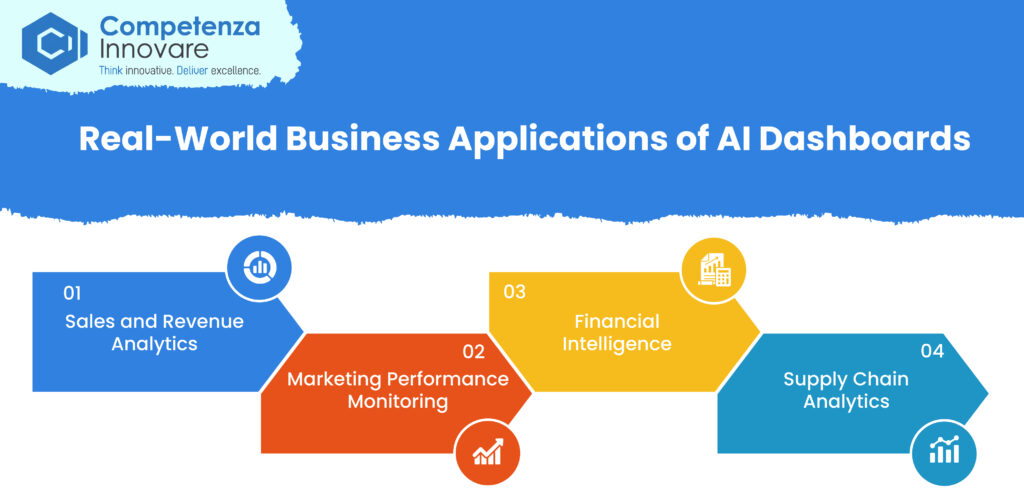
Sales and Revenue Analytics
The AI dashboards assist sales departments in monitoring real-time trends of revenue, sales, and customer purchasing behaviors. Companies are able to understand the better-performing products, wise sales goals, and how to create new revenue growth opportunities.
Marketing Performance Monitoring
AI dashboards enable marketing teams to quantify the performance of campaigns in real-time. They go through customer interaction and conversion rates and campaign outcomes to enable the business to know what is effective and which areas should be improved.
Financial Intelligence
The AI dashboards can help businesses keep track of budgets, expenses, cash flow, and financial forecasts. Real-time financial insights also help organizations to manage their costs, identify potential risks, and make better financial decisions.
Supply Chain Analytics
The utilization of AI dashboards increases the visibility of supply chains through inventory tracking, demand patterns, and performance of logistics. Companies are able to detect delays, optimize resources, and increase the efficiency of the business.
Customer Experience Analytics
An AI dashboard can help companies to understand customer behavior, preferences, and customer satisfaction. By examining customer data, organizations will be capable of improving services and personalizing experiences and will improve customer relationships.
An AI insights dashboard allows the company to turn complex data into actionable insights, whereas an enterprise analytics dashboard provides an all-purpose view of the operations, which helps organizations to improve their performance and make informed decisions.
How AI-Driven Business Intelligence Is Shaping the Future
AI-based business intelligence is transforming the way that businesses gather, process, and utilize data to make decisions. The smart analytics solutions offer quick, reliable predictions and recommendations imposed on modern organizations that are shifting towards an era of data-driven decision-making, not confined by conventional reporting means.
AI technologies will drive the future of business intelligence by assisting businesses in shaping their current performance, making future projections, and taking proactive steps towards the same. A smart analytics solution can help companies to transform dense data into valuable insights and enhance decision-making in various domains.
Key Emerging Trends in AI-Driven Business Intelligence:
- Predictive and Prescriptive Analytics: Artificial intelligence uses the information of the past and the present to predict what will occur in the future and to perform the most optimal decisions. Firms are able to anticipate the demand of customers, diagnose risk, and establish better strategies.
- Conversational Analytics: Conversational AI enables a person to be able to deal with business data by means of simple commands. Teams need not develop elaborate reports contrary to the speaking questions in natural language to get immediate feedback.
- Generative AI in Reporting: Generative AI may be applied to assist the creation of reports to produce summaries and explanations and important insights based on business data. This cuts down the work done by hand in reporting and enhances efficiency.
- Self-Service Business Intelligence: Introduction It enables users who are not technical experts to gain access to insights without relying on data experts. The data exploration, performance monitoring, and effective making of informed decisions can be easily achieved by teams.
Intelligent analytics platforms will become more crucial in business enterprises as AI keeps advancing to enhance efficiency, anticipate opportunities, and make decisions based on the data at a faster rate.
Transform your business reporting with AI intelligence dashboards and unlock faster, smarter decisions using real-time data.
How to Choose the Right AI Intelligence Dashboard
Choosing the right AI intelligence dashboard will help businesses gain access to better insights and make faster decisions. The right dashboard should provide real-time information, intelligent analysis, and reports that can be analyzed by non-technical teams that are also business-friendly.
In choosing an AI dashboard, key aspects that a business might want to consider include real-time data integration, AI and predictive analytics capabilities, scalability, and customization options. The analytics dashboard in real time should be connected to other data repositories and feed corresponding teams with the appropriate data to assist in tracking performance.
Security, compliance, and comfort are also factors to be considered when choosing an AI dashboard. The platform should be able to protect business information and provide easily visualized reports that the user can easily understand. The appropriate AI decision-making tools can help organizations to optimize their efforts and develop more intelligent choices.
The Competenza helps firms adopt AI-enabled business intelligence solutions that give real-time data, auto analytics, and smarter decision-making features.
Conclusion
The standstill information reports do not hold water, since the companies are in need of faster and more accurate data. The AI intelligence dashboard will help organizations to understand real-time information, uncover trends, and make smarter decisions.
AI-driven business intelligence can assist businesses with automating their reporting, monitoring performance, and adapting to changing situations. Reporting and real-time business intelligence solutions relying on AI can assist a company to minimize the workforce and make evidence-based decisions.
With businesses continually producing larger amounts of data, AI dashboards will be seen as valuable tools towards enhanced productivity, growth, and competitiveness.
Frequently Asked Questions (FAQs)
What is an AI intelligence dashboard?
An AI intelligence dashboard refers to a smart analytics solution that employs artificial intelligence to gather, work, and convey real-time business intelligence. It assists businesses to monitor performance, spot trends, and create quicker decisions involving proper insights.
What is the difference between an AI intelligence dashboard and a conventional dashboard?
The historical data presented in traditional dashboards is primarily in the form of reports and charts, whereas an AI intelligence dashboard provides an analysis automatically. It applies AI, machine learning, and predictive analytics to discover the patterns and issues and give actionable insights.
What reasons motivate businesses to stop using on-the-shelf reports?
Businesses are not sticking to fixed reports anymore because such reports tend to provide older results and need to be done manually. AI dashboards will give real-time insights, automated reporting, and faster decision-making.
Why would real-time analytics dashboards be valuable?
Real-time analytics dashboards enable businesses to track performance in real-time, help spot opportunities within a few seconds, spot risks in early stages, and make informed decisions based on the updated information.
What is the benefit of AI to business intelligence?
The AI enhances business intelligence such as handling large amounts of data, discovering latent trends, forecasting upcoming trends and recommending. This assists organizations to be smarter and more accurate in decision-making.
What AI intelligence dashboards are used in industries?
Industries like finance, healthcare, retail, manufacturing, marketing, logistics, and technology are the industries where AI intelligence dashboards find application. These assist businesses to better their operations, to analyze their customer behavior, and to optimize their performance.
What does predictive analytics mean in AI dashboards?
Predictive analytics is an approach that involves the use of historical and real-time data to forecast. Using AI dashboards, businesses can predict the tendencies in sales, customer demand, the operation process, and possible threats.
Could an AI dashboard be used to automate business reporting?
Yes, an AI dashboard can make business reporting automated and enable the collection of data, insightful analysis, and retention of performance by generating summaries and insights without manual reports.
What is the use of AI dashboards in decision-making?
The use of AI dashboards facilitates decision-making by interpreting data to observe trends in real-time and identify significant trends, trace issues in their early stages of creation, and prescribe measures.
What are the features that businesses should look at in an AI intelligence dashboard?
The features to be sought by businesses include real-time data integration, artificial intelligence analytics, predictive insights, customizable dashboards, data visualization, security, and easy-to-use reporting features.