

Warehouses are quickly moving towards being a high connection, technology-based environment that they have always been considered to be. The rise in e-commerce demand, greater demands on businesses to deliver products in a shorter time, labor scarcity, and the persistence of supply chain issues are pushing businesses towards automating their operations to enhance effectiveness in their operations and achieve a competitive advantage. The more complex the operations of the warehouse become, the smarter the companies are seeking to be in how they manage the inventory, workflows, and fulfillment operations at scale.
By 2026, robotics and automated equipment will not in themselves be considered as defining automation in warehouses. Although new technologies like autonomous mobile robots (AMRs), automated storage and retrieval systems (AS/RS), and intelligent conveyor systems remain in use to revolutionize the workings of their warehouses, it is the software serving to drive and coordinate them that truly provides an advantage. Contemporary warehouse automation software is the warehouse digital backbone that provides various opportunities to promote effective communication of inventory data, employees, robots, and supply chains.
This increasing dependence on smart software is creating a need to develop software to automate warehouses and more sophisticated logistics software development applications capable of automating warehouse workflows, increasing visibility of inventory, and aiding real-time decision-making. Companies are moving towards the adoption of automation tools in their logistics and AI-based technologies for warehouse management, minimizing error rates during forwarding, efficiently using resources, and providing timely responses to numerous market fluctuations.
Intelligent inventory management and predictive analytics, real-time monitoring, and integration of warehouse robotics are becoming the basis of warehouse innovation using software. Companies investing in contemporary technologies of warehouses and logistics are placed in a better position to enhance efficiency, overcome scaling, and create more resilient supply chain activities. This article will discuss the best trends in the development of warehouse automation software that is bound to dominate 2026 and how they are changing the future of warehousing and logistics.
Why Warehouse Automation Is Accelerating in 2026
By 2026, warehouse automation is accelerating due to increased order volumes and expectations of the consumer plus more complicated supply chain operations for businesses. This trend towards the further development of e-commerce and omnichannel retail has generated the need for same-day and next-day deliveries, which makes speed and efficiency the key to the modern warehouse.
Meanwhile, labor crunches and escalating operational expenses are pushing firms towards automating monotonous and time-consuming tasks. Businesses have the potential to automate their logistics operations in a warehouse and minimize the number of man-hours working, as well as increase the productivity of the entire warehouse by implementing logistics automation software.
A second significant force is the demand to have a more accurate inventory. Live visibility of inventory prevents inventory differences, minimizes errors during fulfillment, and makes sure customers get what they want when they are in need of the goods. Given that warehouses handle inventory in the different sales mediums, the automation software, used in supply chains, is crucial in ensuring that the operations of warehouses are very much interconnected and aligned.
All these are in a continuous digital change that is taking place in the warehousing industry as automation helps companies reduce human error in the organization, improve warehouse throughput, provide 24/7 business conduct, and increase order fulfillment. Warehouse automation is emerging as an important investment to enable organizations to develop more efficient and scalable logistics in the future in 2026.
The Shift from Hardware-Centric Automation to Software-Driven Warehouses
In traditional terms, automation in warehouses greatly depended on the hardware or implementation of an automated storage system, conveyor systems, sorters, robotics, etc. to enhance efficiency. As much as these technologies contributed to accelerating the processes in the warehouses, they tended to be independent systems with minimal communication and observability.
By 2026, warehouses are more software-driven. Businesses are not simply investing in automation equipment but are investing in warehouse automation software that can link together all the warehouse operations and operate them on one platform. This enables firms to track stocks and operational processes, organize automation systems, and make real-time decisions more quickly.
The new smart warehouse software solutions offer enhanced visibility to all the activities in the warehouse and assist in the removal of the bottlenecks in operational processes. They also enhance the communication across technologies and business systems.
The current smart warehouse management systems are the central node, as they link the following:
- Warehouse Management Systems (WMS)
- ERP systems
- Robotics and automation equipment
- IoT devices and sensors
- Transportation systems
- Inventory databases
These systems can be linked to produce the software as the force behind automating the warehouse to assist businesses in enhancing efficiency and visibility and developing smarter warehouse operations.
AI-Powered Warehouse Management Systems Are Becoming Standard
AI is emerging as an important component in the contemporary warehouses. To enhance efficiency, accuracy, and decision-making, businesses are turning to AI-powered warehouse management systems. AI uses big data regarding the working data to help warehouses optimize their inventories, human resources management, and their day-to-day business.
Demand Forecasting
The use of AI may analyze sales history, patterns, and customer demand patterns to forecast future needs of inventory. This helps businesses to maintain optimum stock levels, to reduce stockouts, and also to help improve inventory planning.
Labor Optimization
Warehouse managers can more efficiently distribute tasks using AI, basing it on workload, availability of the employees, and priorities of the operations. This enhances productivity and balances workload, and these resources are utilized efficiently.
Route Optimization
Intelligent warehouse management systems today involve the application of AI to determine the most effective picking and moving paths in the warehouse. This saves time on traveling, accelerates completion of orders, and improves the overall warehousing throughput.
Predictive Maintenance
Warehouse equipment and automation systems can be constantly observed by AI, which may reveal the possible problems that may lead to failures. Predictive maintenance helps reduce downtime and reduce the cost of repair as well as maintain smooth operations.
With increased investment in warehouse management system development by businesses, AI-based features are being incorporated as a necessary tool to create smarter, efficient, and more data-driven warehouse operations.
Real-Time Inventory Tracking and Visibility
The contemporary warehouses are becoming dependent on the real-time visibility of the inventory. Correct and modern inventory information is required by businesses to avoid cases of inadequate stock, minimize errors, and enhance filling of their orders. To attain this, several organizations are embracing real-time inventory tracking software that enables them to have instant visibility of inventory movement.
Technologies Enabling Real-Time Inventory Visibility
- RFID Technology for automatic item tracking
- IoT Sensors for real-time monitoring and data collection
- Barcode Systems for fast and accurate inventory updates
- Smart Shelving for automated stock tracking
Benefits of Real-Time Inventory Tracking
- Accurate inventory management
- Reduced stock discrepancies and shrinkage
- Faster inventory replenishment
- Improved order accuracy
- Better customer satisfaction
Through automated inventory management software, companies can increase the efficiency of their warehouse, increase the visibility of their warehouse, and make decisions that are based on data and are quicker to make.
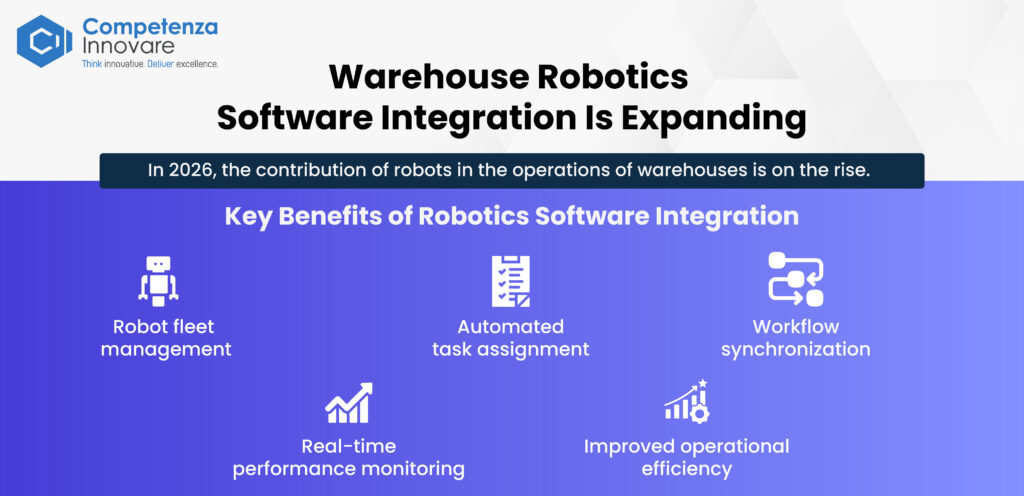
Warehouse Robotics Software Integration Is Expanding
In 2026, the contribution of robots in the operations of warehouses is on the rise. Automation is becoming popular in businesses to carry out tasks like picking, packing, sorting, and transporting materials in order to enhance efficiency as well as lessen manual labor.
Nonetheless, there is no difficulty in implementing robots, but there is difficulty in integrating them with the current warehouse systems. This is why the warehouse robotics software integration is important. The contemporary software assists in coordinating the work of robots, organizing the working processes, and allowing smooth communication among robots and warehouse management systems.
Key Benefits of Robotics Software Integration
- Robot fleet management
- Automated task assignment
- Workflow synchronization
- Real-time performance monitoring
- Improved operational efficiency
Common warehouse robotics technologies include:
- AMRs (Autonomous Mobile Robots) for moving inventory
- AGVs (Automated Guided Vehicles) for material transport
- Robotic Picking Systems for faster order fulfillment
With the combination of robotics and warehouse automation software, companies will be able to enhance their productivity, enhance their accuracy, and develop an efficient method of running a warehouse.
Cloud-Based Warehouse Management Software Development
Modern warehouse operations are shifting towards cloud technology due to its flexibility, scalability, and accessibility compared to the traditional on-premise systems. Due to the increased number of businesses creating logistics chains, numerous companies are exploring warehouse management software development tools based on cloud-related infrastructure.
Warehouse systems that run on the cloud can assist in providing lower infrastructure costs, allow businesses to expand, allow remote access to data, leverage faster software upgrades, and enhance team and location collaboration.
Benefits of Cloud-Based Warehouse Solutions
- Reduced infrastructure and maintenance expenses.
- Scalability with ease at the time of business expansion
- Access to warehouse data and operations remotely
- Quickly displaying new software and features.
- Enhanced cross-team collaboration.
Its new custom warehouse management is also cloud-based and offers multi-location warehouse management, visibility of inventory (wherever in the world), and central reporting. This enables them to have inventory control and performance and make decisions using one platform, contributing to making the process of warehouses even more efficient and interconnected.
Warehouse Workflow Automation Is Reducing Operational Bottlenecks
Warehouse workflow automation is being adopted by more businesses as a way of automating daily warehouse operation and enhancing efficiency. Automation is useful in maximizing receiving, putting away, picking, packing, shipping, and returns processing, minimizing delays and manual interventions.
These modern logistics automation software allow a warehouse to automate routine tasks and increase coordination within the workflow and enable a smoother operation through the fulfillment cycle.
Benefits of Warehouse Workflow Automation
- Faster order processing
- Reduced manual tasks
- Improved productivity
- Fewer operational errors
- Better warehouse efficiency
Automation of key processes also enables the business to achieve higher fulfillment times, enhance accuracy, and develop more scalable warehousing operations.
IoT-Connected Smart Warehouses Are Growing Rapidly
The IoT technology is enabling warehouses to be smarter. IoT vendors gather real-time operational information, which provides businesses with improved insight into the inventory, equipment, and warehouse operations.
Typical examples are smart sensors, connected equipment, environmental monitoring, and asset tracking. Such technologies can be used together with smart warehouse software solutions to enhance efficiency and decision-making.
Benefits of IoT-Connected Warehouses
- Continuous monitoring of warehouse operations
- Better equipment utilization tracking
- Improved inventory visibility
- Automated alerts for potential issues
- More accurate and real-time data
The IoT technology, when used together with real-time inventory tracking software, enhances business performance in the warehouses by minimizing inefficiencies in business operations and ensuring more control by businesses on the day-to-day operations.
Data Analytics and Predictive Intelligence Are Driving Smarter Decisions
Warehouses are becoming more efficient with the use of data analytics that transform data into insights to improve performance. In the current state of AI-powered warehouse management systems, warehouse activities can be analyzed to predict demands, optimize stocks, allocate labor, and detect inefficiencies.
Predictive analytics are also being used by businesses to guess the future needs, prescriptive analytics to suggest what to do, and business intelligence dashboards to monitor the performance on a real-time basis.
Benefits of Data Analytics in Warehousing
- Better demand forecasting
- Optimized inventory management
- Improved workforce planning
- Faster decision-making
- Increased operational efficiency
Using intelligent warehouse management systems, warehouses will be able to make decisions that are more data-driven and enhance productivity levels in their work.
Custom Warehouse Management Software Is Replacing One-Size-Fits-All Solutions
There are quite several businesses with peculiar warehouse procedures that cannot be optimally supported by the use of even common software. Consequently, business enterprises are now investing more in custom warehouse management software that suits their unique requirements.
These solutions are able to accommodate industry-specific needs and customs fulfillment processes, multiworkshop operations, and third-party integration.
Benefits of Custom Warehouse Management Software
- Greater flexibility
- Improved scalability
- Better system integration
- Enhanced operational efficiency
- Competitive advantage
By choosing an appropriate approach of warehouse management system development, organizations can develop warehouse solutions that will expand as the organization expands and increase the overall performance of the organization.
The Future of Warehouse Automation Software Beyond 2026
The automation of the warehouse is supposed to be even smarter and more interconnected after 2026. With technology, businesses will be basing their efficiency, visibility, and decision-making processes on software-based systems in warehouse and supply chain operations.
Key Trends Shaping the Future
- Autonomous Warehouses – Warehouses will be fully equipped with cutting-edge automation technology that will assist in performing more tasks with less human input.
- AI-Driven Decision-Making – AI will evaluate the data on operations and assist businesses to make more rapid and correct decisions.
- Digital Twins – Virtual warehouse models will make companies test workflows and discover bottlenecks and better performance before operational changes.
- Hyperautomation – It will automate additional mechanics of the warehouse, thereby reducing manpower and enhancing efficiency.
- Self-Learning Inventory Systems – The artificial intelligence systems will continuously adjust the inventory data to learn and be better predictors and to manage inventory.
- End-to-End Supply Chain Orchestration – Greater coordination among warehouses, suppliers, transportation service providers, and distribution networks.
The development of future warehouse automation software will assist the businesses in unloading people, robots, inventory, and transportation systems seamlessly, and enhanced supply chain automation software will enhance visibility, efficiency, and scalability within the warehouse operations.
How Businesses Can Prepare for Warehouse Automation in 2026
The growing automation of warehouses requires a decisive plan of action among businesses to achieve success in adopting new technologies and keeping competitive. Automation does not just need the introduction of new tools but rather the establishment of a robust digital base that can be leveraged to ensure growth and efficiency going forward.
Best Practices for Warehouse Automation Success
- Upgrade Legacy Systems – Create an upgrade to the old systems that deny efficiency and visibility of the data.
- Invest in Scalable Software Architecture – Select solutions that can keep pace with business requirements and the growing demand of operations.
- Value System Integration – Ensure that systems within the warehouse, inventory, ERP, and logistics are integrated.
- Implement cloud-based applications – Improve access, elasticity, and visibility of activities in real-time.
- Get AI Properties – Optimize AI inventory and decisions and improve forecasting.
- Consider Data Quality – Operations insight and quality automation – Data is based on accurate information
- Choose Informed Development Pairs – Locate individuals who have expertise on warehouse operations and logistics software to automate knowledge.
Being part of their warehouse digital transformation, a business that invests in appropriate technologies, integrations, and software solutions is going to be more equipped to enhance efficiency levels, scale operations, and respond to future supply chain needs.
Why Businesses Need Custom Warehouse Automation Software Development
The complexity of the warehouse operations requires businesses to have software capable of sustaining their distinct workflows, automation solutions, and operation objectives. Custom solutions offer more flexibility, real-time visibility, and integration even across warehouse systems.
Having experience in logistics software development, Competenza assists companies in developing scalable warehouse solutions that enhance efficiency and process automation that promotes long-term growth. An appropriate software base can help organizations achieve maximum benefits on their investments in warehouse automation and remain ready to meet evolving needs.
Conclusion
The intelligent software that links people, processes, inventory, and automation technologies is driving warehouse automation in 2026. The implementation of AI and cloud computing systems, integration of IoT, analytics, and robotics transforms the modern warehouse to become more efficient, interconnected, and data-driven. Companies that invest in appropriate solutions of automation and logistics software could become efficient in their operations, become more visible, and scale more efficiently. With technology ever-changing, software will continue to be at the heart of smarter and more automated operations in the warehouse.
FAQs
Which are the trends in warehouse automation software in 2026?
The trends expected in the warehouse automation software market in 2026 are AI warehouse management systems, real-time inventory management, integration of warehouse robotics, cloud-based warehouses, easy tracking of inventory, automation in workflow, and smart forecasts. These business technologies assist in enhancing efficiency, the accuracy of the inventory, and the overall performance in warehouses.
Why should modern warehouses use warehouse automation software?
Warehouse automation software enables companies to unite inventory systems, workflow, employees, and automation technologies in one platform. This enhances the visibility of the operations, minimizes the amount of manual errors, accelerates the process of filling orders, and facilitates efficient control of warehouses.
Why is AI important to better warehouse operations?
The intelligent learners pay off warehouses with regard to effective inventory management, demand, labor optimization, identification of optimum picking routes, and maintenance equipment needs. Businesses using AI-enabled warehouse management systems are able to make decisions quicker and more precise and increase productivity.
What are the benefits of live-time monitoring of stocks?
Inventory tracking: Inventory is tracked in real time, thus giving you appropriate visibility to the movement flow and stock. It contributes to minimizing discrepancies in stocks, enhancing order accuracy, saving time in terms of replenishment, and enhancing customer satisfaction due to more guaranteed fulfillment.
What does warehouse robotics software integration mean to efficiency?
The integration of warehouse robotics software enables companies to easily control the robots, assign tasks to them, match workflows, and track the performance of robots through a centralized hub. This improves efficiency and reduces the manpower and the work of the warehouses.
Why do businesses invest in tailored warehouse management software?
Warehouse processes of many businesses are unique and cannot be completely supported by standard software. Dedicated warehouse management software offers more flexibility, meets particular business requirements, can be integrated with existing systems, and can be extended along with business requirements.
How can businesses be ready to automate their warehouses in 2026?
Some of the things that businesses can do to prepare are modernizing the legacy systems, outsourcing cloud-based solutions, introducing new AI features, improving data quality, laying a greater emphasis on system integration, and investing in scalable software programs. These measures assist in establishing a solid base of effective warehouse automation.
What implicates the future of warehouse automation software?
The future of warehouse automation software will be autonomous operations, decision-making using AI, digital twins, hyperautomation, and connected supply chains. Such developments will assist companies in making smarter, efficient, as well as more automated, warehouses.