
As businesses move to use generative AI, selecting the appropriate strategy to tune the large language models (LLMs) has become a pivotal business choice. Although the foundation models have strong capabilities, they tend to require access to specific knowledge about the companies, expertise in the industry, and current information in order to provide meaningful outcomes. It is at this point that RAG (Retrieval-Augmented Generation) and fine-tuning become a factor.
The two methods assist in enhancing AI performance, albeit in various ways. The RAG is capable of enhancing performance by providing helpful information in external data in real-time, and by training a model using specialized data, it can be better aware of this particular duty or area. The right alternative depends on the presence of the data, the interest of the business, the cost involved, and the scalability.
This guide will compare the two, RAG vs. fine-tuning, and their key differences, advantages, and disadvantages and apply them both to your enterprise AI strategy. Regardless of whether you are developing intelligent assistants, enterprise search applications, or unique AI applications, these approaches are crucial to making informed decisions regarding AI investments.
Why Enterprise AI Requires Customization
General-purpose language models are typically not capable of supporting the needs of enterprise AI solutions. Though such models as GPT, Claude, and Llama are powerful, they are trained on open data and might not be aware of the knowledge that a company has or the industry-specific needs and business processes.
The Limitations of Generic LLMs
Generic LLMs can make useful responses but may often be problematic in an enterprise application. Having dynamic business knowledge, they may lack access to proprietary information, struggle with technical language, and present out-of-date information. “This could impact accuracy, compliance, and decision-making.”
The Need for AI Model Customization
To provide the best results to organizations, organizations should have their AI models that cover their workflows and goals. AI systems that are required in businesses can:
- Understand company-specific terminology
- Access internal knowledge bases
- Follow business processes
- Deliver accurate and compliant responses
- Support industry-specific use cases
This increasing need has given rise to the implementation of RAG AI solutions and fine-tuning LLMs to enable organizations to create more successful and scalable enterprise generative AI solutions.
What Is Retrieval-Augmented Generation (RAG)?
Learning about the Framework Retrieval-Augmented Generation (RAG) is one AI method that improves Large Language Models (LLMs) by relating them to external knowledge bases. RAG does not only use the data on which it was trained but will also retrieve other relevant information in documents, databases, APIs, and the enterprise system and then generate a response. This assists businesses in providing more correct, current, and contextual answers.
How RAG Works
- Data Indexing: Enterprise documents, files, and knowledge are transformed into embeddings and stored in a vector database to be able to be retrieved quickly.
- Query Processing: When a query is made by the user, the query is translated into the searchable representation as a vector.
- Information Retrieval: The RAG system not only searches the knowledge base but also retrieves the most relevant information based on the query.
- Response Generation: The retrieved data is fed into the LLM development services, where the model uses the context to come up with a strong and more relevant response.
Key Components of RAG Systems
The RAG AI solution generally involves the integration of models, vector databases, retrieval engines, large language models (LLMs), and knowledge repositories. Combined with these parts, AI systems find and utilize the relevant information effectively.
Benefits of RAG AI Solutions
RAG helps companies to gain access to the current information without training models. It enhances precision in response, minimizes AI hallucinations, eases updates of content, and lowers the cost of implementation. Such benefits have exposed RAG as an ideal solution to companies who wish to develop scalable and trustworthy enterprise-wide solutions in generative AI.
What Is Fine-Tuning in Large Language Models?
Understanding fine-tuning is a process that customizes a pre-trained large language model (LLM) using domain-specific data. The model does not have to look up data in an external source but can learn based on business data to enhance its specialized work. This aids in organizations developing precisely sharpened language models that comprehend the industry-specific demand and procedures more diligently.
How Fine-Tuning Works
- Data Collection: The affected datasets are collected according to the business needs and applications.
- Data Preparation: Data cleaning and data organizing involve preparing the data to be subjected to training.
- Model Training: The trained model receives the training on enterprise data to improve its understanding of some topics and tasks.
- Validation and Testing: The model will be tested to establish the level of performance and accuracy of the model.
- Deployment: The individualized model is done in business operations and applications of the enterprise.
Types of Fine-Tuning
- Full Fine-Tuning: More highly optimizes all model parameters in order to make it fully customizable.
- Parameter-Efficient Fine-Tuning (PEFT): Fine-tunes the chosen model components in such a way as to reduce training costs.
- Fine-Tuning Instructions: Trains the model to better follow instructions and perform tasks.
Benefits of Fine-Tuned Language Models
Fine-tuning allows organizations to produce AI models with more specialized knowledge in the domain and more reliable results. It enhances task-oriented performance and personalizes and assists companies to form tailored enterprise generative AI capabilities that can meet their individual needs.
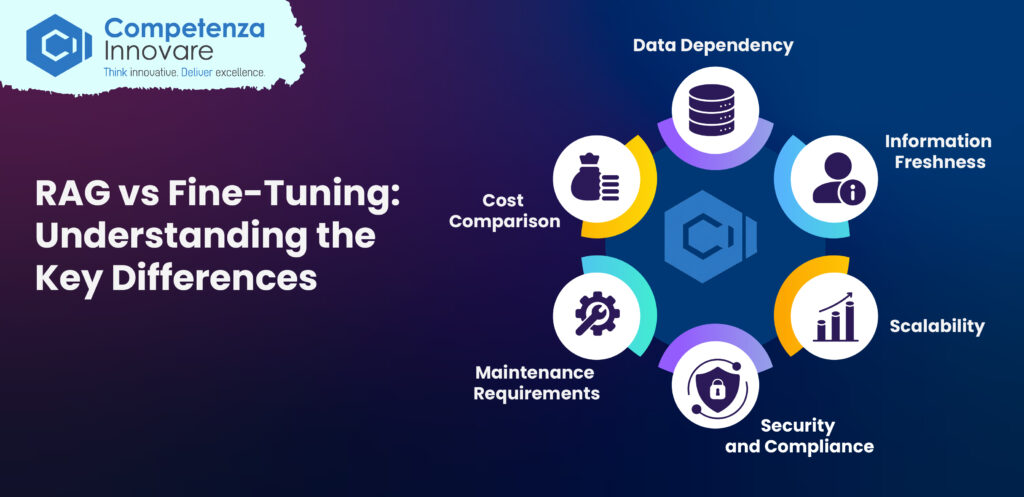
RAG vs Fine-Tuning: Understanding the Key Differences
The RAG vs. fine-tuning is a key choice to consider when organizations are deploying enterprise AI development solutions. Although each strategy enhances the performance of large language models (LLMs), they differ in terms of accessing information, cost management, scaling throughout the organization, and maintaining the product’s long-term support. By being aware of such differences, the businesses can choose an appropriate enterprise AI strategy that will match their goals and applications.
Data Dependency
RAG: The RAG AI solution involves the model accessing external knowledge resources, i.e., enterprise documents, databases, APIs, and internal knowledge bases. This makes sure that the responses are informed by the most current information.
Fine-Tuning: In Fine-Tuning LLMs, the knowledge is instantiated into the model as parts of the model get trained. This model trains on curated datasets and provides answers based on that knowledge, without accessing external data.
Cost Comparison
RAG: Typically less upfront investment, since the existing repositories of knowledge can be linked to the AI system, without the intensive training of the model. This renders RAG an affordable solution to numerous commercial generative AI endeavors.
Fine-Tuning: Generally is more expensive because of the cost of data preparation, training models, and even the use of GPUs as well as continuous optimization. The investment can be justified in high-specificity applications where there is a need to have deep domain expertise.
Information Freshness
RAG: An important benefit of Retrieval Augmented Generation compared to fine-tuning is that RAG has access to real-time information. The AI system can find updated content without retraining the model as the enterprise data gets updated.
Fine-Tuning: The model is based on the training information. Additional training is usually required to distill new business data, policies, or regulations.
Scalability
RAG: Scaling ease performances Easier scaling, as the same AI model can access different knowledge sources found across different departments, teams, and business functions. This is flexibility, which makes RAG applicable in expanding businesses.
Fine-Tuning: It may get more complicated when organizations require distinct, fine-tuned models across various cases of use, products, and industries.
Maintenance Requirements
RAG: This is primarily maintenance such as updating enterprise documents and repositories. This enables companies to maintain the information up-to-date with low disruptions.
Fine-Tuning: This will need periodic retraining, testing, and monitoring of the performance of the model to maintain accuracy and compliance with the changing business needs.
Security and Compliance
Both RAG AI solutions and language models that have been fine-tuned can be used to provide enterprise-grade security, privacy, and compliance. The best solution is reliant on aspects like policy in data governance, regulatory requirements, and management of sensitive information. the company. Enterprises in controlled sectors must consider the security needs when crafting their enterprise artificial intelligence policy.
When Should Enterprises Choose RAG or Fine-Tuning?
The decision between RAG vs Fine-Tuning is based on the purpose of data usage by your organization, the sophistication of your processes, and the amount of AI customization you need. Both methods assist in the development of enterprise AI, yet they address various business-related issues.
When Should Enterprises Choose RAG?
The RAG (Retrieval-Augmented Generation) is a powerful selection in case the organization involves working with great volumes of information that cannot remain the same over time. Because RAG accesses external sources of information on the fly, it is able to offer more up-to-date and contextualized responses without having to retrain the model.
It is widely applied to knowledge management of the enterprise, customer support systems, enterprise search solutions, regulatory compliance, and product information management. These applications have the advantage of fast access to updated documentation and policies or business information. RAG gives a helpful and scaled solution to organizations that value accuracy of information and regular updates of the content.
When Should Enterprises Choose Fine-Tuning?
Fine-tuning works best where the businesses require AI models that possess the specific knowledge and congruent outputs. Training a model on industry-specific data allows organizations to perform better at specific tasks and workflows.
The typical uses lie in legal assistants, healthcare solutions, financial services, creation of brand-specific content, and specific business processes. In such a case, the AI model must be more knowledgeable about industry words, rules, and how it operates. Fine-tuning assists in providing more customized responses and a uniform user experience.
Choosing the Right Approach
In the choice between retrieval-augmented generation and fine-tuning, business requirements sometimes have the last word. RAG can prove to be the more suitable choice in case your organization relies on information that is constantly changing. Fine-tuning can be beneficial to you should you need deep domain knowledge and highly differentiated output. With the ongoing development of enterprise generative AI, most companies are adopting the combination of the two methods to develop more intelligent and efficient AI solutions.
Can RAG and Fine-Tuning Be Combined?
RAG vs Fine-Tuning is not a decision anymore for many organizations. They instead integrate the two strategies to create better enterprise AI solutions that are capable of reaching real-time information as well as providing specialized and consistent responses.
The Hybrid AI Approach
A combination of RAG AI solutions and fine-tuning LLMs can be a hybrid approach, which will integrate the strengths. Fine-tuning assists the model in learning about industry requirements and the processes in the industry, whereas RAG offers you access to up-to-date information by relying on sources of enterprise knowledge. They collaborate to develop smarter and stronger AI systems.
Benefits of Hybrid Architectures
A combination of the two methods will help organizations enhance the quality of response, better situational awareness, minimize hallucinations, and provide more customized user experiences. Facilitating more efficient growth and more diverse enterprise generative AI applications is also facilitated by hybrid architectures.
Real-World Enterprise Applications
Hybrid AI applications exist even in the following categories: intelligent customer support, knowledge assistant automation, enterprise searches, and industry-specific copilots. Using both retrieval and customization features, the enterprises can create scalable and high-performance AI applications that effectively fit into their enterprise AI strategy.
How to Choose the Right Enterprise AI Strategy
The choice of an appropriate enterprise AI approach is based on the business needs, data environment, and business goals. In the case of a perfect fit, there is none because the best solution must correspond to the objectives, resources, and the long-term AI strategy of your organization. Collaboration with expert AI partners like The Competenza will assist companies in assessing their needs and adopting an AI solution that will yield the best results.
Questions Decision-Makers Should Ask
Decision makers ought to look at a number of factors before deciding on whether to pursue RAG, fine-tuning, or a hybrid strategy. How often does your business data vary? Is real-time information required? What resources and budget to implement and maintain are available? Does it have an application scenario that needs specialized knowledge within the industry or extremely personalized outputs? Which security and compliance needs must be satisfied? Lastly, what do you think your AI solution will need to scale in terms of teams, department, or business function?
Decision Framework
- Select RAG because: When you need to process data that changes frequently, need to have knowledge that is available in real time, and need an inexpensive system that can be implemented rapidly.
- Select Fine-Tuning when: You have a domain-based usage that needs strong domain understanding, extremely reliable results, and AI equipped to acquire specialized vocabulary, processes, or business operations.
- Use a Hybrid Approach when: You require real-time information retrieval and one-dimensional AI features. RAG AI solutions and fine-tuning LLMs can also be used together to enable organizations to be more accurate, more personal, and more scalable.
By critically examining these parameters, the companies can decide on an approach to drive their enterprise generative AI-based aspirations and generate long-term value. Engaging in the creation of more sophisticated AI solutions, The Competenza can transfer its expertise to organizations interested in adopting its strategies in order to align with their own business needs.
Future Trends in Enterprise Generative AI
Generative AI in the enterprise is an ever-changing field, and companies are contemplating the possible technologies to increase efficiency and automation as well as decision-making. Enterprise AI is getting defined on a variety of innovations in the future.
Emerging Innovations
- Agentic AI Systems – AI systems can plan and execute as well as perform tasks with minimal human intervention.
- Enterprise AI Agent development – Slave assistants that are used in business activity and processes.
- Adaptive Retrieval Systems – Advanced retrieval systems that increase the quality and relevance of AI-generated answers.
- Multimodal AI Applications – AI systems that understand and process text, images, audio, and video.
- Domain-specific foundation models are specialized versions of AI and are applicable to domains such as medical, money, and law.
- AI Governance Frameworks – Policies and standards that will transform AI use to be a legal, safe, and responsible practice.
Conclusion
The RAG vs Fine-Tuning level will differ, based on your business objectives, data requirements, and AI uses. RAG AI solutions are suitable for organizations that require real-time information and constantly updated knowledge, whereas fine-tuning LLMs are more suitable for special tasks that need profound domain knowledge and consistent results. With the development of enterprise generative AI, what most business leaders are doing is integrating both methods to enhance accuracy, scalability, and performance. Knowing the advantages of the approaches will allow organizations to make the right choices and create AI solutions that bring overall benefits to the companies in the long-term perspective, efficiency, and business sustainability.
FAQs
Why is there a difference between RAG and fine-tuning?
RAG (Retrieval-Augmented Generation) layers external knowledge on information retrieval, and further fine-tuning of a model on specialized datasets enhances the model to understand special tasks. RAG aims toward getting existing knowledge, and fine-tuning aims towards becoming more experienced in the model.
RAG or fine-tuning: which is better in enterprise AI?
The answer does not fit all. The RAG AI solutions can be applied to organizations that require the frequent access to the updated information, whereas fine-tuning of the LLMs can be used in those cases, when the services will need specific knowledge, stable efficiency, and industry expertise.
Does RAG necessitate model retraining?
No. The key benefit of RAG is that external data sources allow retrieving the information; any business can update knowledge repositories without retraining the underlying model.
Is fine-tuning more costly than RAG?
In most cases, yes. Fine-tuning is generally associated with data preparation, model training, and computation, which may raise the cost of implementation. RAG can be less expensive in many cases since it does not require a significant level of retraining to utilize the existing knowledge sources.
Is it possible to use RAG and fine-tuning?
Yes. A hybrid strategy of the use of RAG and fine-tuning is adopted by many organizations. This allows AI systems to receive real time information and it also enjoys the advantage of domain expert knowledge and predictability.
When is the time to use RAG in the business?
RAG is a powerful option when the information is constantly modified and the necessity of real-time access to enterprise knowledge is high. Its typical applications include customer support, enterprise search, and knowledge management as well as applications based on compliance.
Which situations should a business adopt fine-tuning?
Applications that have strong industry knowledge, special processes, and steady outputs are best tuned by fine-tuning. Recurring applications are in healthcare, finance, legal services, and brand-specific AI applications.
What can RAG do to minimize AI hallucinations?
RAG bases answers on verifiable data about the use of credible sources of enterprise knowledge. It assists in the refinements of response generation accuracy and minimizes chances of hallucination as it utilizes the appropriate context.
What business industries are able to apply fine-tuning?
Financial services, healthcare, legal, insurance, and technology are also common examples of good uses of fine-tuned language models, as they require particular knowledge, any understanding of compliance, and industry-specific terminology.
What is the appropriate AI approach of enterprises?
The data freshness, budget, scalability, security requirements, and domain expertise requirements are some of the factors that need to be considered by the organizations. The right enterprise AI strategy relies on the business goals, the needs of the operation, and long-term AI objectives.