
The modernization of applications is a speedy process, and security seldom keeps up. Companies facing the stress to modernize their legacy systems, move to the cloud, or migrate to modern architectures tend to consider security as an issue to resolve once the technical work has been accomplished. The fact that sequencing is among the most costly decisions of a modernization program is a fact. Security vulnerabilities introduced during modernization silently exist in the form of poorly configured infrastructure, poorly migrated access control, and unnoticed data handling holes until they fail.
The end of the project is not a stage of security during application modernization. It is a field utilized between the initial architecture decision and the ultimate cutover and beyond into production. Those organizations in the US, UK, EU, Australia, and APAC that are about to modernize without consideration of security into the modernization process are all coming to the same point: it is a modern application architecture that has merely substituted an old security debt with a new security risk.
This guide discusses application modernization security best practices, the nature of the security risks that the modernization process introduces, the frameworks and controls that should manage these security risks, and what needs to be in place prior to the launch of any modernized system. Whether it is a secure legacy application modernization program or your first move to cloud-native workloads, the disciplines here dictate whether your new modernized environment is really more secure than the one it is replacing.
Why Application Modernization Creates Security Risk
Learning how even the modernization process can bring new vulnerabilities.
These are all legacy application security risks, which can be explained as unpatched software, outdated encryption, and limited audit capacity. What is less understood is that the modernization process itself introduces a rather clear compartment of security risks in application modernization services that is exactly due to the fact that the system is under transition.
During modernization, the attack surface is increased transiently. The existing modern architecture and the old architecture can co-exist. Information is moved across environments. Access controls are reconfigured. Infrastructure is reprovisioned. Integration points are reassembled. Every activity leaves some openings of vulnerability that a non-changing environment, not even a legacy one, offers.
The predominant application modernization security failures follow patterns: identity and access mismanagement in a new environment, improperly set up cloud infrastructure, data leaks during migration, insecure APIs between legacy and modern elements, and compliance failures that arise before new controls become fully realized. Knowing these failure modes is the beginning of a secure application modernization framework.
Application Modernization Security Checklist
A practical reference for security validation throughout the modernization lifecycle.
| Security Area | Action | Stage |
| Security requirements documented | Define alongside functional requirements | Planning |
| Threat modeling completed | Apply STRIDE to modernized architecture | Design |
| Security ownership assigned | Define per layer — infra, app, data, compliance | Planning |
| IAM redesigned to least privilege | RBAC, mTLS, secrets management | Design / Build |
| Data classified before migration | PII, financial, regulated data mapped | Pre-migration |
| Encryption enforced in transit and at rest | TLS 1.3, AES-256, KMS | Build |
| Cloud infrastructure hardened via IaC | IaC scanning with Checkov / tfsec | Build |
| CSPM enabled | Continuous configuration monitoring | Build / Ops |
| DevSecOps pipeline established | SAST, SCA, DAST, container scanning | Build |
| API security tested | OWASP API Top 10, rate limiting | Pre-launch |
| Legacy application security assessment | Document and address all known vulnerabilities | Pre-launch |
| Penetration testing completed | Before production launch | Pre-launch |
| Compliance validation completed | Map requirements to controls | Pre-launch |
| Audit trail continuity confirmed | No gap between legacy and modern logging | Transition |
| Incident response procedures tested | Tabletop exercise before go-live | Pre-launch |
| Continuous security monitoring live | SIEM, alerting, vulnerability management | Post-launch |
Build a Security-First Modernization Strategy
Security has been built into the approach and not attached on the end.
Define Security Requirements Before Architecture Decisions
The earliest security intervention in any modernization program is of the most importance. Document the security requirements of the modernized system, at the same level of detail and with the same importance as functional requirements, prior to the definition of the architecture of the modernized system.
Security requirements at the current level must cover data classification, legal requirements to comply with regulations, access control models, encryption requirements, audit and logging requirements, and controls needed to satisfy the security requirements of any applicable frameworks, such as GDPR regarding EU personal data; HIPAA regarding US healthcare data; PCI-DSS regarding payment data; requirements in the UK financial services sector; and requirements within your industry and region.
An architecture constructed by architectural decisions devoid of security requirements as an explicit input will always result in an architecture with an expensive refinement to a security assessment extended later as an incidental concern. The greatest payback security investment in the whole program is to get security into the requirements definition.
Conduct Threat Modeling During Design
Threat modeling helps the modernized system systematically determine how it could be attacked, the implications of successful attacks, and the controls to reduce each of the threats to be applied in the design prior to commencing implementation. It is a requirement of all solid application modernization security strategies.
The STRIDE framework, Spoofing, Tampering, Repudiation, Information Disclosure, Denial of Service, and Elevation of Privilege is the most common framework used to model threats and the key benefits of modernizing enterprise application programs. It applies to the modernized architecture to reveal certain attack vectors and generate a prioritized set of controls to respond to those.
Design-based security risk assessment is far less expensive than a post-production security risk assessment, since the threats identified in design can be mitigated by design-level and low-cost decisions, whose retrofit costs are very high.
Assign Security Ownership Explicitly
Lack of knowledge is hardly a factor in application modernization security failures. A lack of ownership brings them about. Security tasks lie between teams in large programs with a number of workstreams. Assign concrete ownership at each layer: architecture, infrastructure, application code, data movement, and compliance. Practical shared security ownership is that of none.
Identity and Access Management During Modernization
The most critical area of security in modernized application environments is Identity and Access Management (IAM), one of the most commonly misaligned areas in the process of modernization programs. The starting point of all zero trust security and a key element of safe cloud migration is to get IAM correct.
Migrate Access Controls to Least Privilege
Old systems build years of access control debt of access control permissions granted to users with more access than their job demands, administrative access to their service account that was never revoked, and group memberships no longer representative of the existing structure. The possibility to reestablish an access model of least privilege is known as secure legacy application migration. A wholesale migration of legacy access patterns into a new modern IAM system brings its existing security debt into the new system.
Implement Role-Based Access Control
RBAC ought not to be based on the ad hoc permission structure used in the legacy system but rather on the modernization program. Assign roles that show up-to-date job functions, access requirements, and least privilege concepts. Grant roles and not people. Find work assignments to audit roles prior to the go-live and create a review process after launching.
Secure Service-to-Service Authentication
The microservices architecture places service-to-service authentication pressures on the monoliths, which they do not often handle. Each inter-service call would be an attack point in case of failure to authenticate it. Authenticate inter-services using TLS or tokens. Store secrets using a special secrets manager service, AWS Secrets Manager, Azure Key Vault, or HashiCorp Vault instead of storing credentials in configuration files.
Data Security During Application Modernization
The most valuable thing that exists in any modernization program, as well as the most vulnerable to mismanagement, is data. The greatest exposure risks and the compliance failures that become the most consequential are found in secure legacy application migration of data.
Classify Data Before Migration
Prior to transferring any information, categorize it. Locate data with identifiable personal information, financial information, health information, and any other content that has special processing regulations. Map data under geographic residency requirements GDPR residency provisions of EU data and contractual obligations of any UK or APAC customers to storage locations, addressing the requirements before the migration should commence. In cloud migration security best practices, the basis of all data security decisions is data classification.
Encrypt Data in Transit and at Rest
No data with a sensitivity classification lower than a high level can be encrypted. In transit data must be served with TLS 1.2 or 1.3, which must be applied uniformly to all the parts of the application, API calls, and administration connections. AES-256 should be used to ensure data at rest, and keys ought to be handled in a dedicated key management service. In the process of migration itself, as data is transferred between the old and new environments, encryption should be explicitly defined in the migration pipeline. A particular type of cloud application security risk is pipelines carrying sensitive data in plaintext.
Validate Data Integrity Post-Migration
Corruption of the imported data may be introduced by character encoding variations, schema variations, truncation of field values, or errors in the transformations, which may result in latent integrity issues that may not even be found at the time of the incident. Create automated data integrity checks comparing source and target data sets after migration and notifying deviations in them before migrated data is utilized in production.
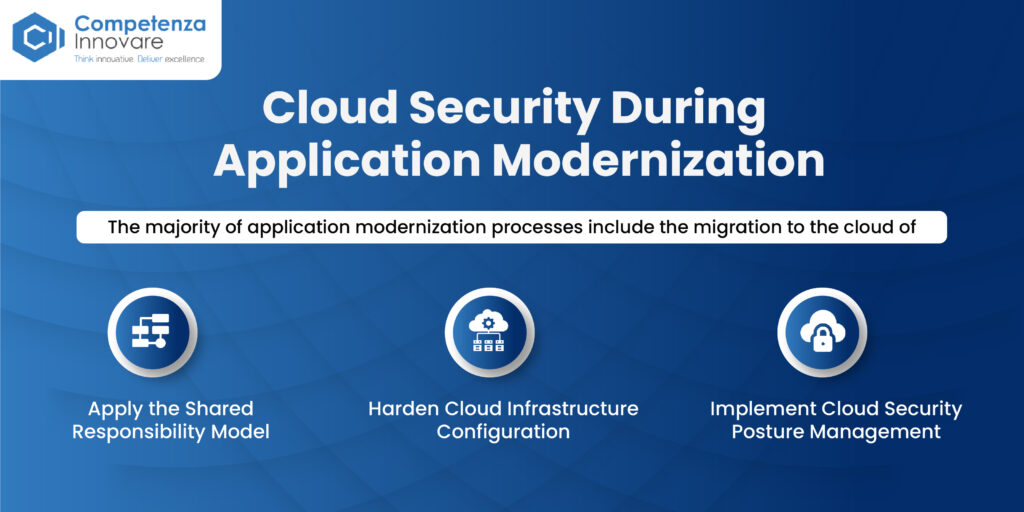
Cloud Security During Application Modernization
The majority of application modernization processes include the migration to the cloud of on-premise setups towards the public cloud, private cloud, or hybrid infrastructure. Cloud environments add the issue of security to considerations that on-premise environments lack and are often undervalued when planning to modernize.
Apply the Shared Responsibility Model
The cloud shared responsibility model outlines what security duties are to be assigned to the cloud provider and to the customer. The provider ensures the physical infrastructure, the hypervisor layer, and the managed services. The customer retains the operating system configuration, applications, data, the network setup, and identity and access management.
The most prevalent cloud security failures in modernization occur due to the fact that teams believe that the cloud provider does more security work than it actually performs. Explicitly capture the boundary of shared responsibility, clearly map each security control with a security control owner, and confirm that all customer-side security controls have been implemented prior to the production workloads becoming live.
Harden Cloud Infrastructure Configuration
Cloud infrastructure misconfiguration has proven to be the main cause of cloud security breaches that occur all over the world and results in a large percentage of the number of data breaches reported every year in the US, UK, EU, and APAC. Examples of the common misconfigurations during the modernization process encompass publicly accessible storage buckets, too liberal security group rules, unencrypted storage volumes, and logging and monitoring, which was not enabled by default.
Write cloud infrastructure configuration in version-controlled templates that can be scrutinized, examined, and audited with Use Infrastructure as Code (IaC), AWS CloudFormation, and Azure Bicep. Use tools such as Checkov, tfsec, or Bridgecrew to perform automated IaC security scanning early in the infrastructure before it is provisioned.
Implement Cloud Security Posture Management
Cloud Security Posture Management (CSPM) tools can automatically track the configuration of cloud infrastructure to security best practices and compliance requirements instead of manually reviewing it periodically. In the case of modernization programs where infrastructure is being deployed and changed quickly, CSPM keeps one informed of the state of the security of the environment all through the transition.
API Security During Application Modernization
Application modernization nearly always adds APIs as the connecting interface between the legacy and modern parts, as the interface between the microservices, and as the means by which the modernized application can expose itself. The OWASP API Security Top 10 is contributory to broken object-level authorization, broken authentication, and broken security misconfiguration, characterizing the types of vulnerabilities most frequently used in real-life assaults on modernized applications.
Authenticate and Authorise Every API Call
All API calls, internal and external, should be authorized and verified. Use OAuth 2.0 and OpenID Connect to authenticate the outside API. Have an authentication between services and encrypted mTLS or signed tokens when making internal calls. Implement authorization at the API layer, not only the UI layer. This forms the basis of a secure application modernization framework.
Conduct API Security Testing
Before any new API is released into production, application security testing, which targets APIs, must occur. OWASP ZAP automated scanning along with manual testing of the OWASP API Security Top 10 would capture the most common vulnerability classes that would be created during modernization. Special focus should be given to APIs between legacy and modern elements—they mark the point of contact between two potential environments with security postures that may be different.
Compliance and Regulatory Considerations
Combating regulatory requirements during the modernization transformation.
Map Compliance to Each Modernization Phase
The compliance requirements do not halt in the process of application modernization. Retrospective requirements apply to the old system being decommissioned as well as the current system being constructed; these include GDPR and HIPAA, PCI-DSS, and FCA requirements, among others. Assign each compliance requirement to detailed controls in every step and ensure that there is no compliance gap in the transition. Any secure legacy application modernization program in regulated industries cannot do without this.
Maintain Audit Trails Throughout the Transition
Audit logging, not only the final modernized system, should be maintained at any rate of modernization. Any compliance gap is not a tolerable side effect of a modernization program in any regulated setting when legacy audit capability is not decommissioned prior to modern audit capability being fully commissioned. Audit trail failure by transition is not acceptable by regulators in the US, the UK, and the EU.
Conduct Pre-Launch Compliance Validation
Prior to the launch of any modernized system, perform a formal compliance validation that catalogs every relevant regulatory need to the particular controls applied in the modernized structure. It is the application modernization security checklist validation that distinguishes programs that start in a position of defensible compliance and those that find openings post-go-live.
DevSecOps: Embedding Security in the Modernization Pipeline
Ensuring that security is made continual rather than a gate.
DevSecOps application modernization responds to putting in the CI/CD pipeline security tooling and the security responsibilities that ensure security validation automatically on each commit of code, build, and deployment of that code. In modernization programs in which code is being written, modified, and deployed quickly, DevSecOps also makes sure that security issues do not build up between releases and forms a fundamental part of any application modernization security best practices framework.
A DevSecOps pipeline ready to move towards modernization consists of SAST on each code commit, software composition analysis of the vulnerable open-source dependencies, IaC security checks prior to infrastructure changes, container image scans prior to deployment, DAST on staging, and automated compliance checks that are aligned to relevant regulatory frameworks.
Implementing the DevSecOps pipeline early, when not much of the code is yet written, implies that all the elements of the modernized system will be security-verified even at the moment of its initial deployment, and not only the final production and release. This is the best structural application of application modernization security best practices in an active delivery program.
Security Testing Before Go-Live
The validation gates ensure security prior to exposure to production.
Penetration Testing
Before production is launched, penetration testing against the modernized application should be accomplished. Skilled professionals find the vulnerabilities that can be missed by automated tools: a business logic vulnerability, bypassing authentication, and configuration problems that will only be evident to the attacker. Under PCI-DSS, it is a compliance requirement. Demonstrable security assurance is an expectation under the GDPR and FCA inspection. Penetration testing is essential to any secure application modernization program.
Legacy Application Security Assessment
Prior to decommissioning the legacy system, perform a legacy application security assessment that records all legitimate vulnerabilities, ensures that all have been mitigated in the updated architecture, therefore verifying that no security controls related to the legacy system have been unintentionally forgotten during transition.
Security Architecture Review
Include a formal security architecture review of IAM design, network architecture, data flow, and encryption implementation, API security, and the controls against each identified threat. This review is the last approval of the secure application modernization framework prior to production exposure.
Post-Modernization Security Operations
Post go-live security is an ongoing discipline of operations, not a deliverable of a project.
Establish Continuous Security Monitoring
The modernized application should have its production monitoring monitored on cloud application security and software security as well as performance and availability. Security surveillance must also cover real-time notifications regarding abnormal access control, higher rates of failed authentication, and abnormal data access, as well as infrastructure changes. A SIEM that consolidates application, infrastructure, and identity logs makes the visibility needed to respond to and detect incidents in real-time.
Maintain Zero Trust Security Principles
The idea of zero trust security, i.e., the idea that no user, device, or service is trusted by default regardless of network location, is an operational discipline that ought to be implemented even following the modernization process. There is nothing such as a standalone configuration: constant checks, minimum privilege, and microsegmentation. They are ongoing occupational roles that are in operation.
Define and Test Incident Response Procedures
Pre-establish formal policies on incident response in the existing environment even before the first instance of a production incident. Exercise by means of a table. The GDPR of the EU stipulates that supervisory authorities be notified of any personal data breach in a 72-hour span. The obligation to notify privately of breaches applies to all 50 states in the US. These timelines involve response processes that have already prepared a response, not one created under the pressure of an incident once an incident is confirmed.
Conclusion
Application modernization security is not one of the work streams that operates along with modernization. It is implemented as part of the modernization itself since its requirements phase, through architecture design, development, testing, and even the continued operation of the modernized system.
The ones doing secure application modernization correctly are lessees of a certain discipline: They see security as a condition or requirement of the modernization strategy, rather than a gateway leading to production. They incorporate DevSecOps in application modernization. They are prone to conducting legacy application security assessments before they decommission anything. They check compliance prior to launch. And they introduce zero trust security and round-the-clock monitoring even at the initial production operation.
When put into practice, the Competenza application modernization security best practices in this guide will result in the creation of a modernized application whose security posture has been brought up to date with its architecture and far more defensible than that of its predecessor system.
Frequently Asked Questions
Why is security more important during application modernization?
Modernization of an application increases the attack surface temporarily. Security at all levels throughout the application modernization process avoids the setting of vulnerabilities introduced during transition instead of dealing with them following such an occurrence.
What is the shared responsibility of cloud security?
The shared responsibility model stipulates which security responsibilities should be assigned to the cloud provider and which to the customer. Managed services and physical infrastructure are obtained by providers. It is the responsibility of the customers to secure applications and data, controlling access and configuring networks.
How does identity and access management fit in the modernization process?
Re-architect the access model instead of wholesale migration of legacy permissions. Adopt RBAC, provide service-to-service authentication with mTLS or token authentication, and utilize a special secrets management service with all credentials. Do not bring legacy permission debt to the contemporary world.
What is DevSecOps, and how can this be applied to modernization?
DevSecOps incorporates security tooling SAST, SCA, IaC scanning, container scanning, and DAST and implements them into the CI/CD process, thus making security validation automatic with each build and deployment. Implementing the DevSecOps pipeline during the modernization program early enough ensures that all the components undergo security validation upon their initial deployment.
What about data security in the migration from legacy to modern systems?
Label each and every piece of data. Encrypt all migration pipelines in transit with TLS 1.2 or 1.3. Mitigate data at rest in the target environment with AES-256. Use data integrity tests that determine that post-migration the data and target data are the same. Pre-migration DLP controls should be in use.
Will we require penetration testing in modernizing the application?
Deficiencies are discovered by penetration testing. Automated tools overlooked the flaws of business logic, authentication breaks, and setups. It is a compulsory requirement under PCI-DSS. Evidential security safeguards are an expectation of GDPR and FCA surveillance.
What are compliance requirements in the process of modernization transition?
They get automatically extended to the legacy system under decommissioning and to the new system under construction. Assign each compliance requirement to a particular control in each stage. Make sure that an ability to audit logs is not alienated in the transition. Make a formal compliance check prior to production.