

The portfolio of applications that organizations in the US, UK, Europe, Australia, and Asia sit on was erected in a world that no longer exists. Corporate needs are no longer the same. The world of technology has changed. There is a tightening of the regulatory environment. And the systems are still costly to maintain, hard to scale, and further and further out of touch with what the business actually needs to do. Most enterprises are no longer able to do without legacy system modernization strategies. They are the means by which organizations regain the operational performance, security stance, and development rate that older systems have incessantly lost.
The obstacle is not being aware of the necessity of modernization. Already, the majority of technology leaders have heard about it. It raises the question of how to go about it, which systems to focus on, what type of legacy system modernization approach is the best choice in this or that use case, how to order the work to deliver value without disrupting operations, and how to prevent the traps that have killed many previous modernization projects. A survey by Gartner suggests that 91 percent of organizations are aware of the direct effect that technical debt in legacy systems has on agility and speed of delivery, but still many will not move, citing a lack of understanding of the right way forward.
This guide offers such clarity. It encompasses the entire range of legacy system modernization best practices, including the strategic frameworks defining the approach to use, the technical practices defining whether implementation is achieved, and the organizational discipline defining whether modernization achieves its promised results.
What Is Legacy System Modernization?
Understanding the problem before selecting the course of action.
“Modernization of legacy systems” refers to the transformation or modification of aging software systems to suit present and future business demands. It includes a range of interventions between minimal changes to keep a given system useful, on one extreme, and complete replacement and starting all over by recreating business logic on a different technical basis.
Age is not the defining characteristic of a legacy system; the defining characteristic is the extent to which the system limits the business. A legacy system is any application that is costly to support, changeable, not well integrated with newer platforms, and susceptible to security threats, no matter the age of its creation. Even a supported application must have been in operation for at least ten years, with in mind that it is cost-effective and meets the needs of the business.
“Migration” and “modernization of legacy systems” are two terms that are usually used interchangeably; however, they are different. Migration generally means the process of relocating a system between two environments, on-premise to cloud, e.g., without overhauling its architecture. Modernization is wider; it focuses on the architecture, technology stack, integration capacity, and security posture of an application but not the area it is being run on.
Why Legacy System Modernization Matters in 2026
The business interests that elevate modernization into a strategic agenda, as opposed to a technical practice.
Security and compliance risk: The older systems that operate on end-of-life software are not patched against security risks. In regulated sectors, financial regulations by the FCA in the UK, healthcare regulations by HIPAA in the US, and businesses with EU personal data handling under GDPR operating systems with no patches and/or support are direct regulatory compliance issues. The breach cost, or the cost of the regulatory sanction, is always higher than the cost of the modernization that would have averted the breach.
Technical debt at scale: The Gartner number is concerning; 91% of organizations state that the presence of technical legacy at scale directly limits their agility. All the features that are slower than they ought to be, all the accidents that are due to fragile code that was not written to take today’s load, and all the man-hours spent by the code writers to wade in untested complexity and not write new functionality are the debt maintenance fee on years of untimely modernization.
Competitive and digital transformation pressure: It needs application infrastructure capable of supporting digital transformation efforts: AI adoption, process automation, omnichannel customer experience, and real-time data analytics. The most frequently used blocker is the legacy system. Modernization of the core application estate by organizations opens the infrastructure layer that their transformation strategy needs.
Talent and maintenance cost trends: There is a declining trend in developer talent pools in legacy technologies. There is no significant replacement of COBOL developers, Delphi specialists, and Oracle Forms experts as compared to retirement. With a shrinking talent pool, the expenses of searching and continuing to employ skills that could support legacy systems rise, and the leverage that talent can offer as the codebases get older declines.
The 7 Core Legacy System Modernization Strategies
The principal approaches available and where each one fits best.
The choice of the modernization method prior to the commencement of work is one of the key decisions made throughout the program. The unwise strategy of trying to do a complete rebuild where a replatforming would have been adequate or rehosting when the business logic actually requires it to be re-architected spends money and delays the value delivery and may leave the organization in a worse state than it entered.
1. Encapsulation
Providing legacy functionality as APIs without modifying the implementation.
The encapsulation encapsulates the functionality of current legacy components and provides them as services using current APIs. A modern API layer is constructed over the legacy application itself, which allows other systems to use its functionality in a structured, standardized manner.
This is the most harmless and quickest modernization strategy to apply. It does not provide the technical debt or maintenance cost of the older system, but it can fix the isolation of integration that cannot allow legacy systems to be part of more modern digital ecosystems. Encapsulation may be used especially as an initial measure, allowing integration as a more extensive modernization effort is scheduled and implemented.
Best for: Systems where the business logic is valuable and needs to be used by other systems, where a full modernization is intended but cannot occur at this moment.
2. Rehosting (Lift and Shift)
Moving the application to a new environment without modifying the code.
Rehosting is used to move the application off the current infrastructure, which is often old hardware deployed on-premises to a new infrastructure, most often cloud infrastructure, but without changing the application itself. Code, architecture, and business logic are retained. Its underlying infrastructure is changed.
Rehosting is quick and non-problematic. It not only removes on-premise infrastructure expense but also enhances reliability with cloud-grade infrastructure of an SLA; it is also capable of delivering instant cost savings. It also makes its commentary on application-level technical debt and code-level security vulnerabilities and lack of scalability due to architectural constraints. But as the initial stage in a more extended modernization process, it is like a base of modern infrastructure, off of which more modernization can extend.
Best for: Any application where the main constraint is infrastructure cost or availability, and modernization at the application level may come at later sites.
3. Replatforming
Switching to a new platform with specific optimizations.
Repacking downloads the application to a new platform or infrastructure with sufficient but narrow changes to ensure the application works on the new platform and will take advantage of the capabilities of the new platform, but not a total re-architecture of the application itself. An example would be the process of moving away from a managed cloud database service or an application server on-premise to a container-based implementation.
Replatforming offers better benefits than rehosting in terms of delivering more modernization, better scalability, and lower infrastructure operation overhead and is frequently lower in cost with lower risk and less investment than an actual re-architecture. It makes some technical debt and offers some meaningful improvement to the dimensions that matter the most to most organizations.
Best for: When infrastructure modernization provides substantial business value and when the current business requirements are not being hampered by the application architecture, which is not optimal.
4. Refactoring
Enhanced the code without altering its functionality.
Refactoring is an internal code organization process that removes redundant code, enhances structure, conforms to existing coding standards, and makes the code simpler without altering the external behavior of the code. The system carries out the same activities that it used to do previously; it carries them out with cleaner and maintainable code.
The most specific of the code-level modernization strategies is refactoring. It leaves no effect on architecture or even platforms, but it decreases the technical debt that one change has on the time and risk of each subsequent change. The most effective long-term legacy modernization best practice is regular, systematic refactoring, which needs to be considered as an ongoing evolution of the development process and not as a project.
Best for: The technical debt is growing slowly such that it is beginning to slow down feature delivery, but the underlying architecture and platform are sound.
5. Re-architecting
Refactoring the architecture without changing business logic.
Re-architecting alters the technical structure of the application, replacing monoliths with microservices, fixed coupling of components with loose coupling of APIs, and on-premise deployment with cloud-native architecture but without changing the business logic that is embodied in the application. The what remains the same; the how is radically different.
It is the most important of the non-replacement strategies and the strategy that provides the greatest benefit of modernization. An application re-architected can scale elastically; interoperate with current platforms with ease; be written and deployed as a service independently of both the rest of its component services; and run at a much lower total cost of ownership than the monolith that it replaces.
It is as well the most complicated and risky strategy other than complete replacement. The most common pattern of managing this type of risk is the strangler fig, which gradually bmitssupplants monolith components with modern services whilst the monolith persists in operation, enabling the organization to deliver value on a case-by-case basis instead of taking a gamble cutover approach in the form of a big-bang migration.
Best for: Applications in which scalability, integration ability, and development speed are all limited by the existing architecture and in which the business logic has sufficient value to be retained.
6. Rebuilding
Beginning afresh with a new business need.
Rebuild replaces the legacy application modernization with a new one built on modern technology and using modern architecture and modern development methods that satisfy the same business requirements. In contrast to replacement, rebuilding keeps the business demands and business knowledge in the legacy system and simply uses it in a clean and modern manner.
It is also correct to rebuild when the legacy codebase is so marred in technical debt, workarounds, and architectural constraints that it cannot be progressively refined to a satisfactory level. It is the most risky and costliest-to-value modernization plan available in any modernization plan except total replacement, and it must have well-documented requirements to confirm that the new system understands all the phenomena that the legacy system can handle, such as the undocumented edge cases, which tend to emerge only once the legacy system has been decommissioned.
Best for: Legacy systems with high constraints where the requirement to modernize cannot or will not be fulfilled through incremental methods at reasonable cost and cycle time.
7. Replacing
Replacing the legacy system with a commercial or open-source system.
Replacement completely replaces the old application and implements a commercial off-the-shelf (COTS) application, SaaS platform, or open-source solution that addresses the necessary business functionality. The radical legacy style of modernization is the most radical and is usually commercially most effective in systems that are generically business-implementing, as opposed to proprietary logic.
In the case that the legacy system is a custom-built CRM, ERP module, or HR system that is actually not providing anything truly proprietary, then a modern SaaS counterpart will often be able to offer superior functionality, reduce the overall cost of ownership, and provide a constantly updated platform at a fraction of the cost of a maintained custom legacy system.
Best for: Applications with legacy code that support generic business operations with no viable proprietary logic distinction and where a developed commercial substitution exists.
Building Your Legacy System Modernization Roadmap
Converting strategy selection into a step-by-step, commercially feasible program.
A legacy modernization roadmap is the implementation plan that converts the choice of the strategy to implement into an ordered, guided program of work. And without a roadmap, modernization will be reactive, focusing on the most urgent and not on the most strategically significant issues and never developing toward the consistent modern application habitat that the business requires.
Assess and Prioritise the Application Portfolio
Its legacy modernization program begins by being honest about the existing portfolio of applications. In every application, consider business criticality, technical health, maintenance cost trajectory, security risk, integration limitations, and alignment with current business strategy. This evaluation generates a prioritized list that orders modernization activity to those areas where action will bring the most business value.
Structured methods of this prioritization, such as the Gartner TIME model (Tolerate, Invest, Migrate, Eliminate) and the BCG Application Portfolio Management framework, offer structure to this prioritization and have been proven in enterprise efforts on modernization programs in the US, UK, EU, and APAC.
Match Strategy to Application
On the portfolio that was evaluated and ranked, use the seven-strategy framework for each application. The criterion used to select an application is its business value, its technical health, the extent of proprietary logic that it implements, and the business case of each mechanism.
A useful simplification: applications that are of high business value and whose architecture can be salvaged become re-architecting candidates. Highly-business-value applications whose codebases are severely compromised are rebuild candidates. Applications that have a low business value and generic functionality are the ones that will be replaced. Applications that require the integration capability but are not budgeted to be fully modernized are eligible as encapsulation applications. Applications that are the main limiting factor are applications in which the infrastructure is the most dominant factor and hence can be rehosted or replatformed.
Define Phases and Milestones
The credible legacy modernization roadmap is staged with demonstrable business value each time and not gambling all on the date by which the program may be finished many years later. Phase structure can normally be of two types: risk-based sequencing (treat the most risky systems first) or value-based sequencing (treat the most valuable opportunities first). In the majority of cases a combination is the most effective solution to critical security and compliance risks at an early stage and scheduling the most valuable architectural modernization work at later stages.
Legacy System Modernization Best Practices
The disciplines that reveal whether execution brings in the promise of the strategy.
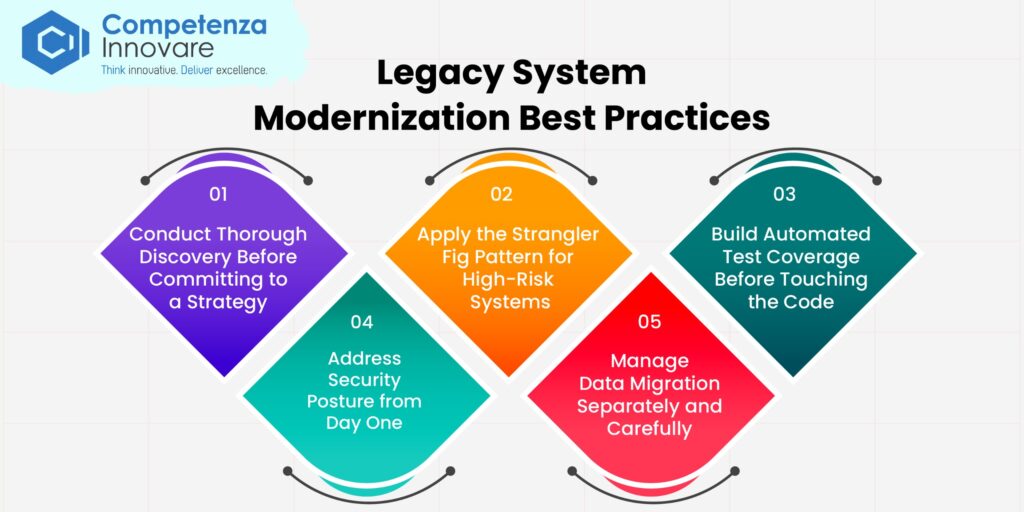
Conduct Thorough Discovery Before Committing to a Strategy
The biggest failure by far of the modernization program is entering into the approach without getting acquainted with the legacy system to get to know whether one approach suits it or not. The current systems are often better documented than legacy systems. There is also the undocumented business logic, unknown dependencies, and integration points that no one can recall but upon which all depend when executed, which had not been revealed during the discovery.
A well-planned discovery phase code analysis, a review of architecture, dependency mapping, business logic documentation, and stakeholder interviews should be invested in prior to finalizing the modernization strategy of any complex system. The exploration investment is trivial as compared to the expenditure of the misguided approach implemented at the full scale.
Apply the Strangler Fig Pattern for High-Risk Systems
In business-critical systems and when a big-bang cutover entails intolerable operational risk, the strangler fig pattern offers the risk management pattern the program requires. The legacy components are gradually replaced by new components while the former system is kept running during the process. Migration of users is done in phases. The retirement system is not decommissioned at some high-stakes event but gradually through parts.
This solution stretches the modernization schedule in relation to a complete rebuild, although it leads to a huge reduction in the areas of concentration of danger whereby a single moment is determined in which the entire program’s success or failure will be determined.
Build Automated Test Coverage Before Touching the Code
The fact that legacy systems lack automated test coverage makes it difficult to change them safely. The code is not well written, the interactions between the components are not completely known, and the code is complicated. Without a test suite, it is possible that with every change something that was previously functioning will be broken without any known method, and this may not be realized until it is too late to alter the production.
One of the best returns on investment in any legacy modernization program is to build automated test coverage, unit tests, integration tests, and end-to-end regression tests before starting active modernization work. The safety net is what enables incremental change to be viable and snatches the regressions that undocumented legacy complexity is bound to generate.
Address Security Posture from Day One
Modernization of a legacy system is the chance to shift the application to the modern context of security and not an issue to resolve later on in the program when the architecture has been established. Threat modeling in design stages, code hardening in development, automatic security testing in CI/CD pipelines, and a broad data protection design are all expected to be instituted as the modernized app gets developed and not refactored post hoc.
In regulated industries like GDPR in the EU, HIPAA in the US, and equivalents like FCA requirements in the UK and APRA guidelines in Australia, it cannot be assumed that the compliance posture of the modernized application has been implicitly designed and proven out by the technology upgrade but must be specified explicitly.
Manage Data Migration Separately and Carefully
The most risky part of most legacy modernization programs is data migration; it is also the most commonly misjudged during the planning stage. With legacy systems, years of data are stored in formats and structures that were not created in line with the new replacement but with the original system. The age of the databases makes the occurrence of data quality problems, duplicates, orphaned records, inconsistent formats, and encoding problems more common exceptions than exceptions.
Migrate the plan as an independent, explicit workstream. Perform data profiling and data quality analysis, and then design the migration process. Pretest several entire migration procedures in non-production to cutover to production. Explicitly define and verify rollback procedures to the data layer but not only to the application layer.
Establish Governance and Progress Monitoring
Enterprise legacy modernization programs usually last several months or years. In the absence of an institutionalized governance framework to guide committee management, establish success goals, and periodically review progress, and a clear procedure of escalation of decision-making actions that stall progress, programs meander. Scope grows. Timelines extend. Budget overruns accumulate.
Governance is not the administration; however, it is the process by which a multifaceted and prolonged program is held within its commercial aims. Establish governance structures initially at the start of the program and implement them throughout the program.
Modernize your legacy systems with expert strategies built for scalable, secure, future-ready business growth.
Common Legacy System Modernization Mistakes
The patterns that are a consistent source of modernization program underdelivery.
Underestimating legacy complexity: The complexity of a legacy system is invariably greater than it appears during analysis. The rule and not the exception is that you find hidden dependencies, undocumented business rules, and integration points that occur only when you test them. Embark on contingency in the timeframes and budgets explicitly explaining this risk of discovery.
Selecting the wrong strategy due to the wrong reasons: The failed selection of a strategy based on the minimization of the budget, instead of the nature of the application, will always have a negative effect. The least expensive method of specific application may not necessarily be the most cost-effective throughout the program lifecycle.
Omitting automated testing: Some of the surest ways of going on a regression-driven overrun are to attempt to modernize large legacy code without automated test coverage. The cost of constructing test coverage prior to reaching the code is large enough always compared to the cost of the regressions uncovered without the coverage.
Trying to do everything at once: big-bang modernization. Trying to upgrade or upgrade an entire application estate at once puts all the risk in one place. Phased, incremental programs are always reliable and less expensive than big-bang approaches.
Oversight of the human factor: Legacy modernization alters the manner in which people work. Two imperfect applications that developers may be accustomed to when substituted will need change management. Training, documentation, and the involvement of stakeholders do not constitute added value to a modernisation programme. They also decide on whether the new system is embraced or not.
Conclusion
Successful legacy system modernization takes three elements together: the correct strategy for each application, its business value, and discipline in execution practice that handles the complexity and risk of the legacy environments, and disciplined governance that helps the program remain on course to meet its commercial goals across a multi-phase and often multi-year delivery process.
The seven strategies in this guide, encapsulation, rehosting, replatforming, refactoring, re-architecting, rebuilding, and replacing, offer the complete array of possible strategies. The most common practices—discovery, stratifier, high-risk systems, test automation, security-first design, cautious data migration, and solid governance—are the practices that make the difference between the strategy of choice and achieving its goals.
No universal approach can be applied to all applications. No program is successful when there are no disciplines governing the implementation. Competenza with deliberate strategy choices and stringent implementation have made a consistent performance in terms of modernization that will justify the investment and leave the business at the edge to compete on modern application infrastructure.
Frequently Asked Questions
What is modernization of legacy systems?
Legacy modernization can be defined as the process of modernizing, re-architecting, or replacing old software systems that have become outdated to business needs.
What are the principal legacy system mainstream strategies?
These 7 strategies have been summarized as encapsulation, rehosting, replatforming, refactoring, re-architecting, rebuilding, and replacing. The combination is common in the majority of the enterprise modernization programs and employs various strategies for various applications depending on their unique nature and business case of a given strategy.
Which is the appropriate legacy modernization strategy?
Align strategy with the business value, technical health, and the level of proprietary logic in the application. Re-architecting is a candidate for high-value applications that have salvageable architecture.
What is the time of modernization of a legacy system?
Timelines vary significantly. An average application with a medium level of complexity can be rehosted within weeks or a few months. The re-architecting or rebuilding of a complex enterprise system is a one-to-three-year process often done in phases.
What is the strangler fig pattern, and what are the reasons it should be employed?
The strangler fig pattern is a progressive modernization process where new components gradually replace the old ones, and the old system continues to run in the process. When big-bang cutover poses inadmissible operational risk, it best suits business-critical systems.
What is the riskiest thing in legacy modernization programs?
The dominant cause of legacy modernization overruns is always underestimation of the complexities of the legacy system based on the hidden dependencies, undocumented business logic, and integration points that only become apparent in testing.
What is the role of modernizing legacy systems in digital transformation?
The most used infrastructure blockers in digital transformation efforts, AI implementation, process automation, real-time analytics, and omnichannel experience are legacy systems. Modernization gets rid of that blocker, and the organization can move to pursue transformation over modern, competent platforms.
What are the differences between cloud migration and legacy system modernization?
Migration to the cloud, i.e., the transfer of an application that is running on-premise to cloud infrastructure, is one of the elements of modernization but not the entirety. The real modernization of the legacy systems takes into account the architecture, technology, security posture, interoperability, and technical debt of the application, rather than only where it is being used.