

All enterprises that deploy generative AI in 2026 inevitably hit the same build vs. buy LLM decision point. You have demonstrated that the use case is being worked on. The pilot was productive. The leadership is now seeking a concrete response to a concrete question, that is, do you build a custom LLM model on your data, or do you use an off-the-shelf AI API offered by OpenAI, Anthropic, or Google and build your application logic around it? There is no single right answer to custom LLM vs. API. It is a question that there may be a right answer to and that is dear to miss in either direction.
This tutorial takes you through the actual process of custom LLM development and the difference between what an off-the-shelf API provides, the real trade-offs and costs of each way, and the decision process that will guide you to either which path or which custom combination best fits your business.
Why Businesses Face the Build vs. Buy LLM Decision
Most organizations have previously used ready-made AI solutions due to the incredible computing power and expert expertise that it takes to train a large language model. Nowadays, the AI ecosystem is mature. There are commercial APIs, open-source foundation models, or custom enterprise LLM options that the businesses can select.
Several factors are driving this decision:
- Increasing pressure on AI-based business apps.
- Growing issues of data privacy and governance.
- Availability of open-source LLMs
- Reduced cost of infrastructure to implement AI.
- Need for industry-specific AI capabilities
- Increasing competition by AI-based innovation.
It no longer depends on whether or not to adopt AI but rather on which approach creates the most excellent long-term value: constructing or purchasing.
Custom LLM vs API: What Are The Key Differences
A custom LLM can be considered an asset owned by your organization and under its control and responsibility to maintain. An off-the-shelf API is an API that your organization utilizes and that you pay for per usage, with the service provider being in charge of the quality of the model, updates, and infrastructure.
What Is a Custom LLM?
The custom LLM is a large language model that has been trained, fine-tuned, or significantly customized to the specific data, field and purpose of an organization instead of being consumed as a general-purpose service. This runs along a continuum from fine-tuning an open-source foundation model on proprietary data, to self-implementing an open-source LLM on owned resources, to, in extreme, highly-resourced circumstances, training up a model on proprietary data.
Benefits of a Custom LLM
A custom LLM offers complete data control applicable to enterprise AI security needs in controlled sectors where prompts and outputs must not exit the organization’s infrastructure. It may be fine-tuned to terminography, tone, and argument structure within a domain that is less accurately tackled by general models. Self-hosted inference tends to be as cost-effective (or cheaper) per token at scale than commercial API pricing because then you are not paying the margin of the provider. And it has no per-query markup or rate dependency on third-party infrastructure or price fluctuations.
Limitations of a Custom LLM
The construction and operation of a custom LLM incurs AI infrastructure costs (GPU compute, LLM hosting, and continued MLOps capability) that is usually not available internally. Only at significant volume- typically of 2 to 5 million tokens a day—is self-hosting competitive with frontier APIs compared to similar closed-source pricing and with significantly more costly open-model API providers. Closed-source models are also many times superior to frontier models in many general reasoning problems unless large amounts of fine-tuning are used. And the skills needed for ML engineers and MLOps experts are limited and costly in most of the markets.
Best Use Cases for a Custom LLM
A custom LLM is reasonable when an organization has restrictive data residency or enterprise AI security needs, which preclude third-party processing; sustained high-volume inference loads, the unit economics of which favor ownership; and a very specialized domain (legal, medical, or scientific) where out-of-the-box performance by a general-purpose model is meaningfully suboptimal.
What Is an Off-the-Shelf AI API?
A commercially available large language model, GPT-5.4, Claude Sonnet 4.6, Gemini 3.1 Pro, or another, is accessed using an API on a per-token basis, with no model training or infrastructure ownership needed. The provider deals with model upgrading, scaling, and reliability. The API forms the basis on which the business constructs its application logic, and often a RAG architecture bases responses on proprietary data without necessarily owning the underlying model.
Benefits of an Off-the-Shelf API
AI API integration is rapid; the vast majority of companies can run a production-grade proof of concept within days as opposed to months. Frontier model prices have plummeted; models in the middle price range are now priced at between 2 and 5 million input tokens each, and low-end models are below 1. It does not need infrastructure, the purchase of GPUs, or an MLOps team. General reasoning, coding, and language task model quality is generally superior to realistic performance with a tailored model. Providers incrementally enhance the underlying models, at no incremental engineering cost to you.
Limitations of an Off-the-Shelf API
Per-token expenses scale, and high-volume applications may experience a monthly API spend that increases at a rate that is much higher than predicted with no active management of usage. Data privacy requires the policies of the provider and data processing agreements to be a real concern to controlled industries without data control that is contracted to the enterprise level. There exists a certain amount of vendor lock-in, especially when application logic is deeply bound to a certain provider and API behavior or tooling. And you can only do a little to radically customize model behavior beyond what is provided by prompting, tuning where available, and RAG.
Best Use Cases for an Off-the-Shelf API
Most businesses developing generative AI banks and capabilities into products, internal applications, and customer interfaces in 2026 should use an off-the-shelf API, especially where speed to market is important; workloads are moderate to high but not at the extreme volume end of the spectrum; and the general-purpose reasoning and language quality of a frontier model or near-frontier model fits the task and is adequate.
Build vs. Buy LLM: Detailed Comparison
The most important dimensions when comparing a custom LLM and an off-the-shelf API to your particular case.
| Factor | Custom LLM | Off-the-Shelf API |
| Development Cost | High $80,000 to $500,000+ depending on approach | Low $20,000 to $200,000 for integration and RAG |
| Time to Market | Months to a year or more | Days to weeks |
| Customization | Deep, full control over training data and behaviour | Moderate prompting, RAG, limited fine-tuning |
| Performance | Strong for narrow domain tasks once tuned | Strong general-purpose performance out of the box |
| Security & Compliance | Full control data never leaves your infrastructure | Dependent on provider’s enterprise data policies |
| Scalability | Requires infrastructure scaling and MLOps investment | Scales automatically with provider infrastructure |
| Maintenance | Ongoing retraining, monitoring, infrastructure upkeep | Provider manages model updates and reliability |
| Vendor Lock-In | Low model and weights are owned | Moderate tied to provider pricing and API behaviour |
| Total Cost of Ownership (TCO) | Lower only at very high sustained volume | Lower for most businesses through moderate-to-high volume |
| ROI | Strong for specialised, high-volume, regulated use cases | Strong for most general business applications |
When Should You Build a Custom LLM?
Develop a custom LLM where data privacy and enterprise AI security needs effectively forbid prompt and output delivery to a third-party API as used in defense and some financial services environments as well as government work. Build when your application processes have high token volumes and these are sustained and self-hosted inference is cheaper than API pricing.
Building your own model is generally the right choice when:
- Your business processes highly sensitive or regulated data.
- Industry-specific knowledge is essential.
- AI provides competitive differentiation.
- You need to be able to have full control over model behavior.
- Currently used APIs are unable to achieve accuracy requirements.
- Infrastructure costs are justified by AI investment on go.
- You have experienced AI and Machine learning development teams.
- Your organization expects very high AI usage volumes.
Industries that commonly invest in custom AI development include:
- Healthcare
- Banking and financial services
- Insurance
- Manufacturing
- Legal technology
- Government
- Defence
When Should You Use an Off-the-Shelf API?
Opt to use an off-the-shelf API when speed to market is a competitive factor. Most businesses cannot afford to use months to custom build an API. Apply an API where your traffic falls within a moderate-high level as opposed to an extreme volume level at which self-hosting economics provides an edge to your advantage.
An API-first approach is ideal when:
- You need to launch an AI solution quickly.
- Internal AI expertise is limited.
- Your budget is constrained.
- Artificial intelligence is a product improvement and not part of your product.
- Business requirements are still evolving.
- You want to validate market demand before investing heavily.
- Standard language understanding is sufficient.
Typical API-powered applications include:
- Customer service chatbots
- Marketing content generation
- Internal productivity assistants
- Email automation
- Document summarization
- Knowledge search
- AI coding assistants
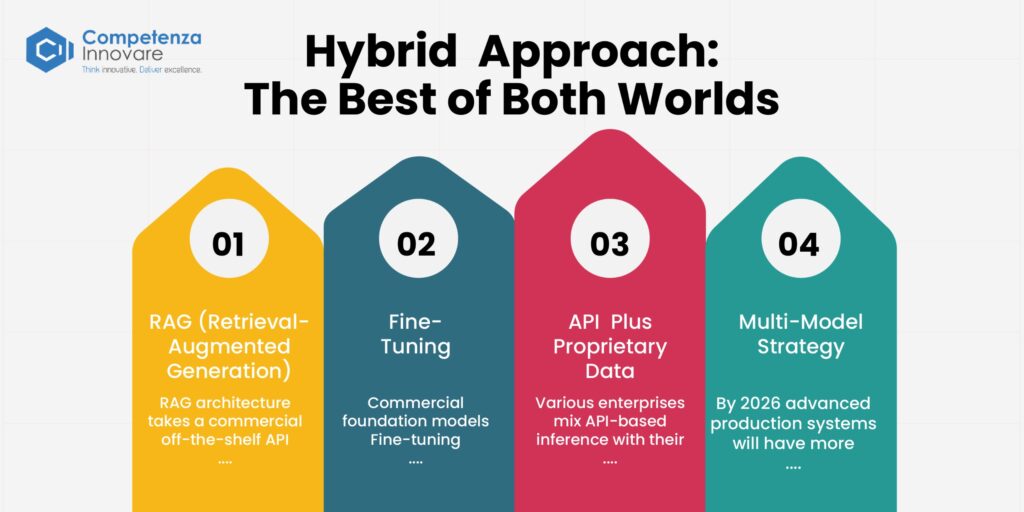
Hybrid Approach: The Best of Both Worlds
The decision is no longer build or buy for too many enterprises. In their place, they integrate their own AI functionality with commercial APIs to have the most optimal mix of speed, flexibility and cost. The typical hybrid networks include:
RAG (Retrieval-Augmented Generation)
RAG architecture takes a commercial off-the-shelf API and a vector database of your proprietary data, retrieving the relevant context at query time and feeding it into the prompt of the model. This provides the majority of the domain-specific accuracy advantage organizations originally desired with a custom model at a fraction of the cost and timeline and is now the common architecture in most enterprise generative AI applications in 2026.
Fine-Tuning
Commercial foundation models Fine-tuning your proprietary data with no need to train a real model asks you to adjust model behavior, tone, and task performance to your domain, incurring the cost of one or two API calls or one or two managed hosting options. This is in between off-the-shelf and a complete build.
API Plus Proprietary Data
Various enterprises mix API-based inference with their own data layer, RAG, fine-tuning or both with ownership and full control of their data and domain logic and use the underlying language power of a commercial vendor. This hybrid re-imbibes the customization advantage without having to bear the infrastructure burden of full ownership of the model.
Multi-Model Strategy
By 2026 advanced production systems will have more and more models specialized to handle various types of requests: cheap, fast models for simple queries and frontier models for complex reasoning based on task complexity. Such a multi-model strategy is also an implementation of the hybrid build-and-buy, and model-tiered routing can be used to usually achieve a 60 to 80-percent savings in the total AI inference cost compared to using a single high-quality model on all requests.
Decision Framework: Build vs. Buy Custom LLM
There are six determinants to the correct path of your particular business.
- Budget: A ready solution with API The pack can be implemented at a cost of $20,000-80,000. RAG-based systems that are fully enterprise integrated are usually priced between 80,000 and 200,000. Refinement of a domain-specific model costs an extra $50,000 to $200,000+ over RAG infrastructure. It is hard to have a truly custom-trained model cost-effective below a few hundred thousand dollars when infrastructural and talent costs and continuous retraining are considered.
- Timeline: Weeks of API-based measurements. The development of custom models takes from months up to a year or more, including data preparation, training, evaluation, and hardening production.
- Data Privacy: If your regulation or contract law actually forbids third-party data processing, then custom or self-hosted deployment is the only possible compliance option, but again, enterprise-level API contracts with solid data processing clauses meet most regulatory obligations of most sectors.
- Talent: MLOps, ML engineering, and infrastructure skills needed to possess a set of custom LLM ownership are both scarce and costly in the US, UK, and EU markets in particular. In case such a capability is not present on the inside and can not be realistically developed, there is a high amount of execution risk in the build path.
- Infrastructure: Self-hosting will involve GPU purchases or renting managed by the cloud, and utilization below about 80 percent will usually result in API usage being less expensive on a like-for-like basis considering the idle compute cost of not fully utilized infrastructure.
- Long-Term AI Strategy: When the capability of generating AI is beginning to be a core and when you have a differentiation in part of your product or business model, it may make sense as a long-term direction to invest gradually in this or that custom model capability, despite using an API now. When AI is an addition to a more general product than the product itself, a hybrid approach, or an API-based one, is highly likely to be the preferred option in the long run.
Conclusion
When deciding to build a custom LLM or to use an off-the-shelf AI API, it is the priorities of your organization that should guide you, rather than comparing the two approaches on a technical basis.
When your business needs a fast deployment and predictable expenses and you need highly trained AI services, the sale of an API is typically the most intelligent choice as a starting point. It enables you to test your use cases, provide value fast, and scale up without maintaining complicated AI infrastructure.
Conversely, investing in a custom LLM may be more firmly in control, secure, and long-term strategic when AI is at the core of your competitive edge, sensitive data is involved, or you have a strong desire to tailor it to your specific needs.
At Competenza, the hybrid option is a viable course towards success in many enterprises. Mixing commercial AI APIs with proprietary information, Retrieval-Augmented Generation (RAG), and selectively fine-tuned models provides the ability to innovate and keep costs and complexity manageable.
Frequently Asked Questions (FAQs)
What is the distinction between a custom LLM and off-the-shelf AI API?
A custom LLM is created or trained on the needs of your organization, and offers more control, customization, and data privacy. Off-the-shelf AI API services are ready-to-use AI services provided as a managed service that can be quickly implemented with reduced initial capital.
Should I construct or purchase an LLM in my business?
It all depends on what you aim at. In a case where you require fast deployment and reduced cost of investment, purchasing an API can be the ideal choice. In the case of AI being a strategic asset that needs specialized expertise, protection, and long-term management, a customized LLM can provide more value.
When does a custom LLM make sense?
Custom LLM is best applicable to organizations with sensitive data, with regulated industries and industry-specific knowledge, or building AI-based products that need customization and competitive advantage.
What are the benefits of an AI API?
An off-the-shelf AI API will be faster to implement, less costly to maintain, automatically update models, be enterprise-scale, and be less expensive. It is a fast, good option when companies are implementing AI-powered applications.
Is developing a custom LLM more costly than an API?
Yes, The cost to build a custom LLM can be very high due to the need to invest in AI talent, infrastructure, and model development and maintenance. A highly AI-based organization may not be the most lucrative long-term, however, or have very high demand; thus, usage-based API pricing might benefit them less than it would other organizations.
Are the custom LLMs usable with the AI APIs by the business?
Yes. A hybrid architecture is a collection of commercial AI APIs, retrieval-augmented generation (RAG), proprietary knowledge bases and fine-tuned models that are used by many enterprises. It is generally a low-cost strategy, fast and bespoke.
What are the factors that a business has to bear in mind before determining on either a custom LLM or an API?
Business goals, cost, privacy of data, legal needs, internal AI capabilities, integration, and scalability over time and long-term cost of ownership are some of the crucial factors to