


Any organization that develops software is inevitably confronted with the same awkward discussion one day. An initiative that began with the correct set objectives and optimistic project estimates has silently or less noisily gone awry. Deadlines have passed. The budget has grown. The crew is mesmerized. There is lost player trust. And the software, which was to be operational months ago, is not ready. A failing software development project is no exception; it is one of the most widespread difficulties in technology delivery that concerns organizations in all industries and all markets in the US, UK, Europe, India, and others.
The first reaction that comes to mind when a project gives in to this stage is to find someone to put the blame on or to work harder on what is already not producing the desired outcome. Both are non-recovery-producing. Software project recovery needs something of its own: a sincere diagnosis of what has gone wrong, a plan that actually addresses the causes, and a realistic roadmap that puts the team and stakeholders on a plausible road to go. The majority of failing software projects can be salvaged, even though not until the correct interventions are employed at the appropriate time and only at the cost of the organization being truthful enough to attribute its actual cause(s) of failure and not its excuses.
This guide entails rescuing a software project that is no longer on track, warning signs to be looked at, the most frequently used reasons behind software project failure, and the recovery process that takes ten steps, which gives the troubled projects the best chance of getting back on track.
What Is a Failing Software Development Project?
A project whose software development is a failure is the one where the status quo of the current trajectory will fail to achieve the desired outcome at an acceptable price, time frame, or quality level. This makes a critical distinction from that of a project, which is merely going through a rough patch. Any multi-faceted software development project faces challenges. An unsuccessful project is one in which the setbacks are inherent in the methodology, the planning, the interactions of the team, or the leadership and not accidental.
This difference is important as the answer is not the same. The incidental barriers require strategic solutions. To fix structural failures requires a software project turnaround or a purposeful, controlled recovery taking care of the underlying causes and not the outward symptoms.
Common Warning Signs of Software Project Failer
Recovery stands a better chance when a failing software development project is identified early. The red flags are not very difficult to notice as long as you are aware of what to check:
- There are repeated deadline delays with every new estimate being as unreliable as its predecessor.
- Budget variances, which are justified every sprint instead of being dealt with on a structural basis.
- The requirement is not yet established and is subject to continuous change with no formal change management or change impact measurement.
- Poor quality of codes that are causing more bugs to accumulate, escalating technical debt, and slowing down features.
- The visible deterioration of team morale leads to key people leaving, loss of engagement, and communication breakdowns.
- Stakeholders who have ceased constructive interaction and have gone to manage themselves.
- No definition of done: the scope boundary differs from where it was yesterday.
Why Early Intervention Matters
Early software project risk assessment done when the warning signs are first observed instead of done after many months have passed and amplified their effects massively enhances the options of recovery. A 20 percent over-budget project can be recovered in a relatively short amount of time when the root causes can be identified. An 80-percent-over-budget project where stakeholders are demoralized, team relationships are in shambles, and no one even comprehends the codebase is fixable as well, but the amount of intervention needed is also proportionally greater, and the recovery time is also greater.
Top Signs Your Software Development Project Is Failing
The particular signals used to differentiate a project that is not going well with the software and an example of software that requires a systematic recovery.
Missed Deadlines
Delays that are occasional are part of software development. Another problem is systematic deadline failure, in which all the estimates are incorrect and the explanations are based on extraneous variables and not causes. It normally signifies that the initial estimates were not realistic, that scope is escalating quicker than it is being controlled, or that actual velocity of the team is considerably less than planning presupposed.
Budget Overruns
Among the most apparent warnings about software project failure is budget overruns that are detected and reported but not addressed. A revised estimate as the response to a cost overrun is already on its way before it is investigated and a structural change to the way the project is operated is made.
Constant Scope Changes
Events that lead to failure of time and budget in software projects include project scope management breakdown. Scope creep is a silent killer of the delivery capability that had been provided to a promise at the outset when imposed on the project without doing so through formal change management, without assessing the impact it has, and without updating the schedule and the budget accordingly.
Poor Code Quality
The increase in the number of defects, a longer time to introduce new features, and regular incidents of production are all evidence of code quality erosion. Poor code quality is a symptom and a contributing factor to failing software development projects; it costs time to deliver, adds to test loads, and makes all the further changes more costly and risky.
Increasing Technical Debt
The accumulating technical debt that cannot be paralleled and solved is a compounding issue. Every time a shortcut is made under the pressure of the schedule, the next task is more difficult. Any workaround that is put instead of the actual fix or solution increases the predictability of the codebase. Technical debt becomes acute when it takes the developers longer to maneuver through than to create new features, thereby placing significant strain on software delivery capacity.
Low Team Productivity
Reduced sprint velocity, more time spent in meetings than developing, and loss of several key team members are all signs of productivity issues that cannot be solved without structural intervention. The problem of team productivity in software projects is almost invariably a process, environmental, or lack of clarity of direction and extent to which the team believes that it is being directed towards an attainable goal.
Stakeholder Dissatisfaction
When the people who commissioned the project, who are the business stakeholders, lose trust in the program, the project is in another sort of crisis. Unaddressed and unmanaged stakeholder dissatisfaction leaves a governance vacuum, and recovery becomes much more difficult. Stakeholder management is a recovery practice, rather than communication syncretism.
Lack of Clear Project Ownership
Without clear ownership, in which decision-making, scope, and output of delivery responsibility lie with multiple parties, projects wander off track. All problems are the problems of another person to solve. Each decision is awaiting a consensus, which never really comes. The structural precondition of any significant software project turnaround is the clear project governance.
Also Check: Custom Software Development Service
Common Reasons Software Projects Fail
The causes of the warning signs and the explanation of how software projects fail are the key to remediating the problem.
Poor Requirements Gathering
The root cause of the software project failure is the most common issue and is poor requirement gathering. The unclear, missing, or volatile requirements create estimates that are created on assumptions. The development teams develop what they thought the requirements meant, and these are usually vastly different from what the business required. It is not recognized until late in the project, and the gap is most costly to fill.
Unrealistic Estimates
Commercially motivated project estimation without technical reality results in estimates that are beyond what is achievable. By establishing timelines based on a desired budget instead of the actual scope and complexity, the project is being configured to fail prior to a single line of code being written—and every fresh estimation is no more reliable than the previous one.
Weak Communication
The failure in communication occurs at all levels of the process, as developers misinterpret the requirements, stakeholders are not informed about progress, and teams are too late unveiling blockers. Poor communication in itself does not cause a software project failure, but it makes sure other issues will be more difficult to handle and fix.
Inadequate Project Governance
The scope change management, risk escalation, decision authority, and stakeholder reporting are under the project governance provision. In the absence of it, there is no mechanism of the early identification of problems, quick decision-making, or team accountability to deliver on commitments.
Resource Constraints
Under-resourcing—an inadequate number of people on the team, too little seniority, or key people diffused—makes all the other issues worse. Projects end up taking more time than observed, quality reduces, and resource limitations that were manageable once a project is initiated often become critical as the software delivery stress grows.
Poor Risk Management
One-time project risk management undertaken upon initiation of a project overlooks the risks that crop up during execution. Unmanaged risks, whether known but unaddressed or even unidentified, can just as well derail an already failing software development project.
Changing Business Priorities
When business priorities change in the middle of the project, market shifts, new regulations, direction changes in leadership, or projects that lack training in change management, they tend to implement the said change in scope without resource differences. That one tendency is a cause of a high percentage of software project overruns.
Lack of Testing
Failure in software testing strategy will enable defects to build up during the process of development until they occur at the worst time possible—late into the project, making them the hardest to fix. There is no end-of-development phase of software quality assurance. It is an ongoing process that helps avoid accumulations of technical debt that causes software project recovery to be so disruptive.
How to Rescue a Failing Software Development Project
A ten-step, step-by-step software recovery process for software projects that have backfired.
Step 1: Perform a Project Health Check
Create a transparent level prior to making any recovery decisions.
Any software project recovery process begins with a project health check. It is a systematic evaluation that reveals the current state of the project budget consumption and schedule as well as the extent to which the project is finished as well as the quality of the code, team capacity, risk exposure, and stakeholder confidence without the preferential rose-colored glasses of the internal team in delivery pressure.
The health check must be performed by an independent or a third party who is not part of the project to date or by an external assessor that has experience in software project recovery. This is aimed at giving a fair assessment of the true status of the project and not a validation of the narrative that has been presented to the stakeholders up to now.
Step 2: Identify the Root Causes
Bring to light the true causes of failure, not the convenient explanations.
Root cause analysis draws a line between the symptoms of project failure, late time, budget, and poor quality and the root causes that generated them. Recovery plans focus on symptoms, and expected problems happening under different names are a common occurrence without root cause identification.
Some of the usual root causes found during the recovery of software projects have been identified as the following: requirements were not adequately defined; estimates were prepared under commercial pressure without proper technical input; teams were structured such that the junior developers had to handle responsibilities that would require senior expertise; dependencies were known to be problematic and had not been actively addressed by integration dependencies; and in the event of schedule pressure, tests were postponed.
Causes of documents’ roots explicitly. They spearhead all the latter decisions of recovery.
Step 3: Reassess Project Scope
Determine what will be accomplished by the project and what will not.
The reassessment of project scope management is the part of the software project turnaround that is commercially the most challenging to undertake, as it entails announcing to the stakeholders that some of what they were promised will not be delivered according to the original schedule. The other option, which is to stick to a full-scale scope that will not be feasible to deliver by the project’s deadline, is poorer.
Reconsider the extent of scope in comparison to the actual remaining capacity, the real schedule, and the business priorities that have been validated on the basis of stakeholder involvement. Determine what should be delivered and what can be postponed, as well as what should be eliminated altogether. Record the redefined scope and formal sign-off before the recovery program gets underway.
Step 4: Prioritize the Product Backlog
Re-rank the work to provide the greatest business value initially.
Recovery backlog prioritization does not refer to normal backlog management. The priority model is no longer what was being planned but what will provide the most business value at minimum risk performance. Nearly complete features should typically be given priority to ensure they are brought to a done state without them incurring software development costs to the feature and not adding value. High-risk/low-value features must be pushed off or eliminated.
Agile project management disciplines, sprint planning, backlog refinement, and velocity tracking offer the framework on how to handle the prioritized backlog using the recovery program. Unless the project has already been operating with agile disciplines, one of the structural changes with the highest value to be introduced at recovery is to implement them instead.
Step 5: Create a Realistic Recovery Roadmap
Develop an effective, evidence-based plan that will be trusted by the stakeholders.
A recovery program software delivery roadmap should be created based on actual team velocity, realistic sprint capacity, and clearly scoped deliverables as opposed to an aspired date worked backward. Recovery roadmaps, which are designed based on a target date and not demonstrated capacity, replay the errors made in estimations that led to the failure in the first place.
Phase milestones that have target success criteria, clear dependencies and risks, contingency against the unknowns that all complex projects generate, and a communication plan that keeps the stakeholders informed without giving them false confidence should all be part of the recovery roadmap.
Step 6: Improve Team Communication
Reestablish the flow of information that unsuccessful projects always lose.
Software project failure is a result and a cause of communication breakdown. To recover, we will need to work on reestablishing the communication practices that maintain teams on track and problems on the surface through daily standups that report progress honestly, not retrospectives that generate true process changes; stakeholder reviews that disseminate honest progress, not partisan highlights; and open communication channels between the operating team and the business that do not need promotions to make regular decisions.
Step 7: Address Technical Debt
Minimize the codebase size dragging down the development pace.
The build-up of technical debt during a failed project is usually one of the main reasons for the fact that the decreasing delivery velocity, which preconditioned the failure in the very first place, was worsened. Recovery programs where the explicit capacity to reduce technical debt is not allocated leave the recovery program to accrue additional interest on its debts over the course of the recovery program.
Focus on decreasing both technical and feature-delivery debt. Most distressed codebases are well-suited with a usual percentage of 20-30 percent of the sprint capacity devoted to debt elimination during a recovery. Consider first the debt, which most directly hinders delivery velocity.
Step 8: Strengthen QA and Testing
Establish the quality culture that avoids the buildup of deficiencies sinking the recovery process.
Software quality assurance during recovery should always be in real time and never postponed to testing, which will come after the months of building defects. Implement automated testing infrastructure at the beginning of the recovery program. Define a definition of done that contains test coverage requirements. Turn quality into a firm delivery requirement and not a renegotiable bargaining point with time.
A strict software testing strategy in the recovery process also minimizes the incident of production in the post-recovery system, which is by far the fastest method of dismantling stakeholder trust that was just restructured in the course of the recovery program.
Step 9: Reset Stakeholder Expectations
Restore confidence of stakeholders by telling the truth and showing them.
The trust that stakeholders have had in the project that fails is normally ruined, in some cases badly. Such confidence has to be rebuilt to regain confidence in the recovery process, and that process takes time to accomplish through a mixture of honesty in communicating the recovery process and delivering on recovery milestones. Stakeholder management in recovery implies reporting bad news early and correctly and not hiding it under rosy forecasts.
Institutionalize the stakeholder report rhythm on a weekly basis on the progress against recovery milestones, on a monthly basis reviewing the steering committee, and instant communication of any matter that will substantially impact the recovery timeline. When stakeholders are communicated to continuously on an honest basis about a recovery program, the stakeholders tend to react positively. Stakeholders who find that there are issues that they are not informed about react quite differently.
Step 10: Track Progress with Clear KPIs
Assess recovery progress in relation to objective measures instead of subjective measures.
Objective measurement of project risk management in the recovery process is necessary. Have effective KPIs, sprint velocities, rates of defect corrections, coverage of tests, rates of budget burn, milestone attainment, and stakeholder confidence indices, and monitor them regularly during the software recovery program. The trending KPIs that are not going the right way are an early indication that adjustments need to be made to the recovery plan. Trending KPIs give the base of evidence to the stakeholders in understanding that progress is being made.
Software Project Recovery Checklist
An excellent guide to every step of the recovery program.
| Recovery Action | Owner | Status |
| Project health check completed | Independent reviewer | ☐ |
| Root causes identified and documented | Recovery lead | ☐ |
| Requirements reviewed and gaps documented | Product owner | ☐ |
| Code quality audit completed | Technical lead | ☐ |
| Team capacity and skills assessed | Delivery manager | ☐ |
| Revised scope defined and signed off | Stakeholders | ☐ |
| Budget reassessed with realistic contingency | Programme sponsor | ☐ |
| Timelines re-estimated from actual velocity | Delivery manager | ☐ |
| Backlog prioritised by business value and risk | Product owner | ☐ |
| Recovery roadmap documented and approved | Steering committee | ☐ |
| Technical debt reduction allocated in sprints | Technical lead | ☐ |
| Automated testing infrastructure in place | QA lead | ☐ |
| Documentation reviewed and updated | Technical team | ☐ |
| Stakeholder communication plan established | Programme sponsor | ☐ |
| KPIs defined and tracking established | Delivery manager | ☐ |
| Risk register updated and actively managed | Project manager | ☐ |
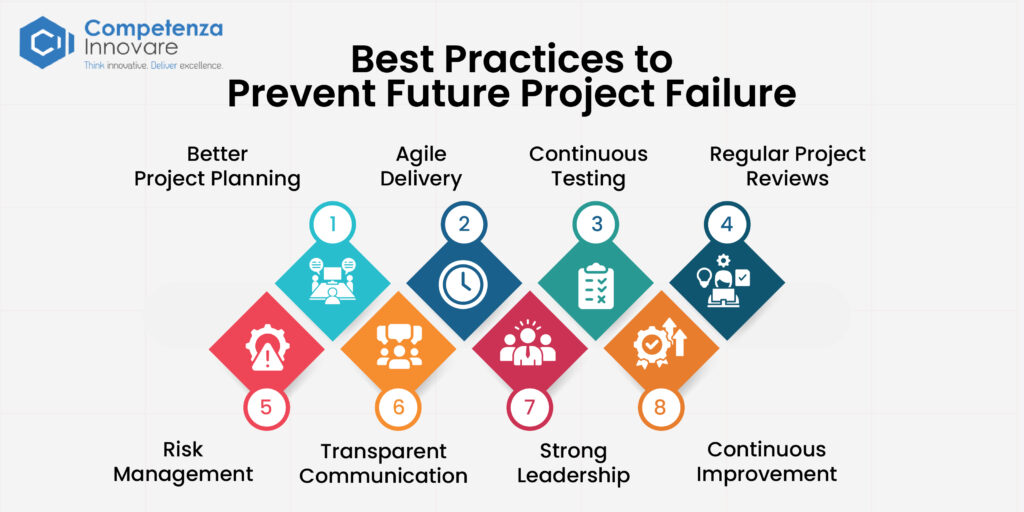
Best Practices to Prevent Future Project Failure
The following are the best practices that you can put into considerations to salvage a software development project that is on the verge of failure.
Better Project Planning
Before agreeing with timelines and budgets, invest in requirements gathering, scope definition, and project estimation. Planning is not overhead, because it is the best-paying investment in any software project, which yields the clarity that enables delivery to be predictable.
Agile Delivery
Agile project management practices, iterative delivery, continuous feedback, sprint planning, backlog prioritization, and retrospectives offer structural processes of detecting issues early and reacting to them before they turn into emergencies. Agile is not the failure insurance, but it is a drastic reduction in the issue of the feedback loop that continues the accretion of problems with impunity.
Continuous Testing
Software quality assurance must not be the end of the development phase but an ensuing activity in the development process. Constant integration, automated test suites, and definition-of-done criteria, including test coverage, ensure the defect buildup that causes late-project recovery to be so disruptive.
Regular Project Reviews
Scheduled project health check reviews on a monthly basis on well-running projects and more often on pressure-straining projects serve as the governance mechanism for identifying problems before it becomes too late to handle. Structured reviews with the goal of bringing true status to light instead of the polished progress reports are always much more useful.
Risk Management
Project risk management is not an event at the start of the project but an ongoing process during delivery. Risks that are detected in the execution process should be captured, evaluated, addressed, and monitored. The early warning system that eliminates surprises is risk registers that are made regularly and discussed at governance meetings.
Transparent Communication
The best prevention of the communication failures that enable software project failure to grow out of hand before intervention is communication disciplines that reveal the problem early as opposed to cultures in which problems are kept within the fold until they grow into crisis.
Strong Leadership
Clarity in project governance, including defining the decision authority, clear accountability, and effective executive-level program sponsorship, are support mechanisms that delivery teams require to make tough decisions within a short period of time. Scope creep, priority conflicts, and the path-of-least-resistance decisions, which eventually stack up to form structural failure, are predictable as leadership voids in software projects.
Continuous Improvement
Viewpoints that generate actual process alterations instead of records of what may have been superior and software development audit reviews that contrast delivery practices with current project requirements suggest to the teams the mechanism to enhance constantly instead of bringing forward the practices that are failing.
Failing Software Project: Signs, Causes and Recovery Actions
| Warning Sign | Root Cause | Recovery Action |
| Missed Deadlines | Unrealistic estimates, scope creep, poor sprint planning | Re-estimate from actual velocity; reassess scope; implement structured sprint planning |
| Budget Overruns | Underestimated complexity, unmanaged change requests, resource over-allocation | Conduct cost audit; freeze unbudgeted scope; reset budget with realistic contingency |
| Constant Scope Changes | No formal change management, weak project governance, unclear requirements | Implement change control process; get scope sign-off; assign clear ownership |
| Poor Code Quality | Rushed delivery, no code review standards, deferred technical debt | Conduct code audits, enforce code review gates; allocate sprint capacity to technical debt reduction |
| Increasing Technical Debt | Short-term fixes under pressure, no refactoring discipline, missing QA | Allocate 20–30% of sprint capacity to debt reduction; introduce automated testing |
| Low Team Productivity | Unclear direction, burnout, insufficient seniority, communication breakdown | Clarify roles and priorities, reduce work in progress; address team morale structurally |
| Stakeholder Dissatisfaction | Overpromised timelines, poor communication, lack of visible progress | Reset expectations honestly, establish regular milestone reporting; deliver visible quick wins |
| Lack of Project Ownership | No clear decision authority, accountability spread across too many parties | Define single delivery owner; establish governance structure; assign escalation path |
| Inadequate Testing | QA deferred under schedule pressure, no automated test coverage | Introduce continuous testing; enforce definition of done, including test coverage |
| Declining Developer Velocity | Technical debt, unclear backlog, misaligned team | Reprioritise backlog; remove blockers; address codebase quality holding velocity back |
| Frequent Production Incidents | Insufficient testing, poor deployment practices, no monitoring | Implement CI/CD pipeline; establish automated regression testing; add production monitoring |
| Requirement Misalignment | Poor requirements gathering, no product owner involvement, assumptions not validated | Conduct requirements review workshop; validate with end users; document and sign off revised scope |
| Integration Failures | Undocumented dependencies, no integration testing, late discovery of constraints | Map all integration dependencies; introduce integration testing in every sprint |
| High Team Turnover | Burnout, unclear leadership, loss of confidence in project outcome | Address root causes of disengagement; bring in experienced team augmentation where needed |
| No Clear Progress Visibility | Missing KPIs, no delivery roadmap, status reporting based on gut feel | Define measurable KPIs; establish sprint reporting; track velocity, burn rate, and milestone achievement weekly |

The circumstances in which outside knowledge speeds up recovery. It is true that sometimes the external intervention in a software project turnaround is not only beneficial; it is the most feasible route to salvaging. These include:
When Should You Bring in an External Software Development Partner?
At competenza, the scenarios in which external expertise is the most feasible route toward software project recovery.
- Independent Project Audit: When internal audits have not been able to identify or recognize root causes, the honest diagnosis that teams with a sense of delivery urgency seldom teach themselves is produced by an external audit of the software development.
- Technical Expertise: In cases where the failed software development project needs experience in architecture, security expertise, cloud migration capability, or performance engineering that the current team does not have; hiring experts is quicker than acquiring such skills within a recovery timeframe.
- Faster Delivery Recovery: Sometimes the software project turnaround needs greater delivery capacity than the current team can offer, either due to inadequate team size or burnout. External team augmentation can recover faster with less onboarding cost than permanent hiring.
- Architecture Review: Once the technical debt and pressure-induced architectural choices have left the codebase with such dense technical debt that the current team no longer feels secure about its navigation, the external review of the architecture offers an objective evaluation and remediation pathway that the internal teams are too near the problem to generate.
- Team Augmentation: When the software project recovery program requires certain capabilities—DevOps practices, test automation, or specialist technology skills that would otherwise require too long to develop internally—external augmentation can have a more immediate impact during this important first phase of recovery.
Conclusion
Not a lost cause, a failing software development project can become. A vast majority of projects that have gone astray, however astray, can be brought back with an appropriate diagnosis, the appropriate recovery plan, and the organization’s determination to see them through. This guide describes the ten-step software project recovery process that gives the framework of that recovery: honest assessment, identifying roots of the problems, reassessing the scope, backlog prioritization, realistic road mapping, restoring communication, reducing technical debt, strengthening quality, realigning stakeholders, and objective progress tracking.
Take timely action. The later the intervention of a failing software development project, the more costly and challenging the recovery may be. This is because one should do a project health check when the problem of the structure starts, not after the situation gets complicated. Tell the truth about underlying causes. Most of the explanations of the problems with a project are comfortable, and recovery plans that are created on the basis of comfortable ones always fail. And when the objectivity or the ability needed to do the recovery cannot be offered by internal means, then external expertise must be brought in before the project becomes too complex to rescue.
FAQs
Is it possible to rescue a failed software development project?
Yes. The majority of software projects that fail can be salvaged through a comprehensive project health check, root cause analysis, scope re-evaluation, tightened governance, and realistic planning.
Why can software development projects fail?
Some of the reasons are poor requirements, unrealistic estimates, poor communication, scope creep, technical debt, inadequate testing, and bad project management.
Is it always possible to reuse a failed software project?
The majority of the software projects that fail can be reclaimed, but there are fewer alternatives, and the reclaim cost is higher the longer intervention is postponed. Early distress projects whose underlying causes can be determined and whose stakeholder belief remains in place despite the failures to a significant degree have much better recovery opportunities, compared to those that have failed over a long period.
What is a plan to recover a software project?
A software project recovery plan draws a roadmap of what must be done to deal with delay, cost increases, quality concerns, and risks of the project and regain stakeholder trust.
What are the red flags of a crashing software project?
The warning signs include missed deadlines, cost increases, decreasing code quality, growing technical debt, poor state of priorities, and stakeholder dissatisfaction.
What is the process of conducting a software project health check?
Reexamine project scope, schedules, budget, staff execution, quality of code, testing, risks, and expectations of stakeholders in order to find the priority of recovery.
Should you re-initiate or salvage a failing software project?
When the current project already possesses a strong base, then it is typically easier to save the project. Restart is something that should be considered in case of a technical or business problem that renders recovery unfeasible.
What can Agile do to salvage a collapsing project?
Agile provides the capability to deliver iteratively, repeat feedback, prioritize the entire backlog, and enhance cooperative efforts, which allows us to quickly recover and deliver value.
What is the right time to contract an outside software developer?
Outsource it to external professionals where the internal teams do not have the professional expertise or impartiality and the ability to salvage the project effectively.